

Introduction
Many privately owned and family-run businesses have a customer service team that genuinely works hard — yet operates in a separate world from the company's actual growth ambitions. Sales wants to scale revenue. Leadership wants to reduce churn. But the service team is measured on ticket closure rates and call volume, with no line of sight to those bigger priorities.
The gap exists because customer service strategy is rarely built from the top down. It defaults to operational metrics that feel manageable, rather than outcomes like retention rates, revenue per customer, or referral volume.
That separation is expensive. Industry research covering 2,030 service executives across 14 industries found that companies that treat customer service as a value center — rather than a cost center — achieved 3.5x more revenue growth, with 5.8% annualized revenue growth compared to 1.6% for cost-center firms over the same period.
For privately owned businesses, the stakes are especially high. With smaller teams and tighter margins, every misaligned interaction chips away at profitability.
This article covers what alignment actually means in practice, why misalignment is costly for smaller businesses, and the concrete steps you can take to close the gap.
Key Takeaways
- Customer service alignment means tying daily service priorities directly to your company's strategic goals — not just managing response times
- Misaligned service teams miss upsell signals, erode brand trust, and accelerate employee turnover
- Alignment starts by defining clear business objectives, then building service priorities around them
- The right KPIs measure outcomes like retention, lifetime value, and referrals: not just activity
- Smaller businesses have a structural advantage: shorter communication chains make alignment faster to implement
What It Means to Align Customer Service Strategy With Business Goals
Alignment means your customer service team's daily priorities, decisions, and success metrics are directly tied to what the business is actually trying to achieve : growing customer lifetime value, reducing churn in a key segment, entering a new market, or improving profitability.
Contrast that with the common default: service teams operating in isolation, measured on average handle time and ticket volume, with no connection to whether those interactions are retaining customers or generating revenue.
Alignment Goes Beyond Mission Statements
Real alignment requires translating big-picture business goals into specific, measurable behaviors that customer-facing teams can act on daily. That won't happen through a mission statement alone.
For example, if the business goal is retention, alignment means service teams are:
- Proactively following up before problems escalate
- Flagging at-risk customers to sales or account management
- Prioritizing resolution quality over speed of closure
It requires intentional design and clear communication from leadership about why it matters.
Why This Matters More for Privately Owned Businesses
For family-run and privately owned businesses, this alignment is both more achievable and more visible when it breaks down. Leadership and customer-facing teams are often small and closely connected, which means the gap between strategic intent and frontline behavior can close quickly with the right direction.
Misalignment is also harder to hide. A customer who calls with a complaint and receives a transactional, scripted response immediately contradicts the relationship-first positioning that most family businesses compete on.
Why Misalignment Is Costly for Small and Mid-Sized Business Owners
Inconsistent Customer Experience Erodes Trust
When a service team doesn't understand or reflect the business's positioning, it creates friction. A premium brand handled with low-cost, transactional support sends a contradictory message. Customers notice. For family-run businesses that compete on reputation and relationships, that inconsistency is particularly damaging — and hard to repair.
Missed Revenue Opportunities
Misaligned service teams focus on closing tickets. They're not trained to notice when a customer's question signals an upsell opportunity, or when frustration during a support call is actually a retention risk worth escalating. Those signals pass unacted on, interaction after interaction.
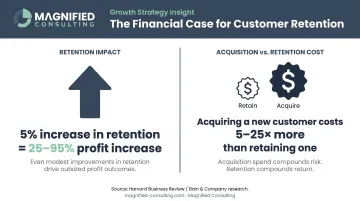
The underlying economics are stark: research from HBR on customer retention found that a 5% increase in customer retention can raise profits by 25% to 95%, and that acquiring a new customer can cost 5 to 25 times more than retaining an existing one. Service teams that don't contribute to retention are effectively leaving money on the table.
That revenue leakage doesn't happen in isolation — it's compounded by what's happening internally.
Operational Waste and Disconnected Data
Without alignment, departments duplicate efforts. Customer feedback from the frontline never reaches product, marketing, or operations. Resources go toward metrics — like average handle time — that don't advance any business objective. The result is a team that's busy but not productive in any strategic sense.
Employee Disengagement and Turnover
Service teams that don't understand how their work connects to company goals often feel undervalued. That leads to disengagement, and disengagement leads to turnover. Gallup's research found 42% of voluntary employee departures were preventable — and that manager communication and purpose clarity were key factors. For smaller businesses, replacing even one experienced service rep carries real financial and operational cost.
The Compounding Risk
These problems don't stay separate — they feed each other. Poor experience accelerates churn, which drives up acquisition costs. Disengaged teams deliver worse service, which accelerates churn further. Every misaligned interaction is a missed chance to retain a customer, capture an upsell, or earn a referral. For privately owned and family-run businesses where margins matter and reputation is everything, those missed chances add up fast.
How to Align Your Customer Service Strategy With Business Goals
Identify Your Core Business Objectives First
Alignment starts at the top. Before adjusting anything in customer service, define what the business is actually trying to achieve over the next 6 to 24 months.
Ask yourself: Is the priority revenue growth, customer retention, market expansion, operational efficiency — or a combination? Without clear answers, customer service goals will default to generic metrics that feel productive but don't move anything meaningful.
Specificity matters. A goal like "improve customer satisfaction" doesn't give your service team anything concrete to work toward. Compare that to:
- Increase repeat purchase rate among top-tier customers by 15% this year
- Reduce churn in the commercial accounts segment by 10% in Q3 and Q4
- Generate 20% of new referrals through service interactions by year-end
These targets give your service team a real destination — not just a direction.
Translate Business Goals Into Customer Service Priorities
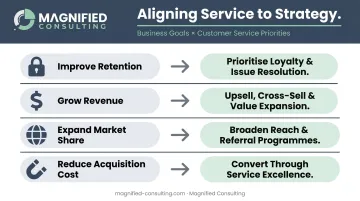
Once business goals are defined, the next step is reverse-engineering. For each objective, ask: what role can customer service specifically play in achieving it?
| Business Goal | Customer Service Priority |
|---|---|
| Improve retention | Proactive follow-up, early complaint resolution, loyalty interactions |
| Grow revenue | Identify upsell signals, route renewal risks to sales |
| Expand market share | Gather competitive feedback from conversations |
| Reduce acquisition cost | Drive referrals through exceptional post-purchase experience |
This translation step is where outside perspective often proves its worth. Magnified Consulting's Strategic Business Planning work is built around this kind of reverse-engineering — helping owners assess whether their current operational structure actually supports their growth objectives, or is creating friction they haven't yet identified.
Set Goals and Incentives That Reinforce the Strategy
With priorities mapped to business goals, the next step is building individual and team incentives that reflect those outcomes — not just operational efficiency metrics.
Instead of measuring agents only on response speed or ticket volume, consider tying incentives to:
- Customer retention rates within their account portfolio
- Referral generation from service interactions
- Upsell or renewal assists handed off to sales
Equally important is communicating the why to the team. Gallup's Q12 meta-analysis — covering over 183,000 business units and 3.3 million employees — found that top-quartile engaged teams showed 23% higher profitability, 18% higher sales productivity, and 10% higher customer loyalty. One of the core engagement drivers in their framework is employees understanding how their work connects to organizational mission. Building it requires deliberate goal-setting and consistent communication from leadership down.
Selecting the Right KPIs to Connect Customer Service to Business Outcomes
Most customer service teams track metrics like average response time, first-contact resolution, and ticket closure rate. These measure activity — but they don't tell you whether service is actually advancing the business.
KPIs Mapped to Business Objectives
Choose metrics that directly reflect your strategic priorities:
For retention goals:
- Customer churn rate (segmented by account type or product line)
- Customer lifetime value (CLV/LTV)
- Repeat purchase rate
For revenue growth goals:
- Expansion revenue generated through service or advisory engagements
- Referrals directly generated by the support team
- Upsell or cross-service opportunities identified and converted
For experience and brand goals:
- Net Promoter Score (NPS) at key journey touchpoints
- Customer Satisfaction Score (CSAT) after critical interactions
Don't Overlook Indirect Indicators
The KPIs above cover direct outcomes, but some of the most valuable service metrics are rarely tracked:
- Number of product improvement suggestions captured from service conversations
- Bugs or operational issues surfaced by the frontline team
- Patterns in complaint categories that signal a systemic problem
These create a feedback loop that benefits the whole organization — not just the service function.
Match KPIs to Your Brand, Not Just Industry Benchmarks
A premium service business that competes on relationships should measure depth and quality of engagement — not just speed. Generic industry benchmarks can push your team toward the wrong behaviors.
A family-run professional services firm optimizing for handle time will quickly start sounding like a call center — and lose the relationship advantage that sets it apart.
Breaking Down Silos: Getting All Teams Aligned
In most small and mid-sized businesses, the silo problem is concrete and familiar:
- Sales closes deals without briefing service on what was specifically promised
- Marketing runs campaigns without consulting service on the most common complaints
- Product decisions get made without customer feedback from the frontline
Each disconnect reduces service quality and creates friction the customer feels — even if they can't articulate why.
Practical Tactics for Smaller Teams
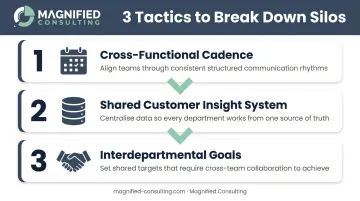
You don't need complex systems to break down silos. For most SMBs, the following is enough:
- Establish a regular cross-functional cadence — a monthly sync between sales, service, and operations leaders surfaces misalignments before they compound
- Create a shared system for logging customer insights — a simple shared document or CRM tag structure can route frontline intelligence to the people who need it
- Build interdepartmental goals — when sales and service share a retention metric, alignment becomes self-reinforcing
This is exactly the kind of work Magnified Consulting addresses in operational engagements — mapping where team handoffs create friction and building coordination systems that don't require large budgets to sustain.
Sales and Service Alignment Specifically
When sales sets accurate expectations upfront and service reps are trained to recognize renewal signals, the full customer journey becomes more cohesive. For businesses with recurring revenue or long-term client relationships, this alignment is especially consequential. Consider what it looks like in practice:
- Sales communicates specific commitments so service teams can deliver on them — not improvise around them
- Service flags renewal risk early, giving sales a chance to re-engage before a client quietly disengages
- Both teams share a retention metric, so neither defines "success" as their deal alone
How to Measure and Sustain Alignment Over Time
Alignment isn't a one-time project. Business goals shift, markets change, and new products launch. If you don't revisit whether your service priorities still reflect current objectives, drift is inevitable.
Build a Regular Alignment Review
A practical internal audit doesn't need to be complex. A few targeted questions asked quarterly will surface most problems early:
- Do our service team's current goals still reflect the business's top priorities?
- Are the KPIs we're tracking connected to the outcomes we actually care about?
- Is customer feedback from the frontline reaching the people who can act on it?
- Have any cross-departmental handoffs broken down since the last review?
If the answers to any of these drift from "yes," that's a signal — not a crisis. The businesses that sustain alignment are the ones that build these check-ins into their planning cadence, treating them with the same weight as financial reviews.
Customer Feedback as a Strategic Signal
Patterns in complaints, praise, and requests from customers often surface strategic problems before they appear in financial results. A spike in a specific complaint category can indicate a product issue, a sales overpromise, or an operational gap — all of which represent decisions that leadership needs to make.
Research found that organizations using customer behavioral insights outperformed peers by 85% in sales growth and more than 25% in gross margin. What separated those organizations wasn't data volume — it was whether customer intelligence was treated as a shared resource across the business or left siloed in the service function.
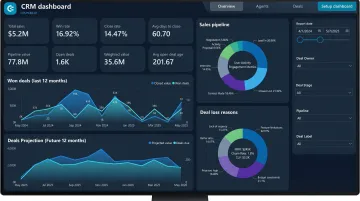
For privately owned businesses, the infrastructure doesn't need to be elaborate. What matters is consistency — a regular process for routing customer intelligence to the people who can act on it.
Frequently Asked Questions
How do you align customer service strategy with business goals?
Alignment starts with defining core business objectives — retention, revenue growth, market expansion. From there, those goals translate into specific service priorities, metrics, and team incentives. Every service interaction should actively support the broader direction of the business, not just resolve the immediate issue.
What does alignment of strategy with business goals mean?
Strategy alignment means the day-to-day actions, decisions, and metrics of a department like customer service are directly connected to the company's core objectives. Without it, teams operate independently with targets that measure activity instead of outcomes.
How do you know if your customer service strategy is misaligned with your business goals?
Key warning signs include: service KPIs that don't connect to business outcomes, a service team that can't describe the company's top priorities, rare or nonexistent cross-department communication, and customer feedback that never reaches decision-makers.
What KPIs should customer service teams use to measure business alignment?
The right KPIs depend on what the business is trying to achieve:
- Retention-focused: churn rate, customer lifetime value (CLV), repeat purchase rate
- Revenue-focused: referral generation, expansion revenue
- Experience-focused: NPS and CSAT at key touchpoints
Avoid defaulting to generic industry benchmarks — measure what your specific goals require.
How does aligning customer service with business goals improve profitability?
Aligned service teams reduce churn, increase repeat business, surface upsell opportunities, and generate referrals. These outcomes grow revenue while cutting acquisition costs — without requiring additional headcount or marketing spend.
Can a small or family-run business realistically align its customer service strategy with business goals?
Smaller businesses are often better positioned to achieve alignment quickly because decision-making chains are shorter. With clear direction from leadership and simple cross-team practices like regular syncs and shared metrics, alignment can be implemented without complex systems or large budgets.