Introduction
Picture a business generating $12 million in annual revenue. On paper, things look good. But the owner hasn't taken a real vacation in two years. Margins have quietly compressed despite revenue growth. Three key processes depend entirely on one employee who's been there since day one. Every hiring decision, client escalation, and operational problem lands on the owner's desk.
This pattern is more common than most business owners recognize. Revenue growth masks it for a while. Then one bad quarter, one key employee leaving, or one attempt to add a new location exposes how fragile the whole thing actually is.
Consulting firms provide structured outside perspective — the kind that's hard to develop when you're running the business daily. They identify where time and money are being lost, build systems that hold up under growth pressure, and create measurable improvements that compound over time.
This article covers how consulting firms assess operations, the specific strategies they deploy, what makes a business scalable and sellable, and what to look for in a consulting partner.
Key Takeaways
- Growing revenue can mask operational inefficiency — margin erosion and owner burnout are the tell
- Consultants run diagnostic audits first, separating root causes from surface symptoms
- Process standardization, decision frameworks, and financial visibility are the highest-leverage fixes
- Documented systems and reduced owner dependency drive higher exit valuations
- Quick wins surface in 60–90 days; structural improvements follow within six months
What Operational Efficiency at Scale Actually Means
Operational efficiency is straightforward: getting maximum output from available resources (people, processes, and capital) without proportional increases in cost or effort. "At scale" means those systems still hold up when revenue doubles, headcount grows, and customer complexity increases.
Most businesses don't build for scale. They build for survival. Founder-driven processes, informal communication loops, and gut-feel decision-making work well at $2–5M in revenue. They break down at $10M+.
Why Growth Exposes the Gaps
The National Center for the Middle Market defines the U.S. middle market as companies with $10M to $1B in annual revenue — nearly 200,000 businesses employing 44.5 million people and generating roughly one-third of private-sector GDP. These businesses operate at a scale where informal systems create real, measurable risk.
As companies cross the $10M revenue threshold, the demands on leadership shift fundamentally: decisions that once lived in a founder's head need to live in documented systems, trained teams, and repeatable processes.
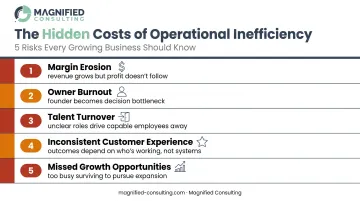
The hidden costs of staying inefficient include:
- Margin erosion — revenue grows but profit doesn't follow
- Owner burnout — the founder becomes the bottleneck for every decision
- Talent turnover — capable employees leave when roles are unclear and accountability is absent
- Inconsistent customer experience — outcomes depend on who's working that day, not on repeatable systems
- Missed growth opportunities — the business is too busy surviving to pursue strategic expansion
According to quality industry benchmarks, the cost of poor quality runs between 5% and 30% of gross sales for manufacturing and service companies. At $10M in revenue, that's $500K to $3M in annual value destruction — hidden inside everyday operations.
How Consulting Firms Assess Your Operations Before Making Recommendations
Experienced consultants don't arrive with a pre-built solution. They start by understanding exactly how the business actually works — not how the org chart says it works.
The Operational Audit
The diagnostic phase reviews workflows, financials, team structure, technology, and decision-making processes to map where time and money are being lost. The assessment is tailored to the specific business model, industry, and growth stage — not pulled from a template.
Magnified Consulting's approach follows three core phases:
- Assess current operations and baseline performance
- Identify inefficiencies and their root causes
- Implement optimized processes with measurable milestones
The output is an actionable roadmap — not a 200-page report that creates more questions than answers.
Process Mapping
Consultants document how work actually gets done, which frequently surprises business owners. The gap between the intended process and the actual process is where most inefficiency lives — redundant handoffs, unclear ownership, and informal workarounds that nobody ever officially sanctioned.
Root Cause Analysis
One of the most valuable things a consultant does is separate symptoms from causes. Hiring more staff to handle overflow is treating a symptom. Fixing the broken onboarding workflow that created the overflow is addressing the root cause.
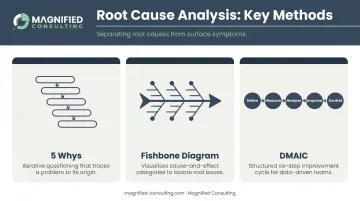
ASQ defines root cause analysis as a structured set of tools and techniques — including the 5 Whys, fishbone diagrams, and DMAIC (Define, Measure, Analyze, Improve, Control) — specifically designed to isolate the true source of a problem rather than its surface manifestation.
Stakeholder Interviews
Consultants talk to both leadership and frontline staff. This matters because the ground-level friction that slows execution — misaligned incentives, unclear roles, communication silos — rarely reaches the owner. Frontline employees often know exactly what's broken, but they're rarely asked.
The Core Strategies Consulting Firms Use to Drive Efficiency
Standardizing and Documenting Processes
The first intervention most consultants make is converting tribal knowledge into documented, repeatable processes. When a task lives entirely in one employee's memory, the business has a single point of failure. That person leaves, gets sick, or simply has a bad week — and the whole process breaks.
SHRM reports that 75% of organizations say preserving institutional knowledge is important, but only 9% feel prepared to do it. Meanwhile, 61% of HR departments don't use knowledge-management tools at all.
Standardized workflows deliver concrete business benefits:
- Faster onboarding (new hires follow documented processes instead of shadowing one expert)
- Lower error rates and rework costs
- Consistent customer experience regardless of who's doing the work
- A more transferable, valuable business at exit
In construction, for example, rework costs 2% to 20% of total contract value on a typical project. Process standardization directly attacks that number.
Building Scalable Decision-Making Structures
Founder dependency is one of the most common and costly operational problems at the $10M+ level. When the owner is the decision-maker for everything from client escalations to vendor selection to HR issues, growth creates chaos rather than momentum.
Consulting firms help owners establish clear decision-making frameworks:
- Identify decisions that can be fully delegated, and assign clear ownership
- Define escalation criteria so teams act on facts, not instinct
- Give teams the authority to move without creating unacceptable risk
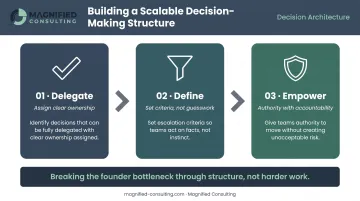
The Vistage/NCMM talent guide for middle-market companies puts it plainly: leaders can become so busy working in the business that they never have time to work on it. Breaking that cycle requires structural change, not harder work.
Technology and Automation Integration
Many businesses at the $10M+ level are still running core operations on spreadsheets, email threads, and tribal knowledge. These systems worked fine at $3M. At $10M they become serious liabilities — version control issues, data loss, process gaps, and hours of manual effort that automation could handle in seconds.
Consultants evaluate the existing tech stack and identify where manual processes can be replaced — from invoicing and reporting to customer communication and scheduling. The goal is removing the fragile workarounds that accumulate over years of growth before they create the next bottleneck.
Financial Visibility and Cost Structure Optimization
Many businesses growing past $10M know their total revenue but have no clear picture of which product lines, clients, or service offerings are actually profitable. Department-level and project-level visibility is often missing entirely.
Magnified Consulting's financial services address exactly this: profitability analysis, cost management, and data-driven financial strategy that exposes where margin is actually being made — and where it's silently leaking away. This financial clarity frequently leads to pricing corrections, cost eliminations, and capital reallocation that improve margins without requiring new revenue.
How Consulting Firms Help Businesses Scale Without Breaking
Scaling without breaking means building operational infrastructure before growth demands it — not scrambling to catch up afterward. Consultants create the scaffolding that holds the business together when adding customers, staff, or locations would otherwise multiply complexity and chaos.
People and Role Alignment
As businesses scale, job roles drift. People accumulate responsibilities that made sense two years ago but no longer align with the business's actual needs. Consultants assess team structure and help redefine roles, reporting lines, and accountability systems so the right people are doing the right work.
Operational Efficiency and Business Valuation
Here's a connection that many business owners underestimate: operational efficiency directly affects business value.
The Exit Planning Institute reports that only 20% to 30% of businesses that go to market actually sell. A 2023 EPI state report found **71% of owners lacked a written transition plan**. The gap between businesses that sell at premium valuations and those that don't often comes down to documentation, financial transparency, and owner independence — all outcomes of good operational consulting.
Buyers don't just purchase revenue. They purchase systems, processes, and predictability. A business that can't operate without its founder, lacks documented workflows, or has opaque financial reporting commands a lower valuation — or no offer at all.
This is where Magnified Consulting's experience across over $1.5 Billion in M&A transactions carries real weight. Their team has seen firsthand what acquirers scrutinize during due diligence — and that perspective shapes every operational recommendation they make. The goal isn't just efficiency today; it's building the structural qualities that make a business scalable and sellable.
Their work with a fast-growing tech startup illustrates this directly: by streamlining operations, building a leadership development plan, and implementing scalable customer success workflows, the company doubled revenue within a year while reducing customer churn by 40% — results tied to systems, not circumstance.
For privately owned businesses generating $10M+ across the Carolinas and Southeast, that combination — operational rigor paired with transaction-level insight — is what separates businesses that scale cleanly from those that stall out or sell short.
Industry-Specific Operational Challenges Consulting Firms Address
Operational inefficiency looks different across industries. A manufacturing business faces different bottlenecks than a professional services firm. Effective consulting firms tailor their approach accordingly — and those with cross-industry experience recognize patterns that operators embedded in a single sector often miss.
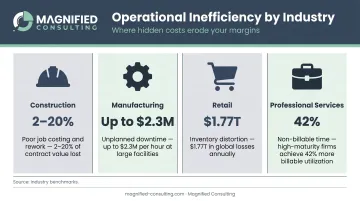
Here's how inefficiency typically surfaces across key sectors:
| Industry | Common Inefficiency | Financial Impact |
|---|---|---|
| Construction | Poor job costing and rework | 2–20% of contract value lost to rework |
| Manufacturing | Unplanned production downtime | Can reach $2.3M/hour at large facilities |
| Retail | Inventory distortion (stockouts + overstock) | $1.77T in global losses annually |
| Professional Services | Non-billable time and scope creep | High-maturity firms achieve 42% more billable utilization than lower-maturity peers |
Magnified Consulting serves clients across manufacturing, construction, retail, professional services, technology, transportation, and home services businesses. A logistics firm they worked with saw a 30% boost in operational efficiency. A family-owned retail client achieved double-digit revenue growth within 18 months after addressing workflow inefficiencies and clarifying market positioning.
That cross-industry exposure matters in practice. A visual management technique from manufacturing can solve a workflow transparency problem in a professional services firm. A scheduling optimization approach from logistics can fix capacity planning in a construction business. The connections are there — they just take a broader vantage point to see.
What to Look for When Choosing an Operational Efficiency Consulting Partner
Not all consulting engagements deliver results. Choosing the wrong partner is expensive — the fees are one cost, but losing another year without structural improvements is the bigger one.
What to Evaluate
- Real-world operational experience, not academic frameworks. Ask where their recommendations come from: cases they've lived through, or textbooks?
- A measurable track record across similar industries and company sizes
- Personalized approach: a consultant who offers the same playbook to every client hasn't actually assessed your business
- Post-engagement commitment : do they stay engaged through implementation, or hand over a report and disappear?
Red Flags to Avoid
- Consultants who deliver thick reports but vanish before implementation
- Generic recommendations that could apply to any business in any industry
- No verifiable client outcomes — vague testimonials without context or metrics
- Engagements structured to maximize hours, not results
Why Magnified Consulting Fits This Profile
Each of those criteria points to the same core need: a partner who is accountable beyond the proposal stage. Magnified Consulting works with privately owned and family-run businesses in Charlotte, Columbia, South Carolina, Myrtle Beach, Savannah, and Charleston SC, with most clients generating over $10M in revenue.
Their long-term mentorship model means the relationship doesn't end when the initial project does. Clients receive ongoing advisory support for both day-to-day operations and major strategic decisions — sustained engagement that produces structural change rather than short-term patches.
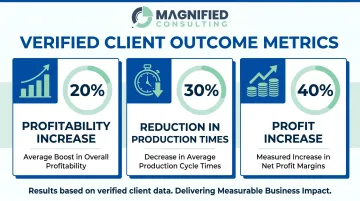
Verified client outcomes speak to that consistency:
- 20% increase in profitability within the first six months
- 30% reduction in production times for operational clients
- 40% profit increase for businesses that fully implemented their strategies
Their team brings decades of real-world experience, including a track record of advising on $300 million in capital purchasing decisions — specific, verifiable credentials rather than general claims.
Frequently Asked Questions
What is the operational efficiency of a firm?
Operational efficiency measures how well a firm converts resource inputs — people, capital, time — into productive outputs. A highly efficient firm consistently delivers results without waste, redundancy, or costs that grow disproportionately to output. The closer that ratio gets to 1:1, the more efficiently the business operates.
Is $100 an hour good for consulting?
Consulting rates vary based on expertise, engagement scope, and outcomes delivered. The BLS reports median annual pay for management analysts at $101,190 — but engagement fees for experienced operational consultants typically exceed that baseline. The more relevant question is ROI: cost reductions and profitability improvements from a quality engagement typically far outweigh the fee.
What are the signs your business needs an operational efficiency consultant?
The clearest signals: the owner is involved in every operational decision, revenue is growing but margins are shrinking, critical processes depend on one or two key people, or every attempt to scale creates more problems than it solves. If firefighting has replaced strategy, that's a diagnostic in itself.
How long does it take to see results from operational efficiency consulting?
Quick wins — process fixes, automation, and financial visibility improvements — typically appear within 60–90 days. Deeper structural changes, such as decision-making frameworks and role realignment, show measurable results within three to six months. Early wins build momentum for the work that drives lasting improvement.
What is the difference between operational efficiency and operational scalability?
Operational efficiency is about doing current work better with fewer resources. Operational scalability is about building systems that handle increased volume without proportionally increasing cost, headcount, or complexity. Both are necessary: efficiency without scalability limits growth, and scalability without efficiency just scales the dysfunction.
How do consulting firms tailor their approach to different industries?
Experienced consultants run industry-specific diagnostics and benchmark against sector norms before recommending any intervention. A construction engagement focuses on job costing and project management; a retail engagement targets inventory and margin. The diagnostic always shapes the approach — not a predetermined methodology.