

Succession planning protects the firm's value, its clients, and the owner's financial future. Done right, it also protects the people inheriting leadership from being set up to fail.
This article walks through a four-step framework built for privately held business owners: establishing a Shared Vision, defining a Transition Strategy, agreeing on Transaction Terms, and creating a Written Transition Plan. Miss any one of these, and even well-intentioned transitions tend to unravel.
Key Takeaways
- Successful succession planning passes down culture, leadership, and institutional knowledge — ownership paperwork is just the starting point
- Most transitions fail due to misalignment between the founding generation (G1) and successor generation (G2), not bad intentions
- Shared vision must come before any financial or operational planning
- Valuation is an independent market assessment — not a number based on what the owner needs for retirement
- A written plan with scheduled reviews keeps the transition on track and accountable
Why Most Firm Transitions Fail — And What You Can Do About It
Poor succession outcomes rarely stem from a lack of goodwill. They stem from a lack of documented agreements.
G1 names a successor but creates no development plan. G2 waits for clarity that never arrives, loses confidence, and eventually leaves. Or G1 delays acting until a health event forces a rushed, undervalued exit. These patterns repeat across industries and firm sizes. Not because the people involved didn't care, but because no one formalized the process before it mattered.
The exposure is significant. Gallup research found that 52.3% of U.S. employer businesses are owned by people aged 55 or older, with 22% planning to sell or transfer ownership within five years. That's a massive wave of transitions approaching with too few structured plans behind them.
The Four-Agreement Framework
The structured solution is a four-part framework that sets both generations up for success:
- Shared Vision — alignment on what the firm is, where it's going, and why
- Transition Strategy — operational roadmap for shifting responsibilities over time
- Transaction Terms — independent valuation and agreed deal structure
- Written Transition Plan — the living document that keeps everything on track
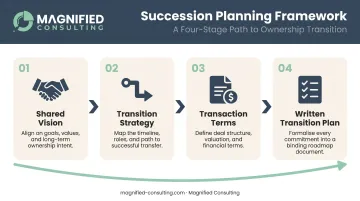
Each step builds on the last. Skipping the foundation doesn't accelerate the process — it creates gaps that surface at the worst possible time.
Step 1: Establish a Shared Vision Between G1 and G2
A shared vision is the first requirement, not a formality to check off before getting to the "real" work.
Without it, every subsequent conversation (about roles, timelines, compensation, and deal structure) becomes a negotiation without a shared reference point. PwC's U.S. Family Business Survey found that only **49% of U.S. family businesses are aligned on company direction**. That means most firms entering a transition are starting from disagreement, whether they realize it or not.
What a Strong Vision Statement Includes
A well-crafted vision statement covers four components:
- An overriding purpose — why the firm exists beyond making money
- Clarifying specifics — the service model, niche, or target client the firm serves
- Measurable goals — revenue targets, client count, team size, or market position
- A defined timeline — when those goals should be achieved
For example, a professional services firm might articulate: "To serve mid-sized manufacturers in the Southeast as their preferred operational advisor, reaching $8M in annual revenue with a team of 12 within five years." That statement is concrete enough to guide hiring decisions, marketing choices, and leadership development — all things that matter during a transition.
Questions G1 Must Answer First
Before G2 can align on a vision, G1 needs clarity on their own answers:
- Is the business built to serve a defined niche, or does it rely on the founder's broad personal network?
- Does the firm have a growth engine that functions without the founder's direct involvement?
- How will leadership responsibilities be distributed, and over what timeline?
The Emotional Dimension
G1 often struggles to separate their personal identity from the firm's identity. G2 may have genuinely different ideas about the firm's direction. Those differences aren't necessarily a problem. In most cases, what looks like conflict is simply the absence of a real conversation.
Open dialogue isn't optional at this stage. Magnified Consulting approaches these conversations as a neutral outside party, helping both generations get specific about what they actually want and separating genuine disagreements from assumptions that were never tested.
Once that shared vision is in place, the conversations that follow — about structure, roles, and deal terms — have a clear reference point. That's what makes Step 2 possible: deciding who actually leads the firm through the transition.
Step 2: Define a Transition Strategy and Structured Process
Once both generations agree on the destination, the transition strategy maps out how to get there — who does what, when, and how responsibility shifts over time.
The shorter the transition window, the more intentional this plan needs to be. FamilyBusiness.org recommends starting succession planning 5 to 10 years before the target date, with a minimum window of three to five years just for successor preparation. The timeline isn't arbitrary — it reflects what the research consistently shows about how long real capability transfer takes.
Four Areas That Each Need Their Own Roadmap
A blanket handoff doesn't work. Each of these areas requires its own phased plan:
- Client relationship oversight — which clients transfer first, who leads introductions, and what the timeline looks like for full relationship ownership
- Business development — how G2 builds their own pipeline rather than inheriting G1's entirely
- Strategic leadership and decision-making — when G2 begins making decisions independently, and what G1's advisory role looks like during the overlap
- Financial management — who manages the firm's finances, P&L responsibility, and reporting as the transition progresses
Assessing G2 Readiness Honestly
If the successor hasn't yet developed rainmaking, leadership, or financial management experience, the transition strategy must include a formal development plan.
Magnified Consulting identifies skill gaps early and designs training and mentoring programs aligned with the future needs of the business. Successors are paired with current leaders for structured knowledge transfer — not just informal observation.
Key questions to answer before finalizing the strategy:
- What specific competencies does G2 still need to develop?
- Who provides that development, and over what timeline?
- How will progress be measured before G2 takes on greater authority?
G1 also needs to ask themselves harder questions — including whether they're genuinely prepared to let G2 make different decisions, and what role (if any) they want during each phase of the transition.
Those questions are harder to answer honestly without someone outside the family dynamic. When discussions become emotionally charged or both generations hold different views about the firm's future, a neutral facilitator keeps conversations productive rather than destructive.
Step 3: Agree on Transaction Terms and Business Valuation
This is where the most financially consequential decisions get made. It's also where most disputes arise.
The single most important principle: the value of the business is not based on what the owner needs for retirement. It's an independent market assessment of what a buyer would pay.
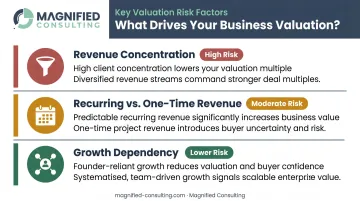
Three Factors That Drive Private Business Valuation
- Revenue concentration — a firm where 80% of revenue comes from a handful of clients carries higher risk and commands a lower multiple
- Recurring vs. one-time revenue — predictable, contracted revenue increases value; project-based or one-time revenue decreases it
- Growth dependency — a business that grows because of the founder's relationships is worth less than one with a self-sustaining sales engine
For context on where values land, IBBA and M&A Source's Q4 2025 Market Pulse data reported average deal multiples ranging from 2.8x SDE for businesses under $500K to 5.5x EBITDA for those in the $5M–$50M range — with sellers averaging 76% to 89% cash at close. Those benchmarks directly shape how the deal gets structured.
Key Deal Structure Elements
G1 and G2 must reach documented agreement on four deal components:
| Element | What to Decide |
|---|---|
| Purchase structure | Lump sum at close vs. tranches over time |
| Equity retention | Does G1 retain any minority stake post-transition? |
| Holdback provisions | Percentage withheld pending revenue retention targets |
| Financing options | Cash, third-party financing, seller note, or a combination |
A third-party valuation removes emotion from the negotiation and gives both sides a fair starting point. Discounts for lack of marketability and lack of control are common in closely held businesses — both should be reviewed by tax and legal counsel as part of the deal process.
That complexity is exactly where outside experience pays off. Magnified Consulting's partners have worked through over $1.5 Billion in mergers and acquisitions across manufacturing, professional services, construction, and other industries — giving business owners a grounded, numbers-based picture of what their firm is worth before they sit down at the negotiating table.
Step 4: Create a Written Transition Plan and Commit to Regular Reviews
The written transition plan ties everything together: the shared vision, the operational strategy, and the agreed transaction terms — consolidated into a single living document.
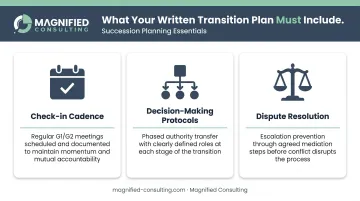
It should also define:
- Check-in cadence — how often G1 and G2 meet specifically about the transition (not just general business meetings)
- Decision-making protocols — who has authority over what during each phase
- Dispute resolution — how disagreements get handled before they escalate
Write It Before You Need It
The time to create this document is when both parties are in a positive, aligned headspace — not mid-crisis. Small misalignments that go undocumented have a way of compounding. What starts as a difference of opinion about client ownership becomes a full breakdown in trust if there's no agreed process for resolving it.
Research on family business succession found that succession appears on the agenda at least annually for 49% of boards and 50% of family councils — which means roughly half of organizations aren't reviewing their plans consistently enough. The plan is only as useful as the discipline behind maintaining it.
Treat It as a Living Document
A written plan isn't something you file away after the ink dries. It should evolve as the business grows, goals shift, or circumstances change — which means building in a regular review cadence from the start.
Magnified Consulting structures client engagements with this in mind. Their involvement doesn't end at plan creation; they provide ongoing mentorship through every phase of the transition, from early vision alignment through post-transaction integration, adjusting strategy as real-world conditions evolve.
Frequently Asked Questions
How do business owners typically plan for succession?
Most owners follow four core steps: establishing a shared vision, identifying and preparing a successor, obtaining an independent business valuation, and formalizing transaction terms in a written plan. Outside advisory support helps maintain accountability and keeps the process on track.
How many business owners actually have a succession plan?
Far fewer than most would assume. MassMutual's 2022 study found only 29% of business owners have a written succession plan, and a separate EIX study found just 21.6% had created or updated one within the prior three years. The gap is widest among owners approaching retirement age.
What are the 5 D's of succession planning?
The 5 D's refer to five unplanned events that can force a business transition: Death, Disability, Divorce, Disagreement (among partners), and Distress (financial hardship). Any one of them can trigger a forced transition, which is why a pre-established plan shifts succession from reactive to controlled.
What is the 80/20 rule in the context of business valuation?
In most privately held businesses, roughly 80% of revenue comes from about 20% of clients — a concentration buyers treat as a liability that reduces the sale multiple. Diversifying that client base before a transaction protects valuation and negotiating leverage.
When should a business owner start succession planning?
Earlier than feels necessary. Industry guidance recommends beginning 5 to 10 years before the target transition date, with a minimum of 3 to 5 years reserved just for successor preparation. Owners who wait until forced — by health, a partner dispute, or market conditions — consistently get worse outcomes than those who plan proactively.