
Introduction
Many privately owned and family-run businesses reach a point that feels contradictory: revenue is solid, the team is working hard, but growth has quietly stalled. Decisions that once felt obvious now feel complicated. The path forward isn't clear, and the problem usually isn't visible from inside the business.
That's where a business growth consultant comes in. Unlike a general advisor or coach, a growth consultant functions as an outside strategic partner — bringing objective analysis, cross-industry experience, and proven frameworks to diagnose what's actually limiting growth and build a plan to break through it.
This article covers what a business growth consultant does, the specific signals that it's time to hire one, how to choose the right partner, and what outcomes you should realistically expect.
Key Takeaways
- Business growth consultants diagnose what's blocking growth — not just what's working
- The right time to hire is often earlier than most owners think
- Effective consultants stay engaged through implementation, not just strategy delivery
- High-stakes moments like M&A, succession, and expansion demand outside expertise
- Results typically begin appearing within 3–6 months of implementation
What Is a Business Growth Consultant?
A business growth consultant is a specialized professional who helps privately owned and established businesses identify growth opportunities, overcome performance plateaus, and build strategies designed to sustain that growth. The role is distinct from a general business advisor (who typically offers broad guidance) and a business coach (who focuses primarily on the owner's leadership development).
Growth consultants examine the full picture — operations, market position, revenue streams, and organizational structure — rather than solving one isolated problem. This matters because the real constraint on growth is rarely where the owner assumes it is.
The businesses that benefit most from this type of engagement share a common profile:
- Privately owned or family-run companies with established revenue but limited internal strategic capacity
- Mid-market businesses generating $10M or more annually that have solid foundations but need outside expertise to scale, streamline, or transition
- Owner-led organizations where leadership is deeply embedded in day-to-day operations, making it difficult to step back and assess the business objectively
The U.S. management consulting industry is valued at $411.7 billion in 2026, reflecting how broadly businesses have come to rely on external strategic expertise. For privately owned companies, it reflects a practical reality: internal teams are built to run the business, not redesign it.
What Does a Business Growth Consultant Do?
A business growth consultant's job isn't to hand you a generic playbook. It's to figure out exactly where your business is gaining ground — and where it's quietly bleeding it.
Starting with a Business Diagnostic
Before any recommendations are made, an effective consultant conducts a deep assessment of the business — financial performance, operational workflows, market positioning, and the competitive landscape. The goal is to identify where growth is being created and, more importantly, where it's being lost.
This diagnostic phase prevents the most common consulting failure: prescribing solutions before understanding the actual problem.
Building a Tailored Growth Strategy
From those findings, the consultant builds a prioritized roadmap — specific actions, timelines, and success metrics tied directly to the business's actual goals. Customization matters here. A strategy pulled from a generic template rarely accounts for the real constraints a specific business faces.
Optimizing Operations and Reducing Costs
Operational inefficiency is one of the most consistent growth suppressors in privately owned businesses. A 2026 survey of U.S. private company leaders found that 62% ranked productivity as a top priority — and 72% cited data quality or availability challenges as a primary operational barrier.
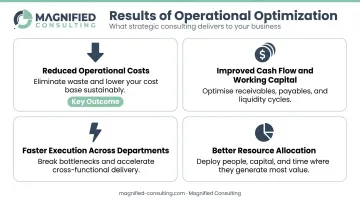
Growth consultants identify the specific workflows, resource allocation patterns, and process bottlenecks that are limiting output. The outcomes from this work are tangible:
- Reduced operational costs
- Improved cash flow and working capital
- Faster execution across departments
- Better resource allocation decisions
Advising on Capital Decisions, M&A, and Transitions
High-stakes financial decisions — acquisitions, capital investments, ownership transitions — require a level of objectivity and experience that internal teams rarely have. The partners at Magnified Consulting have been collectively involved in over $1.5 Billion in mergers and acquisitions and have advised on $300 million in capital purchasing decisions, giving them a ground-level understanding of how these transactions actually unfold from pre-deal planning through post-transaction integration.
Mentorship and Accountability Through Implementation
Delivering a report and stepping away isn't consulting — it's documentation. Effective consultants stay involved through implementation, monitoring KPIs, adjusting strategy as conditions shift, and holding leadership accountable to the plan they helped build.
When to Hire a Business Growth Consultant
Most business owners wait too long. Here are the clearest signals that it's time to bring in outside expertise.
Revenue Has Plateaued Despite Consistent Effort
When sales figures flatten even though the team is working hard, it rarely signals a failing business. More often, the current strategy has simply reached its natural ceiling. An outside consultant can diagnose the actual constraint — whether it's market positioning, pricing, sales process, or something else entirely — and build a plan to break through it.
Operational Complexity Is Slowing Things Down
Growing businesses frequently reach a point where internal systems become the enemy of growth. Hiring, communication, technology, and fulfillment processes that worked at $5M in revenue start breaking down at $15M. This is a prime moment for a consultant to redesign systems that actually scale.
According to PwC's U.S. Family Business Survey, only 39% of U.S. family businesses report having strong digital capabilities — a gap that consistently translates into operational drag.
Entering a New Market or Pursuing Expansion
New market entry without external expertise is one of the highest-risk moves a business can make. MIT Sloan Management Review found that while 80% of companies claim to ideate and incubate new ventures, only 16% successfully scale them. A growth consultant provides market research, competitive positioning, and entry strategy to improve those odds substantially.
Preparing for a Significant Business Transition
Some of the highest-stakes moments in a privately owned business's life include:
- Succession planning and leadership transfers
- Ownership changes or partnership restructuring
- Potential acquisitions (buying or being acquired)
- Exit planning and business sales
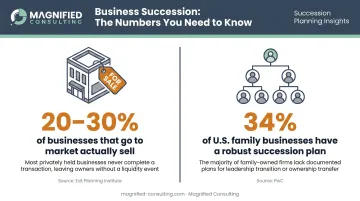
The numbers here are sobering: according to the Exit Planning Institute, only 20–30% of businesses that go to market actually sell. Outside expertise — and the objectivity it brings — often determines whether owners capture full value or leave money behind.
The PwC survey also found that only 34% of U.S. family businesses had a robust, documented succession plan — meaning most are heading into transition without a clear plan in place.
Lacking Internal Capacity for Strategic Planning
Execution-focused management teams aren't built for high-level strategic planning. Strategic thinking and day-to-day execution require fundamentally different orientations. When leadership is too close to operations to see the full picture, a consultant provides the external vantage point that shifts the conversation — and the direction.
The Benefits of Hiring a Business Growth Consultant
Senior-Level Expertise Without the Full-Time Cost
A growth consultant delivers strategic thinking drawn from cross-industry experience without the overhead of a full-time executive hire. According to BLS data, chief executives earned a median annual wage of $206,420 in 2024, with general and operations managers earning around $102,950. An external consultant delivering comparable strategic value on a project or retainer basis represents a meaningfully different cost structure for mid-market businesses managing tight leadership budgets.
An Outside Perspective That Internal Teams Can't Replicate
Internal leaders are shaped by the company's culture, history, and assumptions — sometimes without realizing it. An outside consultant brings what internal teams structurally can't:
- Challenges entrenched assumptions before they become costly blind spots
- Spots growth opportunities that are invisible from inside the organization
- Applies patterns observed across multiple industries to your specific situation
- Provides candid analysis free from internal politics or job preservation instincts
Measurable Results Tied to Real Business Performance
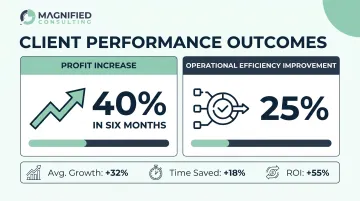
Magnified Consulting's clients have reported a 40% increase in profits within six months and a 25% improvement in operational efficiency across engagements. A family-owned retail client achieved double-digit revenue growth within 18 months through strategic analysis and operational repositioning.
Scope the engagement around specific metrics from the start — revenue targets, efficiency gains, cost reductions — so progress is visible, not assumed.
Business Growth Consultant vs. Management Consultant: What's the Difference?
The distinction is worth understanding before you hire.
| Focus Area | Business Growth Consultant | Management Consultant |
|---|---|---|
| Primary question | "How do we grow faster?" | "How do we run this better?" |
| Core emphasis | Revenue expansion, market positioning, strategy | Operations, organizational structure, cost reduction |
| Typical trigger | Plateaued growth, new markets, transitions | Inefficiency, restructuring, cost pressure |
| Best for | Scaling, M&A, succession, growth roadmaps | Team restructuring, process redesign |
For privately owned businesses, the line between these two roles often blurs. A business facing stagnant revenue, operational bottlenecks, and a pending ownership transition doesn't fit neatly into either column. In those situations, engagements that draw on both disciplines — growth strategy and operational rigor — tend to deliver more useful outcomes. The right consultant recognizes which problem is actually driving the others, and starts there.
How to Choose the Right Business Growth Consultant
Look for Real-World, Cross-Industry Experience
The most effective consultants bring decades of hands-on business experience, not just theoretical frameworks. Ask for specific examples of outcomes delivered across different industries — not generic case study language. A consultant who has personally navigated M&A transactions, capital decisions, and operational turnarounds brings a distinctly different perspective than one who has only advised on them.
Prioritize Customization Over Templates
Be cautious of any consultant who arrives with a pre-packaged strategy before understanding your business. The right partner spends significant time in discovery before prescribing anything — because real constraints rarely surface without a thorough diagnostic.
Evaluate Their Commitment to Long-Term Accountability
A consultant who delivers a report and disappears is selling analysis, not growth. Look for partners who define success criteria upfront, stay engaged through implementation, and provide ongoing mentorship beyond the initial engagement. The relationship structure matters as much as the strategy itself.
Why Magnified Consulting
Magnified Consulting works with privately owned and family-run businesses generating $10M or more in revenue. The firm's partners have been collectively involved in over $1.5 Billion in M&A transactions and $300 million in capital purchasing decisions — numbers that reflect real operator experience, not just advisory roles.
They serve businesses across industries including:
- Manufacturing, Construction, and Transportation
- Retail, Professional Services, and Technology
- Home Services Businesses
Engagements span the full lifecycle — from initial diagnostic through ongoing mentorship — across Charlotte, Columbia, South Carolina, Myrtle Beach, Savannah, and Charleston, SC.
Frequently Asked Questions
What is a growth consultant's salary?
BLS data puts the median annual wage for management analysts at $101,190 as of May 2024. External consulting firms and independent consultants operate differently — typically charging a project fee or monthly retainer rather than drawing a salary.
How much does it cost to hire a business growth consultant?
Costs vary based on engagement scope, consultant experience level, and whether the arrangement is hourly, project-based, or a retainer. The more useful frame is ROI: a well-structured engagement should generate measurably more in revenue or profitability than it costs.
How long does it take to see results from a business growth consultant?
Most businesses begin seeing measurable progress within three to six months — Magnified Consulting clients have reported profit increases of 40% and profitability gains of 20% within that window. Larger organizational transformations typically unfold over 12 to 18 months.
What's the difference between a business growth consultant and a business coach?
A business coach focuses primarily on developing the owner's leadership skills and mindset. A growth consultant diagnoses specific business challenges and builds actionable strategies to improve performance and profitability. The focus is on the business as a whole, not the individual running it.
Can a growth consultant help with business succession or exit planning?
Yes — and for privately owned and family-run businesses, this is one of the highest-value applications. Growth consultants assist with succession planning, ownership transitions, business valuation, and positioning a business for a successful sale or exit.
What industries benefit most from hiring a business growth consultant?
Growth consultants add value across most industries. Manufacturing, Construction, Retail, Professional Services, and Home Services Businesses tend to see strong results — these sectors involve layered operations, tight margins, and transition decisions (like succession or exit) where an outside strategic perspective directly affects the bottom line.