
Key Takeaways
- B2B revenue growth consulting builds repeatable systems that connect every decision to measurable financial outcomes.
- The best firms tailor every engagement to the client's industry, ownership structure, and specific goals.
- Engaging a consultant during a period of stability produces far better outcomes than waiting for a full growth crisis.
- Long-term mentorship sustains results where one-time project delivery falls short.
- Evaluate consultants on demonstrated track record and industry fit — not brand name alone.
What B2B Revenue Growth Consulting Actually Involves
Many privately-owned businesses generating $10M or more hit a ceiling — not because the team isn't working hard, but because the business has outgrown its informal systems without yet having the infrastructure of a large enterprise. That gap is exactly where B2B revenue growth consulting operates.
This work is not generic business advice. According to the U.S. Bureau of Labor Statistics, management consultants recommend ways to improve efficiency and advise managers on increasing profitability by reducing costs and increasing revenues. In practice, that means identifying what's suppressing growth, redesigning commercial strategy, and building systems that compound results over time.
The Four Core Areas of Focus
Effective revenue growth engagements work across four connected areas:
- Strategic planning — closing the gap between where the business is and where ownership wants it to go
- Operational efficiency — eliminating the process bottlenecks and cost leaks that steadily drain margins
- Financial structuring — aligning capital allocation, cash flow management, and profitability targets
- Go-to-market alignment — ensuring the sales process, customer targeting, and revenue generation work as a system
None of these operates in isolation. A sharp pricing strategy means little if operations can't deliver profitably. A strong sales process breaks down without a clearly defined ideal customer.
How This Differs from Sales or Marketing Consulting
Sales consultants focus on pipeline and closing rates. Marketing consultants focus on demand generation. Revenue growth consultants address the entire business model — operations, capital strategy, market positioning, and financial structure — so that growth becomes scalable rather than dependent on individual heroics.
Who Needs This Most
That distinction matters most for businesses in the middle market. The National Center for the Middle Market defines this segment as companies with $10M to $1B in annual revenue — nearly 200,000 businesses generating more than $10 trillion annually. Privately-owned and family-run businesses in this range — across Manufacturing, Construction, Retail, Professional Services, and Home Services Businesses — are the primary beneficiaries of this type of work. They've achieved real scale, but they often lack the in-house strategic infrastructure that larger corporations take for granted.
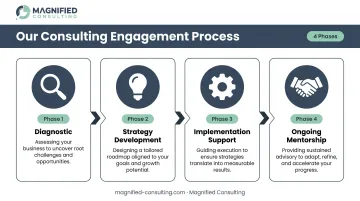
A typical engagement moves through four phases: diagnostic, strategy development, implementation support, and ongoing mentorship. That last phase is where strategy becomes habit — and where owners stop reacting to problems and start building toward a defined outcome.
Core Strategies Top B2B Consulting Firms Use to Drive Revenue Growth
Operational Efficiency as a Revenue Lever
Operational inefficiency isn't just a cost problem; it's a growth ceiling. When workflows are fragmented, processes are duplicated, or technology is underused, the business spends resources running in place rather than moving forward.
Top consulting firms conduct structured operational audits to surface these drains. The NIST Manufacturing Extension Partnership, which provides operational advisory support to small and mid-sized manufacturers, reports that its network has generated an estimated $152.2 billion in new sales and $34.2 billion in cost savings for manufacturers it has worked with — evidence of what structured operational guidance can produce at scale.
For clients of firms like Magnified Consulting, documented outcomes have included production time reductions of 30%, translating to millions in annual savings.
Revenue Model Redesign
Many businesses leave money on the table not from lack of effort, but from pricing architecture that hasn't kept pace with value delivered, or customer segments being ignored in favor of familiar accounts.
Revenue model redesign involves:
- Auditing pricing against market benchmarks and true cost-to-serve
- Identifying underserved or overlooked customer segments within the existing base
- Finding adjacent revenue streams from existing capabilities
This work often produces near-term wins. In many cases, results come faster than owners anticipate because the opportunity is already embedded in the business.
Capital Strategy and Investment Prioritization
Capital misallocation is a common drag on mid-market growth. Businesses reinvest in what's familiar rather than what generates the highest return, and cash flow suffers as a result.
Top consulting firms bring discipline to this decision: which initiatives get funded, in what sequence, and how to protect liquidity while still investing in growth. For Magnified Consulting, this is grounded in real transactional experience — the firm's partners have collectively advised on more than $1.5 Billion in mergers and acquisitions and $300 million in large capital purchasing decisions.
Sales and Pipeline Alignment
Unpredictable revenue usually traces back to undefined systems. When the sales process lacks structure, the ideal customer profile is vague, or too much depends on a single top performer, growth stalls the moment that person has a bad quarter.
Consulting firms restructure the sales process to make revenue generation repeatable:
- Refining the ideal customer profile to concentrate effort on winnable, profitable accounts
- Building a sales process that doesn't collapse when one person leaves
- Aligning go-to-market activity with the highest-margin offerings
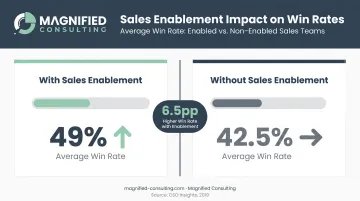
According to CSO Insights' 2019 Sales Enablement Report, organizations with formal sales enablement reported 49% average win rates — 6.5 percentage points above those without any enablement function.
Business Transition and M&A Readiness
For privately-owned businesses, growth strategy can't be separated from succession and transition planning. A survey of 300 family business executives found that 78% expect a CEO transition within 10 years, and 42% expect one within three to five years.
Strategic consulting firms embed transition readiness into growth planning from the outset, treating it as a lens that shapes every major decision rather than a final-phase conversation.
Whether the goal is acquisition, succession, or market expansion, businesses that arrive at that moment operationally clean and financially well-structured consistently negotiate from a position of greater strength.
What Separates Top B2B Consulting Firms from the Rest
Tailored Strategy Over Templated Frameworks
The best firms don't apply the same playbook to every client. They invest in understanding the specific industry, competitive dynamics, and ownership goals before recommending any path forward.
This matters especially for family-run and privately-held businesses, where non-financial dimensions — legacy, succession, team culture, generational continuity — carry as much weight as revenue numbers. A consulting firm that overlooks these factors will deliver a technically sound strategy that the owner has no real interest in executing.
Demonstrated Track Record, Not Just Credentials
There's a meaningful difference between a firm with impressive academic pedigree and one with documented results from comparable engagements. When evaluating a consulting partner, look for:
- Specific transaction history and capital decisions, not just advisory experience
- Client outcomes from businesses similar in size, industry, and ownership structure
- Proof that recommendations were implemented — not just presented in a deck
Magnified Consulting's track record includes involvement in over $1.5 Billion in M&A transactions and advisory work on $300 million in capital purchasing decisions — the kind of real-world transactional depth that translates directly into client outcomes.
Long-Term Mentorship vs. One-and-Done Delivery
A strategy deck delivered at the end of a project engagement has a short shelf life. Ownership transitions, acquisition opportunities, and operational pivots all surface after the initial engagement wraps. The most impactful consulting relationships extend well beyond initial delivery — firms that provide ongoing mentorship help clients navigate these moments and continue building value over time.
Magnified Consulting explicitly structures its client relationships this way: the engagement doesn't end with a single deliverable. Partners remain involved as long-term sounding boards, particularly for the major decisions that privately-owned businesses face as they grow.
Cross-Functional Execution Capability
That mentorship only holds value if the underlying strategy can actually be executed. Top firms work across finance, operations, sales, and leadership simultaneously — ensuring that growth plans reflect the business's real capacity, not just an ideal-state model. A recommendation that requires resources the client doesn't have isn't a strategy; it's a liability.
When to Hire and How to Choose the Right Partner
The Right Time to Engage
Most business owners wait until growth has fully stalled before seeking outside help. That's the wrong timing. The three most common triggers that should prompt action are:
- Revenue has plateaued despite increased investment and effort
- A major inflection point is approaching — acquisition, succession, or market expansion
- Leadership bandwidth is consumed by day-to-day operations with no capacity left for strategic thinking
Engaging during a period of relative stability, not crisis, produces dramatically better outcomes. The business has more options, more time to execute thoughtfully, and more negotiating leverage in any transaction or transition.

Before engaging, three readiness indicators matter:
- Basic financial visibility into current performance
- A leadership team genuinely willing to act on recommendations
- Clarity on the primary growth objective — profitability, valuation, market expansion, or transition readiness
How to Evaluate a Consulting Partner
Two criteria filter out most mismatches before you sign anything:
- Industry and stage fit: A consultant who built their practice around SaaS growth will struggle with the operational complexity of a $20M manufacturing or construction business. Ask directly for examples of comparable client engagements.
- Engagement model: Determine whether the firm offers ongoing advisory support or only project-based delivery. For privately-owned businesses, a long-term sounding board is often more valuable than a one-time report.
Questions worth asking before signing anything:
- What does your diagnostic process look like?
- Can you share specific revenue outcomes from similar engagements?
- How do you stay involved after the initial strategy is delivered?
- How do you measure your own success?
Vague answers to these questions are an answer in themselves — the right firm will have concrete examples ready.
What to Expect: Measurable Outcomes from Strong Engagements
The best consulting engagements produce results on two timelines simultaneously.
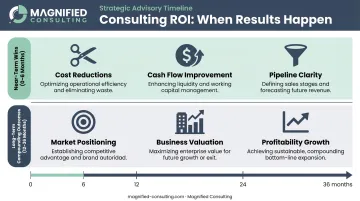
Near-term wins (typically within the first six months) include operational cost reductions, cash flow improvements, and pipeline clarity. These early wins validate the engagement and fund the longer-term work.
Longer-term compounding outcomes — stronger market positioning, improved business valuation, and higher profitability — build over 12 to 36 months as the strategic changes take hold across the organization.
At the outset of any engagement, top consulting firms co-define what success looks like with the client: specific revenue targets, profitability benchmarks, cost reduction goals, or transaction readiness milestones. That shared definition creates accountability on both sides and ensures progress is measurable, not just directional.
Even well-defined strategies lose momentum without continued support. This is where firms like Magnified Consulting — which prioritize ongoing mentorship over transactional project delivery — deliver results that compound well beyond the initial engagement.
Strategy built in year one needs to adapt as market conditions, competitive dynamics, and ownership goals evolve. The firms that stay engaged through those shifts are the ones that help clients build durable, measurable value — not just short-term wins.
Frequently Asked Questions
What does a B2B revenue growth consultant actually do?
They go beyond advice-giving to build operating systems. Consultants diagnose growth bottlenecks, design strategies across operations, finance, and go-to-market, and support execution to produce measurable revenue outcomes — not just recommendations.
When should a privately-owned business hire a revenue growth consultant?
Three situations consistently signal it's time to bring in outside expertise:
- Revenue has plateaued despite continued effort and investment
- An inflection point is approaching — succession, acquisition, or major transition
- Leadership bandwidth is consumed by day-to-day operations with no capacity for strategic work
How long does it take to see results from B2B consulting?
Operational improvements and cash flow gains often appear within the first few months. Deeper strategic outcomes — improved valuation, profitability growth, stronger market position — typically develop over 12 to 36 months depending on business complexity and engagement scope.
What industries benefit most from B2B revenue growth consulting?
Industries with complex operations and high capital intensity see the strongest returns: Manufacturing, Construction, Home Services Businesses, Professional Services, and Transportation. These sectors have the most to gain from structured operational and strategic improvements.
How do consulting firms measure success in B2B revenue engagements?
The engagement should begin with clearly defined success metrics agreed upon by both sides — specific revenue targets, profitability benchmarks, and cost reduction goals. Firms that hold themselves accountable to those numbers throughout the engagement deliver outcomes; firms that don't tend to deliver presentations.
What is the difference between a growth consultant and a sales consultant?
Sales consultants focus on pipeline activity and closing rates. Growth consultants address the entire business model — operations, capital strategy, market positioning, and financial structure — to build revenue that is sustainable and not dependent on any single person or channel.