

Introduction
For privately owned and family-run businesses, the pressure to adapt has never been more immediate. Whether it's a supply chain disruption, a market shift, or a competitor moving faster than expected, the window to respond keeps getting shorter. The question is no longer whether to innovate — it's how, and with whom.
Innovation consulting firms help close the gap between where a business is and where it needs to go. What many owners discover only after a costly engagement: choosing the right firm matters as much as the decision to engage one. A global brand with a prestigious logo doesn't automatically translate into the right fit for your business, your industry, or your growth goals.
This article breaks down what innovation consulting actually delivers, profiles the top global firms, and outlines how to evaluate which partner — whether enterprise-scale or boutique — will actually advance the goals of your business.
Key Takeaways
- Innovation consulting delivers measurable outcomes: new revenue streams, operational efficiency, and successful business transitions
- Global leaders each specialize in distinct approaches, from design thinking to digital ventures
- Privately owned and mid-market businesses often need a more customized, hands-on approach than large firms provide
- The best consulting partner matches your size, industry, and goals, and stays engaged well beyond the first deliverable
What Is Innovation Consulting and Why Does It Matter
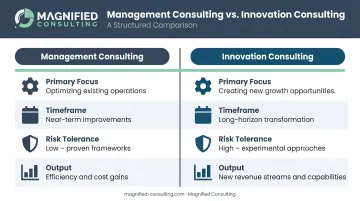
Innovation consulting is a specialized advisory service that helps organizations develop new strategies, processes, products, or business models to maintain competitive advantage and grow revenue. Unlike general management consulting, which focuses on improving what already exists, innovation consulting introduces structured experimentation and transformation methodologies designed to change how a business competes.
The distinction shapes every engagement — from the questions asked to the outcomes expected.
The distinction matters in practice:
| Management Consulting | Innovation Consulting | |
|---|---|---|
| Primary Focus | Optimizing existing operations | Developing new models and opportunities |
| Timeframe | Near-term improvements | Medium-to-long-term transformation |
| Risk Tolerance | Low — proven frameworks | Higher — experimentation required |
| Output | Efficiency and cost gains | New revenue streams, market positioning |
The demand for this type of advisory work reflects how seriously business leaders take the innovation gap. Industry research shows that 80% of executives rank innovation among their top three priorities — yet fewer than 10% are satisfied with their organization's innovation performance. Closing that gap is where external advisory expertise earns its value.
Fortune Business Insights values the global management consulting services market at $491.68 billion in 2025, projected to reach $796.38 billion by 2034. That trajectory reflects how central external strategic expertise has become to sustaining business performance.
Top Innovation Consulting Firms for Business Strategy
These firms were selected based on market reputation, industry breadth, methodology, and ability to deliver measurable results across sectors.
How to Choose the Right Innovation Consulting Firm for Your Business
The most common mistake business owners make is selecting a firm based on name recognition. A globally recognized firm is not automatically the right fit — especially for privately owned or mid-market businesses that need customized, hands-on guidance rather than enterprise frameworks applied at scale.
Key Evaluation Criteria
Before signing an engagement, assess each firm against these factors:
- Relevant industry experience — Have they worked with businesses of similar size and sector, or only with Fortune 500 enterprises?
- Clarity of methodology — Can they explain how they approach your type of problem, or do they lead with brand prestige?
- Measurable outcomes, not just deliverables — Ask for specific client results, not polished case study decks
- Team accessibility — Who actually works on your account? Senior practitioners or junior analysts?
- Post-engagement support — Do they hand over a report and exit, or stay engaged as strategy gets implemented?
Questions to Ask Before You Commit
Push for specifics during any selection process:
- What does success look like at six months into the engagement?
- How is the strategy customized to our specific market and industry — not just our category?
- Who on your team leads our account, and how available are they?
- What ongoing support is provided after initial delivery?
The Case for Boutique Consulting Partners
For privately owned and family-run businesses, the scale of global firms can work against you. Large consulting firms often assign their most senior talent to enterprise clients — a structural reality of how those organizations operate.
Boutique firms like Magnified Consulting offer a different model. Partners work directly on every client engagement, drawing on decades of real-world experience in M&A, capital strategy, and operational transformation — with no layers of junior analysts between the client and the decision-makers.
That experience is grounded in substance: Magnified's partners have been involved in over $1.5 Billion in mergers and acquisitions and $300 million in large capital purchasing decisions, with that depth applied directly to privately owned businesses generating $10M+ in revenue across manufacturing, construction, retail, professional services, and more.
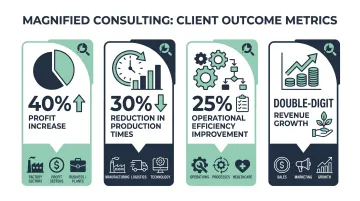
Specific client outcomes include:
- 40% increase in profits within six months across multiple engagements
- 30% reduction in production times for manufacturing clients
- 25% improvement in operational efficiency for a family-owned retail company
- Double-digit revenue growth within 18 months for a multi-location retail business
Every engagement starts with a diagnostic review of operations, financials, competitive positioning, and leadership alignment — then builds a tailored roadmap with measurable milestones. That relationship continues well past initial delivery. Magnified's ongoing mentorship model means clients have direct access to their partners through day-to-day decisions and major transitions alike.
Conclusion
Choosing the right innovation consulting firm comes down to fit — your business size, goals, and operating constraints matter more than a firm's brand recognition. Enterprise-scale firms each serve distinct needs, from digital transformation to structured innovation frameworks. Privately owned and family-run businesses face a different set of priorities. Long-term mentorship, direct senior-level access, and strategies built around your specific industry and growth goals tend to deliver more value than global brand equity. When evaluating partners, focus on the results they've delivered for businesses like yours.
If you're ready to explore what a tailored, experience-backed consulting engagement looks like, connect with Magnified Consulting to start the conversation.
Frequently Asked Questions
What is innovation strategy consulting?
Innovation strategy consulting is a specialized advisory service that helps businesses build structured plans to innovate — spanning new products, processes, business models, or market approaches — and translate those plans into measurable outcomes.
What do innovation consulting firms do?
These firms assess a company's current state, identify growth opportunities, and develop tailored strategies to help the business compete more effectively, enter new markets, or improve operations. The best firms stay involved through implementation, not just strategy delivery.
What is the difference between innovation consulting and management consulting?
Management consulting focuses on improving existing operations using proven frameworks, while innovation consulting emphasizes new business model development and transformative change. Many modern engagements blend both approaches.
How much do innovation consulting firms charge?
Fees vary based on firm tier, engagement scope, and duration. Top-tier global firms typically charge well above the general U.S. market benchmark of $150–$250 per hour, while boutique firms typically offer more flexible pricing for mid-market and SMB clients.
How do I choose an innovation consulting firm for a small or mid-sized business?
Prioritize firms with direct experience working with businesses of similar size and industry. Look for a demonstrated track record of measurable results — not just polished case studies — and confirm that senior practitioners will be actively involved in your engagement.
What results can I expect from working with an innovation consulting firm?
Outcomes typically include improved operational efficiency, new revenue streams, clearer strategic direction, and stronger competitive positioning. Strong engagements also build internal capability, so the gains outlast the consulting relationship.