
Introduction
Most business owners are exceptional at what they do — their craft, their industry, their customers. Running their own company with the same strategic clarity? That's where things get complicated.
Research from the Harvard Business Review found that CEOs of large companies spend less than 5% of their time on strategy. For owners of privately held businesses, that number is often lower — consumed by operations, client demands, and daily problem-solving that crowds out long-term thinking.
The owners who break through that ceiling share a common trait: they stop working purely in their business and start working on it. They lead with vision, set structured goals, track the right metrics, and build systems that create progress without constant firefighting.
This article walks through exactly how to do that — from defining your long-term vision to building the quarterly review habits that separate business owners who plateau from those who grow.
Key Takeaways
- Vision comes first — without a clear picture of what you're building, every goal is just a guess
- Effective practice goals pair outcome targets (revenue, client retention) with activity-based goals (prospect outreach, referral asks)
- The SMART framework turns vague intentions into trackable, achievable milestones
- Revenue alone is a weak dashboard — client retention rate, revenue per engagement, and referral conversion rate reveal the full picture
- Quarterly reviews keep goals alive and turn annual planning into a continuous growth cycle
Why Financial Advisors Need to Think Like a CEO
There's a concept in business called the "technician trap" — the tendency of skilled practitioners to spend all their time doing the work rather than building the business that does the work. For financial advisors, this trap is almost unavoidable.
Client meetings, portfolio reviews, compliance requirements, and service calls fill the calendar fast. Business development — the activities that actually grow the practice — gets squeezed into whatever's left. According to Kitces, that's about 4.5 hours per week for the average advisor.
Owning a Job vs. Owning a Business
The distinction matters more than most advisors realize:
- An advisor who owns a job is indispensable to daily operations. Revenue depends on their personal effort. Growth is capped by their available hours.
- An advisor who owns a business has built systems, delegated appropriately, and created a practice that functions and grows with or without their constant presence.
The CEO mindset doesn't require stepping away from clients. It requires intentionally designing how the practice runs — who does what, which activities get prioritized, and what the next 3 years actually look like.
The Planning Gap
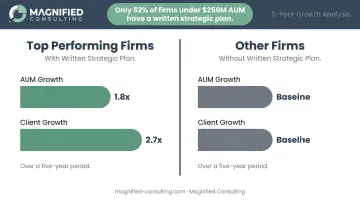
The numbers on strategic planning in the advisory industry are telling. Schwab's 2024 RIA Benchmarking Study found that only 52% of firms under $250M AUM had a written strategic plan. Nearly half are navigating growth without one.
The same study found that Top Performing Firms — those with written plans, defined client personas, and documented growth strategies — delivered 1.8x more AUM growth and 2.7x more client growth than other firms over a five-year period. The firms that plan ahead aren't just better organized — they consistently outgrow the ones that don't.
The planning gap is a prioritization problem. Most advisors know they should have a business plan. The CEO mindset is what finally moves it from intention to action.
Start With Vision: Define What You're Actually Building
CEOs don't open the year by listing goals. They start with a long-range vision — a clear picture of what the organization looks like in five to ten years — and work backward from there. Without that anchor, goals are directional guesses that can pull the practice in conflicting directions.
The Four Vision Questions Every Advisor Must Answer
Before setting any targets, work through these:
- What type of clients do I want to serve? A focused niche versus a generalist practice requires entirely different growth strategies.
- What services will I offer? Comprehensive planning, investment management, tax coordination — the scope determines the team and the pricing.
- How large do I want the practice to grow? There's no wrong answer, but there is a wrong answer for you specifically.
- What role do I play long-term? Relationship manager, lead advisor, or practice owner who's stepped back from day-to-day service?
Aligning Personal and Business Goals
The practice exists to fund the life the advisor wants. That sounds obvious, but many advisors pursue AUM growth without ever connecting it to a personal financial target, an exit timeline, or a lifestyle goal.
Two advisors with completely different visions would set very different goals:
- Building a sellable, lifestyle-friendly practice: Prioritize systematizing client service, developing a junior advisor pipeline, and maintaining a client-to-advisor ratio that protects quality
- Aggressive AUM accumulation: Focus on prospecting volume, referral network expansion, and AUM-per-household growth
Neither path is wrong. But without the vision conversation, both advisors end up chasing the same generic benchmarks.
Why Clarity Filters Out the Noise
Schwab's 2023 RIA Benchmarking Study found that firms with a defined ideal client persona and client value proposition attracted 52% more new clients and 46% more new-client assets than firms without them. Clarity about who you serve has a direct, measurable impact on growth — not just on strategy documents.
Set Goals Like a CEO: The Framework That Works
Vision defines the destination. Goals define the route. The challenge for most business owners is that their goals are vague enough to feel motivating but too loose to drive real behavior change.
The SMART Standard
The SMART framework provides the structure goals need to be actionable:
- Specific — Exactly what will you accomplish? ("Grow the business" is not specific. "Add three new commercial clients in the construction sector by Q3" is.)
- Measurable — What number confirms success?
- Achievable — Ambitious but realistic given your current capacity
- Relevant — Connected to your vision, not just what sounds good
- Time-bound — A deadline, not an open-ended intention
Outcome Goals vs. Activity Goals
CEO-minded business owners track both types — and understand why each matters:
- Outcome goals define where you're headed: "Grow revenue by $2M this year." They provide direction but are only partially within your control.
- Activity goals define what you'll do each day: "Hold 15 qualified sales conversations per month." These are fully within your control and predict outcomes before results arrive.
Business owners who track only outcomes often don't know what's broken until it's too late to course-correct. Activity goals give you an early warning system.
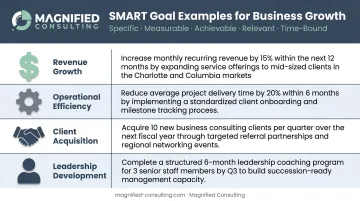
SMART Goal Examples Across Key Categories
| Category | SMART Goal Example |
|---|---|
| Revenue growth | Increase total revenue by 20% by December 31 by entering two new commercial accounts in the manufacturing sector |
| Operational efficiency | Reduce order fulfillment time from 12 days to 7 days by implementing a standardized production workflow by Q2 |
| Client acquisition | Sign five new B2B service contracts with businesses generating over $5M in annual revenue by September 30 |
| Leadership development | Complete one executive leadership program and implement a documented succession plan for two key roles by June 30 |
Prioritize Ruthlessly
One of the most common planning mistakes: listing 12 goals and wondering why none of them get traction.
According to What Matters, the OKR framework that powers Google's goal-setting recommends 2–3 priorities per cycle, each with a handful of key results. EOS (the Entrepreneurial Operating System) uses a similar model — "Rocks" are the 3–7 most important priorities for the next 90 days. The shared logic is the same: focus beats volume.
For most businesses, 2–3 priority goals per quarter is the ceiling. More than that and everything competes for attention.
The KPIs Every Advisor-CEO Should Be Tracking
Most advisors use AUM as their primary — sometimes only — performance metric. Relying on it alone is like evaluating a company's health by revenue alone, with no view of margins, churn, or customer acquisition costs.
A well-run practice needs a dashboard of both leading and lagging indicators.
Understanding the Difference
- Lagging indicators measure results already achieved: AUM this quarter, new clients added last year, revenue closed
- Leading indicators predict future results: prospect meetings scheduled, referral conversations initiated, proposals submitted
CEOs pay close attention to leading indicators because they create the opportunity to course-correct before the quarter closes. If prospect meetings drop in October, November's new client numbers will suffer — but you'll see it coming.
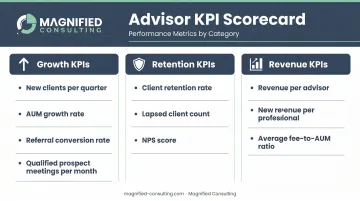
The Advisor Practice Scorecard
Organizing your metrics into categories makes it easier to spot which area of the business is underperforming. Here's a practical starting framework:
Growth KPIs
- New clients per quarter
- AUM growth rate (year-over-year)
- Referral conversion rate
- Number of qualified prospect meetings per month
Retention KPIs
- Client retention rate
- Number of lapsed or departed clients
- Client satisfaction or NPS score
Revenue KPIs
- Revenue per advisor
- New revenue generated per professional
- Average fee-to-AUM ratio
How Your Practice Compares
Benchmarking your KPIs against industry norms helps distinguish a performance gap from a growth opportunity. A few reference points worth knowing:
- Strong client retention typically runs 95–97% in well-managed advisory practices
- Top-performing firms generate roughly 70% more new revenue per professional than their average-performing peers
- Practices that track leading indicators consistently tend to close revenue gaps faster — because they catch the problem before it shows up in end-of-quarter numbers
If your retention is slipping or your new revenue per professional trails peers significantly, diagnose those gaps before layering on more prospecting goals. Chasing new clients while losing existing ones is a costly treadmill.
Build Systems That Work Without You
Goals without systems are just intentions with deadlines. What separates advisors who consistently hit their targets from those who fall short isn't motivation — it's whether progress depends on willpower or process.
What Should Be Systematized
Start by categorizing goal-related activities:
- Systematize or automate: meeting reminders, CRM follow-up sequences, birthday and anniversary touchpoints, referral request prompts, client review scheduling, onboarding checklists
- Keep personal: initial prospect conversations, referral relationship building, annual planning meetings, complex planning discussions
Schwab's 2024 data found that 63% of Top Performing Firms had standardized CRM workflows for more than half of their tasks, up from 55% in 2020. CRM usage overall reached 87% across RIA firms — but having the tool and building the workflows inside it are two different things.
The advisors closing the gap aren't necessarily working harder. They've built systems that make consistent follow-through automatic. Even well-designed internal systems, though, have a ceiling — and that's where external accountability comes in.
The Role of an Outside Partner
At some point, most advisors find that accountability to their own systems isn't enough. It's too easy to deprioritize a quarterly planning session when a client issue demands attention. Having an objective external partner changes the dynamic.
Magnified Consulting works with business owners to bring outside perspective, hold them accountable to plans they've already committed to, and identify gaps — like underperforming service lines or missed referral patterns — that are hard to see when you're operating from inside the practice. Clients have documented outcomes including a 40% profit increase within six months and a 30% reduction in operational time costs, results that reflect what structured accountability and external perspective can produce.
The Quarterly Review: Making Goal-Setting a Habit, Not a Holiday
Most advisors set goals in January and revisit them in December. Whatever progress happened in between was accidental. The CEO model runs on a tighter loop.
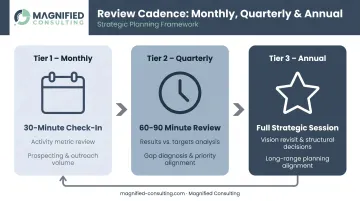
The Review Cadence
- Monthly: 30-minute check-in on activity metrics only — prospect meetings, referral conversations, outreach volume. Are you doing the activities that drive the outcomes?
- Quarterly: Deeper 60–90 minute review comparing actual results to targets, diagnosing gaps, adjusting activity plans, and confirming current priorities still align with the long-term vision
- Annual: Full strategic planning session to revisit vision, set next-year targets, and make structural decisions about team, services, or market positioning
According to What Matters, quarterly is the most widely used OKR cadence — four 90-day cycles that build toward annual objectives. Google's goal-setting team recommends a mid-quarter check-in specifically to catch goals that have become unachievable before the cycle ends.
What a Quarterly Review Actually Covers
- Results vs. targets — For each goal, what actually happened? By how much did you hit or miss?
- Root cause analysis — If you missed, was it an activity problem (didn't do the work) or a conversion problem (did the work, got different results)?
- Activity plan adjustment — Change the inputs, not necessarily the goal
- Vision alignment check — Do your current priorities still move you toward the practice you described wanting to build?
The Accountability Factor
Solo reviews tend to become self-justification exercises. A peer advisor, a mentor, or an experienced external consultant changes the quality of the conversation. When someone else is on the call, the questions get sharper and the commitments become real.
The review process only produces growth when it's honest. An accountability partner makes it easier to stay honest — and harder to rationalize away a missed target.
Frequently Asked Questions
What are good financial goals for a business?
Strong business financial goals span revenue growth targets, profitability margins, cost reduction, and cash flow improvement. The best ones are tied to a specific time horizon — quarterly or annual — and measured against defined KPIs so progress is visible and adjustable.
What are the goals of a financial advisor?
Advisor goals fall into two categories: client-serving goals (helping clients reach their financial objectives) and practice-building goals (new client acquisition, operational efficiency, and long-term scalability). A healthy practice requires progress on both fronts simultaneously.
What is the SMART goal framework for financial advisors?
SMART stands for Specific, Measurable, Achievable, Relevant, and Time-bound. A vague goal like "grow my book of business" becomes a SMART goal when restated as: "Add 8 new households with $500K+ in investable assets by December 31 through referral partnerships and COI outreach."
How often should a financial advisor review their business goals?
Use a three-cadence approach: monthly check-ins on activity metrics (prospecting volume, meetings scheduled), quarterly reviews to assess goal progress and adjust plans, and an annual session to revisit vision and establish new targets for the year ahead.
What KPIs should financial advisors track to grow their practice?
Track across three categories: client acquisition (new clients per quarter, referral conversion rate), retention (client retention rate, lapsed client count), and revenue (revenue per advisor, revenue growth rate, new revenue per engagement). Together, these metrics give a complete picture of practice health.