
Introduction
If you run a business generating $10M or more in revenue, you've probably lived this scenario: an audit deadline appears, and suddenly your operations manager is buried in spreadsheets, your HR team is tracking down policy documents from three years ago, and your leadership team is fielding questions from regulators instead of running the business.
That scramble is expensive — and entirely avoidable.
Compliance automation consulting combines expert advisory with technology tools to replace that frantic, point-in-time approach with a continuous, systematic process. Rather than treating compliance as a crisis to manage, you build a compliance function that runs alongside operations without disrupting them.
This article covers what compliance automation consulting is, why manual compliance costs more than most owners realize, and how businesses move from reactive audit firefighting to a managed compliance model — one where compliance becomes a predictable operational cost, not a recurring crisis.
Key Takeaways
- Compliance automation requires expert configuration and ongoing human oversight to deliver real results — buying software alone won't get you there
- The highest ROI comes from moving proactively before an audit deadline, not reacting to one
- Automation covers monitoring and evidence collection; consultants bring the judgment, interpretation, and strategic direction that software can't replicate
- The right consulting partner brings industry-specific expertise and stays engaged well beyond the initial project
What Is Compliance Automation Consulting?
Compliance automation consulting is the combination of expert advisory and technology tools that helps businesses continuously monitor, document, and maintain adherence to regulatory requirements. It replaces manual, point-in-time processes with ongoing, systematic oversight.
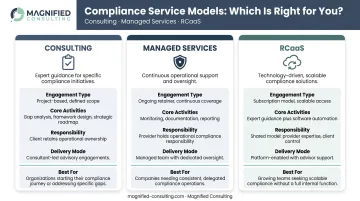
Three service models fall under this umbrella:
| Model | What It Is | Best For |
|---|---|---|
| Compliance Consulting | Strategic, project-based advisory — gap analysis, policy development, framework design | Businesses starting from scratch or preparing for a specific audit |
| Managed Compliance Services | Provider takes ongoing operational responsibility for monitoring, documentation, and updates | Growing businesses that need a functional compliance operation without hiring internally |
| RCaaS (Regulatory Compliance as a Service) | Subscription model combining expert guidance with software automation for continuous reporting | Businesses subject to multiple frameworks needing constant visibility |
Who Actually Needs This?
Privately owned businesses across regulated industries face compliance obligations that increasingly rival those of large corporations — but with far fewer internal resources to manage them. If your business operates in any of these sectors, you're subject to overlapping federal, state, and industry-specific requirements:
- Manufacturing and Construction — OSHA, EPA, and state-level safety standards
- Professional Services and Technology — data privacy, contractual compliance, and licensing
- Retail and Transportation — consumer protection laws, wage regulations, and DOT requirements
The real challenge isn't knowing what the regulations require. It's building a system that proves you're following them — through operational changes, staff turnover, and new client contracts alike.
Why Manual Compliance Costs More Than You Think
Most business owners underestimate what manual compliance actually costs. Direct expenses show up in budgets. The indirect costs — time, opportunity, and exposure — rarely do.
The Resource Drain
When compliance is managed manually, preparing for a single audit can consume weeks of staff time — pulling operations, finance, and HR personnel away from their core responsibilities.
For a technology or professional services firm pursuing SOC 2 certification, vendor estimates from Drata put Type 1 preparation alone at 3–6 months, with costs ranging from $7,500 to $60,000. That figure covers getting ready to be evaluated — before a single finding is addressed.
The Point-in-Time Problem
Traditional audits capture a snapshot of your compliance posture on one specific day. But as NIST SP 800-137 documents, maintaining ongoing awareness of security, vulnerabilities, and threats is what actually supports organizational risk management. Configurations drift. Staff change. New systems get added. Between audit cycles, gaps can open without anyone noticing until it's too late.
The Real Cost of Getting It Wrong
Financial penalties are only the most visible consequence. Consider what's happened to real businesses:
- Raleigh Orthopaedic Clinic (NC) paid a $750,000 HIPAA settlement after disclosing the PHI of 17,300 patients to a vendor without a business associate agreement
- Dollar General faced $1,680,216 in proposed OSHA penalties across four store inspections for blocked exits, unsafe storage, and fire hazards
- Alpha Baking Co. received $326,276 in proposed OSHA penalties for repeat lockout/tagout and machine guarding violations following an employee injury
Beyond penalties, non-compliance triggers operational shutdowns, reputational damage, and in serious cases, personal legal liability for business owners.
The Framework Overlap Problem
Businesses subject to multiple regulations — say, OSHA and EPA, or HIPAA and SOC 2 — often duplicate compliance work because they don't know which controls satisfy multiple requirements at once. Manual processes rarely capture these efficiencies. The result: redundant effort, higher costs, and a compliance program that's harder to sustain.
When your best people spend weeks on compliance prep and documentation, they're not driving revenue, serving clients, or running operations. That tradeoff compounds quietly — until the cost becomes impossible to ignore.
The Compliance Journey: From Reactive Audits to Managed Services
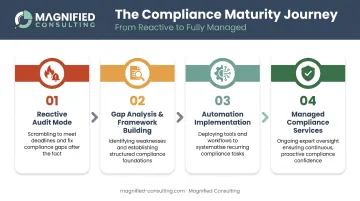
Most businesses don't arrive at a managed compliance model on day one. They work through stages, and understanding where you currently stand clarifies exactly what it will take to reach a proactive, sustainable position.
Stage 1: Reactive Audit Mode
This is where most privately owned businesses start. Compliance is a one-time project triggered by an audit notice or regulatory letter. Consultants are brought in under pressure, evidence is gathered in a rush, and the engagement ends when the audit closes.
It's also the costliest approach. Without proactive documentation, each new audit cycle starts from scratch — the same scramble, the same gaps, the same exposure.
Stage 2: Gap Analysis and Framework Building
The first step toward a proactive approach is a structured compliance assessment. A consultant reviews current operations, identifies regulatory gaps, maps existing controls to applicable frameworks, and develops a policy foundation.
Businesses should expect concrete deliverables at this stage:
- A written gap analysis report identifying specific vulnerabilities
- Control mapping documentation showing where existing practices align with regulatory requirements
- Policy documentation that formalizes compliance procedures
- A prioritized remediation roadmap
After this stage, leadership has a clear, documented picture of where the business stands — and a defined path forward.
Stage 3: Automation Implementation
Once the framework is established, automation tools are configured to continuously monitor controls, flag deviations, collect evidence automatically, and maintain audit-ready documentation.
This stage requires expert configuration: automation tools don't self-calibrate. Controls must be tailored to the business's specific risk profile, industry, and operational structure. A generic controls template designed for a software company won't map correctly onto a manufacturing operation with OSHA and EPA obligations.
Stage 4: Managed Compliance Services
This is the most advanced and cost-effective model for growing businesses. The consulting partner takes ongoing responsibility for:
- Monitoring regulatory changes that affect the business
- Conducting periodic internal audits and reviews
- Maintaining compliance documentation continuously
- Advising leadership on strategic compliance decisions
The practical benefit: a large, unpredictable compliance burden becomes a predictable operational cost. No more audit scrambles. No more compliance gaps building silently between review cycles.
This ongoing engagement model reflects how Magnified Consulting approaches client relationships. The firm stays involved as the business grows and its regulatory obligations shift — acting as a long-term partner, not a one-time project vendor.
What Compliance Automation Actually Does (and What It Can't)
Understanding automation's actual capabilities — and its real limits — is what separates businesses that get value from compliance software from those that buy it and watch it underperform.
What Automation Does Well
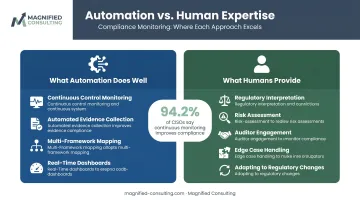
Modern compliance platforms like Vanta and Drata provide measurable capabilities:
- Continuous control monitoring — moving from point-in-time checks to automated, real-time visibility into control health
- Automated evidence collection — timestamped, audit-ready documentation gathered without manual effort
- Multi-framework mapping — a single control configured once can satisfy HIPAA, SOC 2, OSHA, and other overlapping requirements simultaneously
- Real-time dashboards — leadership gets immediate visibility into compliance posture without waiting for an annual review
According to Hyperproof's 2025 IT Risk and Compliance Benchmark Report, 94.2% of CISOs believe continuous controls monitoring improves compliance — but only 72% of organizations have actually implemented such solutions.
What Automation Cannot Replace
Automation handles the repetitive, high-volume tasks well. Judgment is a different matter. Businesses still need human expertise for:
- Interpreting how specific regulations apply to their unique operations
- Assessing risk tolerance and making strategic compliance decisions
- Engaging with auditors and regulators directly
- Handling edge cases that don't fit standard control templates
- Adapting when regulations change or new requirements emerge
As NIST SP 800-37 makes clear, risk management decisions require senior leaders with the information and judgment to determine appropriate responses — not just automated alerts.
The Right Model: Human + Automation
The most effective compliance programs combine automated monitoring for efficiency with human oversight for accuracy and strategic direction. For a manufacturing company navigating both OSHA requirements and SOC 2 certification, the software flags the gaps — but a consultant determines which gaps actually pose business risk and what to prioritize first.
Industries That Benefit Most from Compliance Automation Consulting
Manufacturing
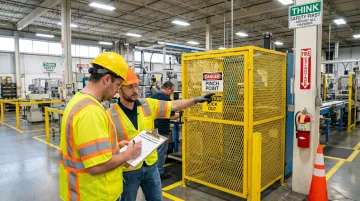
Manufacturers face a multi-framework compliance burden that few other industries match: OSHA workplace safety standards, EPA environmental regulations, product labeling requirements, and supply chain obligations, often running concurrently.
OSHA's top cited violations consistently include Hazard Communication and machine guarding standards, both directly relevant to manufacturing operations. The National Association of Manufacturers estimates that small manufacturers with fewer than 50 employees face a $50,100 per-employee regulatory burden, compared to $29,100 for the average manufacturer. Automation helps manufacturers monitor safety controls continuously, maintain documentation across federal and state agencies, and catch drift before it becomes a citation.
Professional Services and Technology
Firms handling sensitive client data face HIPAA (if health information is involved), state privacy laws, and SOC 2 requirements. The Raleigh Orthopaedic Clinic settlement — $750,000 for a missing business associate agreement — shows how a single administrative gap can turn into a costly penalty.
For these firms, compliance automation addresses two pressure points directly:
- Reduces audit preparation time by continuously collecting control evidence
- Builds a documented compliance record that holds up during breach investigations or regulatory reviews
Construction, Retail, and Transportation
Where manufacturing deals with internal safety controls, industries like construction, retail, and transportation face compliance complexity that extends across worksites, fleets, and storefront operations simultaneously. The overlap of OSHA, DOT, state licensing, and employment law obligations creates exposure at every level:
- A Georgia contractor faced $61,065 in proposed OSHA penalties after a fatal fall through a skylight due to fall protection failures
- Transportation companies operating commercial vehicles face motor carrier penalties up to $19,246 per violation for non-recordkeeping violations, with employers knowingly allowing CDL holders to drive during out-of-service periods facing up to $39,615
- Retail operations face recurring OSHA exposure around exit access, storage, and fire safety as Dollar General's well-documented penalty history illustrates
How to Choose the Right Compliance Automation Consulting Partner
Not all compliance consulting relationships are built the same. Here's what separates a valuable long-term partner from a vendor who delivers a report and disappears.
Look for Industry-Specific Experience
The regulatory landscape for a family-owned manufacturer in the Carolinas looks nothing like what a financial services firm in New York faces. Ask potential partners directly for references from businesses in your industry and revenue range.
Generic compliance knowledge isn't enough. You need someone who understands the specific frameworks your business is subject to and has navigated them before — ideally with clients similar in size and structure to yours.
Evaluate Their Commitment to Customization
The best partners don't apply off-the-shelf templates to your business. They conduct a genuine assessment of your specific operations, configure tools to your actual risk profile, and build a compliance program that reflects your regulatory obligations.
When vetting a potential partner, ask:
- Do they offer ongoing managed services, or is the engagement purely project-based?
- Can they show examples of customized compliance programs from similar businesses?
- How do they handle regulatory changes that affect your industry mid-engagement?
A purely project-based model signals a vendor mindset. Managed services signal a partnership mindset — and that distinction matters when regulations shift unexpectedly.
Consider the Long-Term Partnership Model
Compliance isn't a project with an end date. Regulations change, your business grows, and new obligations emerge. The most valuable partners stay involved after the initial engagement — monitoring for regulatory updates, conducting periodic reviews, and advising on compliance decisions as they arise.
For privately owned and family-run businesses across the Carolinas and Southeast, Magnified Consulting takes this long-term advisory approach. With experience spanning Manufacturing, Construction, Retail, Professional Services, Transportation, and Technology, the firm focuses on sustained mentorship and ongoing support. Reach out to discuss where your business currently stands.
Frequently Asked Questions
What is regulatory compliance consulting?
Regulatory compliance consulting is an advisory service where experts help businesses understand, implement, and maintain adherence to applicable laws and regulations. Consultants translate complex requirements into actionable policies and processes — tailored to the business's industry, size, and operations.
How much does a regulatory consultant cost?
Costs vary based on scope, framework count, number of locations, and whether the engagement is project-based or ongoing. Always weigh the fee against the risk of non-compliance — OSHA willful violations can reach $165,514 per violation, and HIPAA settlements routinely exceed $500,000.
What is the difference between compliance consulting and managed compliance services?
Compliance consulting is typically strategic and project-based — conducting a gap analysis, building a framework, or preparing for a specific audit. Managed compliance services involve the provider taking ongoing operational responsibility for monitoring, documentation, and regulatory updates on a continuous basis.
Can compliance be fully automated?
No. Automation handles repetitive tasks like control monitoring, evidence collection, and reporting effectively. It cannot replace human judgment for interpreting regulations, assessing unique business risks, or making strategic compliance decisions. Effective programs require both.
When should a business hire a compliance consulting partner?
Proactively — before an audit deadline or compliance failure. The best time is during a period of business growth, a new regulatory obligation, or a business transition. Waiting until a problem surfaces is the most expensive approach.
What industries need compliance consulting the most?
Highly regulated industries — including Manufacturing, Financial Services, Construction, Transportation, and Technology — carry the heaviest compliance burdens. In practice, any privately owned business subject to federal, state, or industry-specific regulations can benefit from expert compliance support.