
Introduction
Shared services implementations promise real operational gains — the 2025 Global Business Services Survey found that roughly 50% of organizations achieved over 20% in cost savings from their GBS models. Yet many implementations fall short of those targets, and the culprits are rarely technical. The design is sound, the systems work — but adoption collapses when leadership alignment, communication, and employee buy-in are treated as afterthoughts.
For privately-owned businesses, the stakes are higher than they are for large corporations. A botched transition doesn't just delay ROI — it fractures team morale, triggers talent loss, and can destabilize the very operations the project was meant to improve.
This guide provides a practical, phase-by-phase change management strategy for business owners and operations leaders navigating shared services transitions. Inside, you'll find concrete approaches for:
- Building leadership alignment before the transition begins
- Managing resistance from frontline teams and middle management
- Communicating effectively with different stakeholder groups
- Sustaining momentum and measuring adoption after go-live
Key Takeaways
- Shared services change management must address structural and cultural shifts simultaneously — you can't separate them
- Leadership buy-in isn't a launch event; it's an ongoing, visible commitment
- Four strategies — directive, expert-led, participative, and negotiated — each serve a distinct purpose at different stages of implementation
- Communication, training, and measurement must run continuously throughout the transition, not wrap up at go-live
What Makes Change Management Different in a Shared Services Implementation
Most organizational changes affect how people do their work. Shared services changes who owns the work entirely.
When you transition to a shared services model, you're not updating a system or revising a policy. You're restructuring accountability, reshaping professional identity, and upending power dynamics across multiple departments at once.
Finance leaders who built their teams lose direct control. Business unit heads become service consumers instead of resource owners. Employees who've spent years in siloed roles must reorient around a customer-service mindset.
That dual challenge: structural change and cultural change happening simultaneously — is what makes shared services transitions uniquely difficult. SSON identifies shared services failure patterns including lack of active senior sponsorship, no clear communication plan, shadow organizations forming, duplication of effort, and blame cultures emerging. None of those are technical failures. All of them are people failures.
Shared Services vs. Centralization: A Critical Distinction
This misconception causes more early resistance than almost anything else, so address it head-on before you start.
Centralization pushes control upward — corporate dictates structure to the field, standardizes regardless of business unit needs, and removes local decision-making authority.
Shared services works differently. Business units become the "choosers." They pull resources from a central team, shape service scope through agreements, and influence quality and pricing through governance mechanisms. The field retains significant influence; it just exercises that influence differently.
Explaining this distinction early in your change narrative reduces the fear of lost autonomy — the single most common source of initial resistance.
The ROI Case for Structured Change Management
Prosci research shows that projects with excellent change management are up to 7 times more likely to achieve their intended outcomes. In shared services terms, that gap shows up as the difference between an implementation that reaches full adoption within 18 months and one that's still fighting shadow processes three years post-go-live.
Treating change management as a communications task rather than a structured discipline is what produces those shadow processes — and keeps them alive long after go-live.
The 4 Core Strategies of Change Management for Shared Services
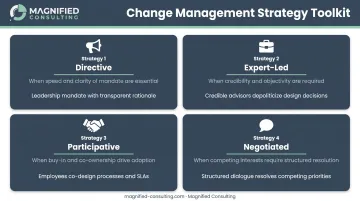
No single change management approach works across an entire shared services implementation. Different phases require different strategies, and different stakeholder groups respond to different approaches. The four strategies below form a deliberate toolkit — matched to the right moment, each one serves a distinct purpose.
Strategy 1 — Directive
Senior leadership communicates a clear, non-negotiable mandate: the transition is happening.
This approach is appropriate early in the project, when the organization needs to understand that the decision has been made and that backing is real. Without a visible directive, ambiguity festers and skeptics wait for the initiative to quietly disappear.
The critical execution note: a directive without rationale triggers blanket resistance. Pair the mandate with transparent reasoning and an explicit commitment to support affected employees through the transition. The message isn't just "this is happening" — it's "this is happening, here's why, and here's how we'll support you."
Strategy 2 — Expert-Led
Bringing in credible, experienced advisors to design the shared services model based on established best practices.
Expert involvement does two things simultaneously: it improves the quality of the design, and it depoliticizes scope decisions that might otherwise become turf battles. When an experienced outside advisor recommends a particular service scope or governance structure, it's harder for individual department heads to reject it as politically motivated.
For mid-market businesses without internal shared services experience, external advisors frequently prevent the costly rework that comes from designs built on internal politics rather than operational logic. Key areas where expert guidance adds the most value:
- Scoping which functions belong in shared services vs. staying decentralized
- Designing governance structures that don't create new bottlenecks
- Setting realistic service-level benchmarks based on comparable implementations
- Identifying integration risks before they become go-live problems
Strategy 3 — Participative
Actively involving employees, team leads, and business unit representatives in co-designing processes, service-level agreements, and performance metrics.
Research on organizational transformations puts hard numbers behind what most change practitioners already know: transformations involving at least 7% of employees in design initiatives were twice as likely to outperform sector peers. Success rates dropped to just 3% when neither line managers nor frontline employees were engaged.
When people help build the model, they defend it rather than resist it. That shift from critic to co-owner is what separates implementations that hold up from those that get quietly undermined the moment leadership attention moves on.
Strategy 4 — Negotiated
Facilitating structured dialogue between the shared services team and business units to resolve competing priorities and reach consensus on service trade-offs.
This strategy is especially critical in privately-owned businesses where long-tenured employees and department heads carry significant informal authority. Telling these individuals what the service model will look like rarely works.
Negotiating it with them — through structured forums where their concerns are genuinely heard and incorporated — produces both better agreements and more durable buy-in.
Phase 1: Defining the Vision and Securing Leadership Buy-In
Before any town hall, email, or training session happens, leadership must be aligned on a clear, compelling vision — one that answers "what's in it for me?" for every stakeholder group.
What each group needs to hear:
- Executives: Cost control, operational scalability, reduced administrative overhead
- Business unit leaders: Reliable service delivery, less time managing support functions internally
- Employees: Clarity about their roles, career path options, and what the transition means for them personally
Building the Vision
A strong visioning process typically includes:
- Executive interviews — Surface individual expectations, concerns, and definitions of success before the room gets together
- Strategic alignment — Connect the shared services initiative explicitly to the company's growth goals (not just cost targets)
- Guiding principles — Establish 4-5 principles that will govern decisions when trade-offs arise during implementation
- Outcome targets — Set measurable goals that go beyond cost savings to include service quality and employee experience metrics
The Sponsorship Imperative
Prosci has identified active and visible sponsorship as the top contributor to change success in every benchmarking study since 1998. Projects with highly effective sponsors meet or exceed their objectives more than twice as often as those with ineffective ones.
The distinction that matters: active sponsorship versus passive sponsorship.
| Active Sponsorship | Passive Sponsorship |
|---|---|
| Appears at town halls and team meetings | Signs off on the initiative and steps back |
| Reinforces messages in leadership forums | Delegates communication to the project team |
| Models the customer-service mindset personally | Assumes the project team will carry the message |
| Addresses resistance publicly and directly | Avoids difficult conversations |
Passive sponsorship is one of the primary reasons shared services implementations lose momentum after launch.
For privately-owned businesses navigating this level of change, the vision-setting process often benefits from an outside perspective. Magnified Consulting works directly with business owners across the Carolinas to build roadmaps grounded in their specific culture and growth goals — not one-size-fits-all frameworks built for large public companies.
Phase 2: Communication Planning and Stakeholder Engagement
An effective communications plan for shared services isn't a single announcement. It's a layered, sequenced campaign — different messages for different audiences, delivered through multiple channels over the full implementation timeline.
Audience-Specific Messaging
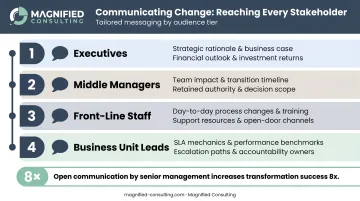
Each group needs different information at different stages:
- Executives — Strategic rationale, financial projections, governance structure, and milestone accountability
- Middle managers — Impact on their teams, new role definitions, and what decision-making authority they retain
- Front-line staff — What changes day-to-day, the timeline, training plan, and available support
- Business unit leads — How service-level agreements work, how they influence service quality, and what escalation paths exist
Industry research on transformation success found that open communication by senior management about transformation progress increased success likelihood 8 times — and 12.4 times for enterprise-wide efforts. That number alone justifies investing in a structured communications plan rather than ad hoc updates.
Addressing Resistance Before It Surfaces
Most communications plans wait for resistance to emerge and then react. High-performing implementations anticipate resistance and address it early.
Identify likely resistance sources before kickoff:
- Specific department heads who have the most to lose in perceived influence
- Long-tenured employees whose identity is tied to their current role structure
- Business units that had negative experiences with prior centralization attempts
- Teams with the most to learn in terms of new systems or workflows
Build messaging that directly addresses these concerns — before the rumor mill does it for you. When people understand what's changing and why, they have far less reason to fill the gaps with worst-case assumptions.
Communication Channels and Cadence
A single channel is never enough. Use a mix — and match the frequency to the phase:
- Town halls — Broad updates and live Q&A; most valuable at launch and at major milestones
- Written project updates — Visible progress dashboards sent on a set schedule (bi-weekly works well during active rollout)
- One-on-ones — Reserved for high-influence stakeholders, particularly those identified as likely resistors
- Manager briefings — Always before organization-wide announcements, so managers aren't caught off-guard when their teams come to them with questions
Phase 3: Managing Employee Resistance and Cultural Shifts
Resistance is a predictable response to uncertainty. The best change management plans treat it as a design challenge — something to be anticipated, structured around, and resolved through deliberate action.
Common Sources of Resistance
- Fear of job loss — especially among employees whose roles overlap with functions being centralized
- Perceived loss of control — business unit managers who built their teams and processes often feel stripped of agency
- Skepticism from prior failures — if a previous centralization attempt went badly, employees will assume this one will too
- Uncertainty about performance expectations — what does "good" look like in the new model?
Industry best practices on shared services frame resistance through a useful lens: people resist because they are "not knowing," "not able," or "not willing." Each category requires a different response — information, training, or direct engagement with underlying concerns.
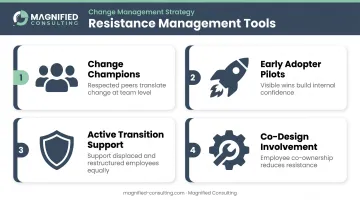
Practical Tools for Easing the Transition
- Designate respected employees as change champions within each business unit — credible peers who translate the change narrative into team-level terms, not cheerleaders
- Run early adopter pilots before full rollout so visible wins build confidence and generate internal proof points
- Provide active support for both displaced employees and those staying in restructured roles — "survivors" often face as much uncertainty as those transitioning out
- Involve employees in designing the processes they'll work within — co-ownership is the most reliable antidote to resistance
Reframing the Control Narrative
One of the most effective messages in a shared services transition reframes the shift from loss to gain:
"You're not losing a resource — you're gaining a responsive service partner who is accountable to you through a service-level agreement."
Business units do give up direct management of support staff. But they gain influence over service quality, scope, and pricing through formal governance mechanisms. Making that trade explicit — walking business unit leaders through a real SLA example and showing exactly how escalation paths work — tends to move skeptics faster than broad executive messaging ever will.
Phase 4: Training, Measurement, and Sustaining Momentum
Two Dimensions of Training
Shared services training requirements fall into two distinct categories:
Technical training:
- New systems, service portals, and workflow tools
- Escalation paths and ticket management processes
- Reporting and performance dashboards
Mindset training:
- Shifting from a corporate staff orientation to a customer-service orientation
- Understanding accountability norms in a service delivery context
- Operating within SLA frameworks rather than direct management relationships
The mindset shift is consistently the harder of the two. It can't be addressed in a single orientation session — it requires ongoing coaching, reinforcement from managers, and visible modeling by leadership. The post-go-live plan needs to account for this just as deliberately as the technical training curriculum.
Measuring What Actually Matters
SSON recommends shared services KPIs cover customer service level, quality, cost, and efficiency. Industry benchmarking data shows that 78% of mature shared services organizations use performance metrics, 76% use SLAs, and 60% use customer satisfaction surveys as standard governance tools.
Alongside operational KPIs, track change management metrics explicitly:
| Metric | What It Measures |
|---|---|
| Adoption rate | % of staff performing in new roles as defined |
| Business unit satisfaction | Confidence in service delivery quality and responsiveness |
| Employee transition satisfaction | Whether staff feel informed, equipped, and supported during the transition |
| Shadow process rate | % of business units still maintaining unofficial workarounds |
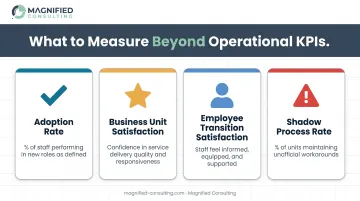
Tie a portion of team and individual performance plans to these change metrics. The behavioral shift is as important as the technical outcomes — and it needs to be measured accordingly.
Sustaining Gains Post-Go-Live
Go-live is a milestone, not a finish line. Embedding the new model into daily operations — and keeping it there — requires deliberate structure after launch.
Establish formal mechanisms for continuous improvement:
- Structured feedback loops between SSC staff and business unit customers
- Quarterly governance reviews to assess SLA performance and surface adjustment needs
- Recognition programs that reward process innovation, not just compliance
This is where ongoing advisory support makes a measurable difference. Magnified Consulting's partners stay involved after go-live — monitoring key metrics, guiding optimization decisions, and helping business owners sustain the operational gains they worked to build.
Frequently Asked Questions
How do you implement shared services effectively?
Effective implementation follows four phases: assess and scope the opportunity, design standardized processes and governance structures, execute with a structured change management plan running in parallel, and optimize continuously post-go-live. The change management workstream should begin in Phase 1, not Phase 3.
What are the 4 strategies of change management?
The four strategies are directive (leadership mandates change with clear rationale), expert-led (advisors design the model from best practices), participative (employees co-design processes), and negotiated (structured dialogue resolves competing priorities between business units). Effective implementations blend all four based on the phase and stakeholder group.
What are the most common reasons shared services implementations fail?
The most common failure factors are lack of executive sponsorship, underinvestment in change management, unresolved cultural resistance, unclear service-level agreements, and inadequate role-specific training. Technical design flaws are rarely the primary culprit.
How long does a shared services change management process typically take?
Most implementation projects run 12 to 36 months from the decision to proceed. Change management is a continuous workstream throughout that period — it doesn't conclude at go-live.
How is shared services different from centralization?
Centralization pushes control upward — corporate standardizes regardless of business unit needs. Shared services gives business units meaningful influence over service scope, quality, and pricing through service-level agreements. Business units retain input and choice rather than receiving top-down mandates.
How do you get employee buy-in for shared services?
Involve employees early in co-designing processes rather than presenting finished decisions. Communicate frequently, address job security concerns directly, and designate respected change champions within teams. Linking individual performance expectations to new model behaviors reinforces lasting adoption.