The stakes are higher than most owners realize. According to BDC research on advisory board structures, businesses with structured advisory support had 24% higher average annual sales and 18% higher productivity than comparable companies without it. The model you choose — advisory or consulting — directly shapes how fast those results arrive and how long they last.
This article breaks down exactly what each model includes, where they differ, and which fits your business based on where you are today and where you're trying to go.
Key Takeaways
- Business advisory packages provide continuous, relationship-based guidance focused on mentorship, accountability, and long-term course correction
- Growth consulting packages are scoped, deliverable-driven engagements suited to specific challenges like scaling revenue or preparing for M&A
- The core difference is duration and ownership: advisory is continuous; consulting is scoped and deliverable-driven
- The right choice depends on your revenue stage, goal clarity, and internal leadership capacity — neither is universally better
- Many high-performing businesses combine both — consulting for an immediate problem, advisory for sustained growth
Advisory Packages vs. Growth Consulting Packages: Quick Comparison
| Dimension | Business Advisory Package | Growth Consulting Package |
|---|---|---|
| Engagement Type | Ongoing, relationship-based | Time-bound, project-based |
| Primary Focus | Strategic direction, mentorship, accountability | Solving a specific problem or achieving a defined outcome |
| Typical Duration | 12+ months (rolling retainer) | 60–180 days |
| Deliverables | Strategic plans, performance reviews, check-ins, network access | Diagnostic assessment, roadmap, implementation support, milestones |
| Best For | Stable businesses needing sustained improvement or transition support | Businesses at an inflection point needing fast, focused expertise |
| Pricing Model | Monthly retainer (tiered by scope and access) | Fixed project fee, milestone-based, or hybrid |
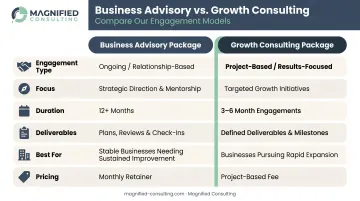
These two models overlap more than the table suggests. Firms like Magnified Consulting build packages around each client's stage, goals, and industry rather than fitting clients into a fixed template — which means the right structure depends heavily on where your business is right now.
That choice has real financial consequences. According to a BDC study, sales grew 66.8% in the three years after an advisory board was established, compared to just 22.9% in the three prior years. Getting the model right matters.
What Are Business Advisory Packages?
A business advisory package is an ongoing engagement where an advisor works alongside the owner on a continuous basis — not for a single project, but as an embedded strategic partner over months or years. The relationship deepens over time, which is precisely what creates its value.
What Advisory Packages Typically Include
Most packages cover a combination of:
- Strategic planning sessions — quarterly or monthly reviews that set direction and measure progress against business goals
- Financial and operational performance reviews — tracking KPIs and identifying gaps before they become problems
- Real-time decision support — direct advisor access between formal sessions for time-sensitive calls
- Accountability check-ins — structured touchpoints that keep execution moving between planning cycles
- Network and expertise access — connections to specialists, capital sources, and industry contacts as needs arise
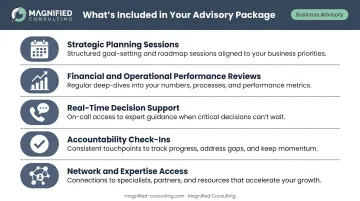
Scope and frequency vary by provider and package tier. A basic advisory retainer might include monthly check-ins and quarterly reviews; a comprehensive retainer adds ongoing financial analysis, deeper operational involvement, and more frequent touchpoints.
Why Advisory Packages Work for Family-Run and Privately-Owned Businesses
The relationship-based nature of advisory engagements is particularly valuable for family businesses navigating complex, layered decisions. Succession is a clear example: industry research found 78% of family-business executives expect a CEO transition within the next decade, yet only 23% are actively implementing a succession plan.
An advisor embedded in the business over years — not parachuted in for a single project — is positioned to close that gap in a way a short-term engagement simply cannot.
Advisory packages also improve decision-making quality during periods of uncertainty. Business owners who cited their reasons for adopting advisory support listed complementary expertise (21%) and decision support (20%) as the top drivers, according to a BDC survey of SMB owners.
Advisory Package Pricing
Advisory retainers are typically structured as monthly fees, with cost driven by:
- Frequency of contact (monthly vs. weekly access)
- Depth of financial analysis included
- Number of business areas covered (operations, finance, strategy, succession)
- Seniority and track record of the advisory team
IBISWorld benchmarks management consulting services at $297 per hour for market reference, though advisory retainers for $10M+ businesses are priced on overall scope rather than hourly. At Magnified Consulting, retainer scope is built around each client's revenue stage, number of business areas involved, and planning horizon rather than a fixed menu of tiers.
Use Cases: When Advisory Packages Fit Best
Advisory packages deliver the strongest return in these situations:
- Stable revenue, unclear strategic direction — the business generates solid cash flow but lacks a defined growth path
- Long-term transition planning — succession, estate strategy, or exit that unfolds over 3–5 years
- Family business dynamics — complex interpersonal and ownership decisions that require a trusted outside voice
- Ongoing operational mentorship — owners who want continuous improvement, not a one-time diagnosis
A manufacturing firm in the $15M–$30M revenue range, for example, might use a quarterly advisory retainer to track KPIs, refine capital allocation, and develop a leadership succession plan over a multi-year horizon. That kind of work compounds: each planning cycle builds on the last, producing results that a one-time engagement can't replicate.
What Are Growth Consulting Packages?
Growth consulting packages are time-bound, project-based engagements brought in to solve a specific business problem or achieve a defined outcome. They have a clear scope, defined deliverables, and a set endpoint — typically 60 to 180 days. Unlike advisory, the engagement is designed to close.
What Growth Consulting Packages Typically Include
A well-structured growth consulting package goes beyond slide decks. Expect:
- Diagnostic assessment — a thorough evaluation of current performance, operations, and competitive position
- Market and competitive analysis — identifying gaps, threats, and untapped opportunities
- Revenue optimization strategies — pricing, sales process, customer mix, and channel analysis
- Operational process improvement — identifying and removing the inefficiencies dragging on margin
- Implementation roadmap — a sequenced, prioritized action plan with measurable milestones
- Execution support — involvement through the implementation phase, not just the strategy phase
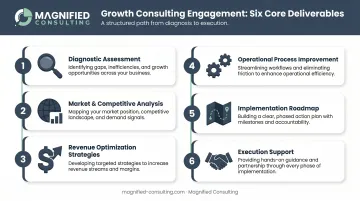
The last point matters. Research on business transformations shows that revenue levers in structured engagements typically begin generating measurable impact three to six months from launch — but only when execution support is built into the engagement structure.
The Outcomes Growth Consulting Targets
Business owners engage growth consulting for concrete results:
- Revenue acceleration through pricing, market, or sales improvements
- Cost reduction and margin expansion
- Cash flow optimization
- Positioning for M&A, capital raises, or ownership transitions
- Identifying new markets or revenue streams
Magnified Consulting's partners have been involved in over $1.5 Billion in M&A transactions and have advised on $300 million in capital purchasing decisions. That experience directly shapes how each engagement is structured. Client outcomes have included a 40% increase in profits within six months and a 30% reduction in production costs for operational clients. Every engagement starts with a deep diagnostic before any recommendations are made.
Growth Consulting Pricing
Pricing structures typically fall into one of three models:
- Fixed project fee — defined scope, single payment or split into phases
- Milestone-based — payments tied to completion of defined deliverables
- Hybrid — base fee plus a performance component tied to outcomes
The right way to evaluate cost is against the specific ROI being pursued. A $30,000–$50,000 engagement that generates $300,000 in operational savings or positions the business for a higher-value exit is a clear investment case. Magnified Consulting prices growth consulting engagements based on complexity and scope. Contact Magnified Consulting directly for a tailored proposal.
Use Cases: When Growth Consulting Packages Deliver the Most
Growth consulting produces the highest impact when:
- The business has hit a revenue plateau and needs a diagnosis, not just encouragement
- There's a specific, urgent challenge — operational bottleneck, stalled market growth, cost structure problem
- The company is preparing for M&A, a capital raise, or an ownership transition
- Leadership is aligned on direction but needs external expertise to design and execute the strategy
- The owner wants a defined engagement with clear deliverables, not an open-ended relationship
A professional services firm approaching a partner transition, or a manufacturer preparing for acquisition, benefits most from a focused engagement with a defined end state. An open-ended advisory relationship serves a different purpose entirely.
Which Advisory Package Is Right for Your Business?
Choosing between advisory and consulting comes down to one thing: where your business actually stands right now — and what it needs next.
Three Questions to Evaluate First
- How specific is the problem? — A defined challenge (stalled revenue, preparation for sale) points toward consulting. Ongoing uncertainty and layered decisions point toward advisory.
- How much your team can handle internally? — If the owner's leadership team can execute once a strategy is built, consulting works. If ongoing course correction is needed, advisory fits better.
- What's the timeline? — Fast results in a defined window = consulting. Sustained improvement over 12–24 months = advisory.
Choose a Business Advisory Package If:
- The business generates stable revenue but lacks strategic clarity or direction
- You're preparing for a long-term transition — succession, estate planning, or exit — over a 3–5 year horizon
- Complex, layered decisions (capital allocation, family dynamics, leadership development) need a trusted advisor over time
- You want ongoing accountability and mentorship, not a one-time fix
Choose a Growth Consulting Package If:
- There's a specific, urgent challenge to solve within a defined timeframe
- You need a clear diagnosis and actionable roadmap in 90–180 days
- The business is preparing for M&A, a capital raise, or a structured ownership transition
- Internal leadership is aligned but needs external expertise to build and execute the strategy
The Sequenced Approach: Both Models, in Order
Privately-owned businesses generating $10M+ in revenue often get the most out of running both models in sequence. Here's how it typically breaks down:
- Consulting phase — solves the immediate problem, produces a clear strategic roadmap, and builds internal alignment
- Advisory phase — sustains those results, provides ongoing accountability, and guides decisions as the business grows or prepares for transition
- Combined outcome — each phase reinforces the other, turning short-term gains into durable, long-term performance
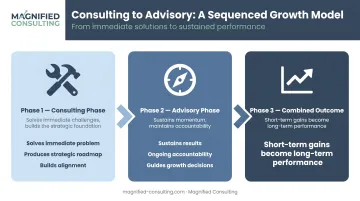
This sequenced structure is especially effective when leadership is capable but stretched — and when the decisions ahead are too consequential to navigate without an experienced outside perspective.
How the Right Advisory Package Drives Real Results
Consider a common scenario: a $20M manufacturing business in the Southeast facing a revenue plateau. The owner knows something is wrong — margins are compressing, a key manager is nearing retirement, and a competitor has started targeting their core accounts — but lacks the internal bandwidth to diagnose all three simultaneously.
The right move in this case is a growth consulting engagement first. A structured diagnostic identifies the pricing gap driving margin compression, surfaces the operational bottlenecks the departing manager has been masking, and maps the competitive threat clearly enough to build a response. Within 90–120 days, the business has an actionable roadmap and measurable milestones.
From there, transitioning into an advisory retainer maintains execution discipline — tracking KPIs quarterly, supporting the leadership transition over 18 months, and keeping capital allocation decisions aligned with the eventual exit plan.
This is exactly the kind of work Magnified Consulting does across the Carolinas and Southeast. The team has been involved in over $1.5 Billion in M&A transactions, $300 million in large capital purchases, and $12 million in capital spending for high-growth startups. That transactional depth shapes every engagement. The measure of success is specific: profitability improvement, cost reduction, or a more valuable, better-positioned business.
For privately-owned and family-run businesses generating over $10M in revenue across Charlotte, Columbia, South Carolina, Myrtle Beach, Savannah, and beyond, Magnified Consulting offers tailored advisory and growth consulting packages built around each client's unique goals. Connect with the team for a consultation to determine which model fits your business stage.
The best-fit package aligns with where the business stands today: its revenue trajectory, leadership gaps, and how close the owner is to an exit. Matching structure to stage is what turns consulting spend into a measurable return.
Frequently Asked Questions
Which is better, advisory or consulting?
Neither is universally better. Advisory packages suit businesses that need ongoing strategic guidance, long-term mentorship, and continuous course correction. Consulting packages are more effective for solving a specific, defined challenge within a set timeframe. The right choice depends on how clearly the problem is scoped and how much continuous external support the business needs.
What is the rule of 3 in consulting?
The "rule of 3" refers to organizing recommendations, priorities, or strategic options into three clear categories, so decisions are easier to present and act on. In advisory engagements, consultants typically use this framework to surface three growth levers or strategic paths for the business owner to evaluate.
What is typically included in a business advisory package?
Most advisory packages include regular strategic planning sessions, financial and operational performance reviews, direct advisor access for real-time guidance, and ongoing accountability check-ins. Scope and session frequency vary by tier and provider — more comprehensive tiers typically add deeper financial analysis and broader operational involvement.
How long does a growth consulting engagement typically last?
Most engagements run 60–180 days. Diagnostics and strategy development wrap up in the first 30–60 days, with implementation support and milestone tracking carrying through to completion.
How do I know which advisory package tier is right for my business size?
Match the tier to your goals' complexity and how often you need decision-making support. Businesses generating $10M+ with active growth or transition plans typically need comprehensive packages covering both strategic planning and operational mentorship, not just periodic check-ins.
Can advisory and consulting packages be combined for better results?
Yes. Many businesses use a consulting engagement to address an immediate challenge, then transition into an ongoing advisory retainer to sustain and build on those results. This structured approach is often the most effective model for privately-owned businesses pursuing both near-term performance gains and long-term business value.