
The frustrating part? Most business owners already know profitability is a problem. They see it in the numbers every quarter. What they lack isn't awareness — it's an outside perspective to identify where the real leaks are and a structured plan to fix them.
This article breaks down the specific, measurable ways business advisory services improve profitability — three core advantages that directly affect margins, cash flow, and growth — plus what happens when that support is missing and how to get the most from an advisory relationship.
Key Takeaways
- Advisory services provide an external perspective that identifies the root causes of shrinking margins
- The three highest-impact profitability levers advisors address: operational efficiency, financial clarity, and revenue strategy
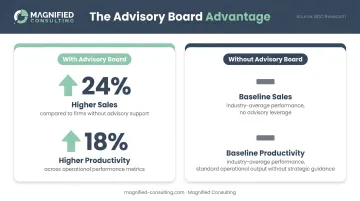
- BDC research found SMEs with advisory boards had 24% higher sales and 18% higher productivity than comparable firms without
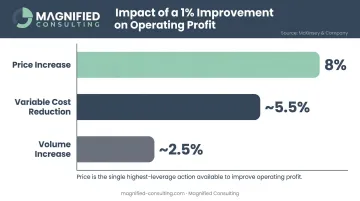
- Pricing is the most underutilized profit lever — a 1% price increase generates an 8% increase in operating profit
- Advisory value compounds — year two and three typically deliver more return than year one
What Are Business Advisory Services?
Business advisory services are professional, ongoing strategic guidance that helps owners make better decisions across finance, operations, and growth. The key word is ongoing. Advisory services differ from one-time consulting engagements in a fundamental way: the advisor learns the business deeply over time and provides guidance as conditions evolve, not just during a single project window. There's no defined end date — the relationship adjusts as the business does.
The goal isn't the advice itself. It's measurable improvement in profitability, operational efficiency, and business value. That means advisors are accountable for results — revenue growth, cost reduction, stronger margins — not just for producing reports or recommendations.
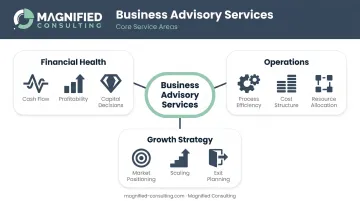
Advisory engagements typically span across three core areas:
- Financial health — cash flow management, profitability analysis, capital decisions
- Operations — process efficiency, cost structure, resource allocation
- Growth strategy — market positioning, scaling decisions, exit planning
The Three Core Advantages That Drive Profitability
The advantages below are grounded in operational impact. Each one ties directly to metrics business owners track: margins, costs, revenue, and cash flow. They are most powerful when applied consistently over time, not as one-time interventions.
Advantage 1: Operational Efficiency and Cost Reduction
One of the most direct ways advisory services improve profitability is by identifying and eliminating operational waste — the inefficiencies that quietly erode margins year after year without anyone formally addressing them.
In practice, advisors conduct structured process reviews, analyze cost structures, flag redundant or underperforming spend, and recommend changes that reduce expenses without cutting quality or capacity. Unlike broad cost-cutting, this targets specific sources of drag identified through structured analysis.
Why this matters for the bottom line:
Operational inefficiencies compound. A 5% cost drag in year one becomes a structural feature of the P&L by year three. Advisors identify and address that drag before it gets baked into the business permanently. Every dollar saved in operations drops directly to the bottom line, with no additional revenue required to get there.
The productivity evidence supports this. BDC's study of over 1,000 SME leaders found businesses with advisory boards had 18% higher productivity (measured as sales per employee) than comparable firms without boards. That gap reflects the impact of structured operational guidance applied consistently over time.
KPIs this advantage directly influences:
- Operating cost as a percentage of revenue
- Gross margin
- Cost per unit
- Overhead ratio
- Labor efficiency
When the impact is highest: Businesses that have scaled quickly without updating their processes, companies carrying high overhead, and thin-margin industries like manufacturing, construction, and transportation. Magnified Consulting's partners work extensively in logistics, manufacturing, and construction — industries where process inefficiency has a direct and measurable impact on the bottom line.
Advantage 2: Financial Clarity and Cash Flow Control
Many businesses that look profitable on paper struggle because the owners don't have real-time visibility into their actual financial position. Advisory services close that gap by building the dashboards, forecasts, and reporting structures that turn raw numbers into decision-ready intelligence.
Advisors implement regular financial reviews, build cash flow forecasting models, identify gaps between reported profit and actual cash availability, and help owners understand which parts of the business are genuinely generating value — and which are quietly consuming it.
The data on cash flow is stark:
The Fed's 2025 employer-firm report found **51% of firms reported uneven cash flows** as a financial challenge, and 56% reported difficulty paying operating expenses. These aren't distressed businesses. They're operating companies with revenue — and the root issue is visibility and financial management, not revenue volume.
When owners know exactly where their money is and where it's going, the decisions change. They stop funding underperformers. They invest in high-return activities. They time capital decisions — equipment purchases, hiring, expansion — based on actual financial position rather than instinct.
Proactive financial planning, including tax strategy alignment, allows businesses to retain more of each dollar earned. Tax and financial strategy requires continuous adjustment — ongoing advisory relationships outperform one-time engagements precisely because the landscape keeps changing.
KPIs this advantage directly influences:
- Net profit margin
- Cash conversion cycle
- Days sales outstanding
- Operating cash flow
- Effective tax rate
When the impact is highest: Growth phases, ahead of major capital decisions, and when owners are evaluating M&A activity or business transitions. Magnified Consulting's partners have been involved in over $1.5 Billion in M&A transactions — the financial clarity work that precedes those decisions is where preparation determines outcome quality.
Advantage 3: Strategic Revenue Growth and Business Positioning
The first two advantages improve profitability by reducing costs. This one grows it from the top line — identifying and activating revenue opportunities that don't require proportional increases in spend.
Advisors analyze the competitive landscape, assess current pricing against value delivered, identify underserved customer segments, and help build a growth roadmap that is realistic and capital-efficient.
Pricing is the most underutilized lever available to most businesses.
Pricing research is unambiguous: a 1% price increase with stable volume generates an 8% increase in operating profit — nearly 50% more impact than a 1% variable-cost reduction, and more than three times the impact of a 1% volume increase. Most business owners are leaving significant margin on the table by underpricing, and an outside advisor can identify that gap objectively.
Strategic positioning also affects long-term business value. A business with a clear market position and sustainable revenue model commands higher value at exit and holds up better during downturns. This is particularly relevant for privately owned businesses approaching a transition.
Only 20% to 30% of businesses that go to market actually sell — preparation, positioning, and financial groundwork determine which side of that statistic a business lands on.
KPIs this advantage directly influences:
- Revenue growth rate
- Gross profit margin
- Customer lifetime value
- Average transaction value
- Market share
When the impact is highest: Businesses at inflection points — approaching $10M–$20M in revenue, preparing for acquisition, evaluating geographic expansion, or navigating a major market shift. For family-run businesses, strategic advisory also addresses succession planning and transition value. Magnified Consulting's partners bring direct M&A experience to these engagements — the kind of strategic context that's difficult to replicate with generalist advice or internal teams alone.
What Happens When Advisory Support Is Missing
Without structured advisory support, a predictable pattern emerges: decisions get made reactively, cost structures go unexamined, and margin improvement gets deferred in favor of day-to-day firefighting. No external perspective exists to hold the business accountable to its own numbers — so the drift continues unchecked.
The compounding consequences look like this:
- Margins fluctuate quarter to quarter with no clear explanation or corrective action
- Rising costs get noticed but treated as a fact of life rather than a solvable problem
- Investment decisions stall because no clear strategy exists for where to commit resources next
- Delegation breaks down without repeatable systems for process management or team accountability
- Exit value erodes because the financial and operational groundwork was never built
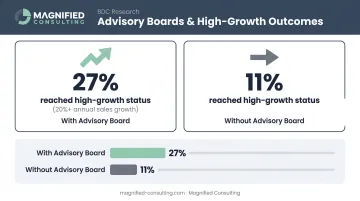
The BDC data frames this as a probability problem: 27% of SMEs with advisory boards reached high-growth status (20%+ annual sales growth) versus 11% of those without boards. For privately owned businesses already operating in competitive markets, that gap in outcome is difficult to close through effort alone.
How to Get the Most Value from Business Advisory Services
Advisory services produce their best results when the business owner treats the relationship as a genuine strategic partnership — not a service to be called upon in a crisis and ignored otherwise.
The conditions under which advisory value compounds:
- Share accurate data — advisors can only address what they can see. Withholding financial reality limits what's possible.
- Set measurable goals — benchmarked outcomes create accountability that open-ended discussions rarely do
- Involve the advisor in major decisions — the highest-value moments often happen before a capital purchase, a hire, or a market move, not after
- Implement recommendations — this is where profitability improvement actually occurs. Advice that goes unimplemented produces no return.
Of course, none of this works if you've selected the wrong advisor. Look for real-world operational experience in industries relevant to your business, a track record of measurable client results, and an approach tailored to your specific business stage — not a generic framework applied uniformly.
Continuity also has compounding value. An advisor who knows your business deeply by year two — your margins, your team, your decision-making patterns — will spot opportunities and risks that someone new to the engagement simply cannot see. At Magnified Consulting, this kind of long-term mentorship is built into every client relationship, not offered as an add-on.
Conclusion
The value of business advisory services ultimately comes down to operational control, financial clarity, and a growth strategy that's built around your actual numbers — not generic benchmarks. Each one moves the profitability needle on its own. Together, they create momentum that builds over time.
These advantages don't peak after a single engagement. The advisory relationship becomes more valuable in year two and three than in year one, as the advisor's understanding of the business deepens and the improvements start reinforcing each other.
For privately owned and family-run businesses in the Carolinas and Southeast, Magnified Consulting's partner-led advisory model is built around exactly this kind of sustained engagement. If you're ready to move from knowing there's a profitability problem to doing something systematic about it, reach out to schedule a consultation and see what a structured advisory relationship looks like in practice.
Frequently Asked Questions
How can I improve profitability in my business?
The three core levers are pricing optimization, cost control, and cash flow management. A business advisor identifies which will have the highest impact for your specific situation, since the right starting point varies by industry, margin structure, and business stage.
Can business advisors increase my business's profitability?
Yes, and the evidence is direct. BDC's research found SMEs with advisory boards had 24% higher sales and 18% higher productivity than comparable firms without them. The improvement is tied to sustained engagement, not a single project or conversation.
How much does a small business advisor cost?
Fees vary by scope and engagement model, ranging from project-based arrangements to ongoing monthly retainers. The more relevant question is ROI: firms with advisory support consistently outperform those without on sales growth, productivity, and survival rates.
What is the difference between business advisory services and consulting?
Advisory services are a continuous strategic partnership where the advisor learns the business over time and provides ongoing guidance as conditions change. Consulting is typically project-based — solving a defined problem with a clear start and end date.
How long does it take to see results from business advisory services?
BDC data shows advisory-board firms grew sales 66.8% in the three years after forming a board, compared to 22.9% in the three years prior. Most operational improvements materialize within six to twelve months, with pricing and cost changes showing results sooner.
What should I look for when choosing a business advisor?
Prioritize real-world experience in your industry, a track record of measurable results, and a customized approach. Advisors who invest in long-term relationships consistently deliver more value than those focused on a single engagement.