Introduction
Many privately owned businesses hit a revenue ceiling not because demand has dried up, but because their operations, systems, and leadership structure were never built to handle more. The owner works longer hours, margins stay flat, and momentum stalls — not from lack of effort, but from lack of infrastructure.
This pattern is more common than most business owners realize. Family businesses account for 54% of U.S. GDP and 59% of employment, yet many of these enterprises operate on informal systems that cap their growth potential. When revenue crosses the $10M mark, those informal systems start breaking under the weight of organizational complexity.
That organizational complexity is precisely where business scalability consulting comes in. A consultant diagnoses what's limiting growth at the $10M threshold and beyond, builds a customized roadmap to remove those constraints, and stays engaged through execution — not just planning.
What follows is a practical breakdown of what scalability means for privately owned businesses, what a consultant actually does, and how to know when it's time to bring in outside expertise.
Key Takeaways
- Scalability means growing revenue without a proportional rise in costs — not just hiring more people or working harder
- Privately owned and family-run businesses face unique barriers: founder-dependent workflows, informal processes, and blended personal-business finances
- A scalability consultant diagnoses bottlenecks, builds a tailored growth roadmap, and guides execution through ongoing mentorship
- Core strategies include documenting SOPs, optimizing capital allocation, and building leadership capacity beyond the owner
- The right time to engage is before a crisis — when revenue plateaus, the owner is stretched thin, or a transition is approaching
What Business Scalability Is — And Why Most Private Business Owners Get It Wrong
Scalability vs. Simple Growth
Scalability is not the same as growth. A 2024 peer-reviewed analysis defines scaling as expanding outputs by transforming internal organization without a corresponding increase in inputs. Growth, by contrast, can simply mean one indicator — revenue, headcount, locations — going up in isolation.
The difference matters more than most owners realize. A business that adds $3M in revenue by adding $2.8M in costs hasn't scaled — it's worked harder for similar margins. True scalability is about operating leverage: the ability to handle more volume without proportionally increasing overhead.
The misconception that revenue growth alone signals business success is what leads owners into a familiar trap:
- Revenue climbs, but profitability stays flat
- Quality deteriorates as the team gets stretched
- The owner becomes more involved in daily operations, not less
- The business feels harder to run at $15M than it did at $8M
Why Privately Owned and Family-Run Businesses Face Unique Scalability Hurdles
Privately owned businesses — especially family-run ones — tend to operate with founder-dependent workflows, undocumented processes, and financial structures that blur personal and business decisions. These aren't character flaws. They're the predictable result of building a business without the formal systems that larger organizations install from day one.
The problem surfaces when revenue crosses into mid-market territory. NCMM defines the U.S. middle market as companies with $10M to $1B in annual revenue — and at that threshold, organizational complexity quickly outpaces what informal management can handle. The systems that got a business to $8M become the obstacles that keep it from reaching $20M.
That professionalization gap shows up in concrete ways. According to PwC's U.S. Family Business Survey, only 39% of U.S. family businesses report having strong digital capabilities — a gap that compounds every other operational bottleneck when a business tries to scale without outside support.
What a Business Scalability Consultant Does
Diagnosing Bottlenecks and Operational Gaps
The first phase of any scalability engagement is diagnostic. A consultant maps current workflows, reviews financial performance, evaluates resource allocation, and identifies where the business is losing time, money, or growth potential.
In privately owned businesses, the most common findings include:
- Owner dependency — major decisions require the owner's direct involvement, creating a bottleneck at the top
- Undocumented processes — critical workflows exist only in people's heads, making consistency and delegation impossible
- Misaligned capital — money deployed where it's comfortable, not where it generates the best return
- Team structures built for yesterday — organizational design that worked at $5M but can't support $20M
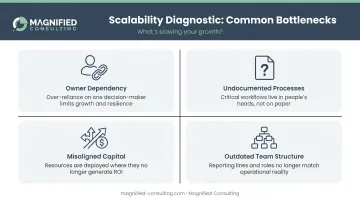
This diagnostic phase isn't generic. The goal is to understand the specific constraints this business faces before recommending anything.
Building a Customized Growth Roadmap
Once the diagnosis is complete, the consultant builds a tailored growth roadmap specific to the client's revenue goals, operational realities, and stage of growth.
A well-constructed roadmap addresses both short-term efficiency wins and long-term value creation. It includes measurable milestones, accountability checkpoints, and strategies calibrated to the client's actual revenue goals, profitability targets, and operational realities.
Magnified Consulting's approach reflects this depth. With involvement in over $1.5 Billion in mergers and acquisitions and advisory work on $300 million in capital purchasing decisions, their team brings transactional expertise that informs how growth strategies are structured — grounded in what actually drives business value across the full lifecycle: scaling, transition, exit, and succession.
Long-Term Mentorship Beyond the Initial Engagement
There's a real difference between a one-time project consultant and an ongoing advisory partner. Businesses that sustain growth need someone who stays engaged through implementation, course corrections, and critical decisions — well past the planning phase.
Magnified Consulting structures client relationships around exactly this. Partners stay involved through day-to-day operational decisions and major inflection points alike, including M&A activity, capital deployment, succession planning, and organizational restructuring.
Key Scalability Strategies a Business Consultant Brings to the Table
Systematizing Operations With SOPs and Process Automation
Documented Standard Operating Procedures (SOPs) do something simple but powerful: they take knowledge out of people's heads and put it into repeatable systems. According to Penn State Extension, well-written SOPs improve communication, reduce training time, and create work consistency — all of which are prerequisites for scaling without proportionally increasing overhead.
When processes are documented, the business can:
- Handle higher volume without the owner's constant involvement
- Onboard new team members faster and more consistently
- Delegate effectively, because expectations are clear
- Identify inefficiencies that were previously invisible
Automation works at the task level — repetitive administrative work, customer onboarding workflows, reporting systems. Freeing up team capacity for high-value work directly improves margins without requiring new hires.
Capital Strategy and Financial Optimization
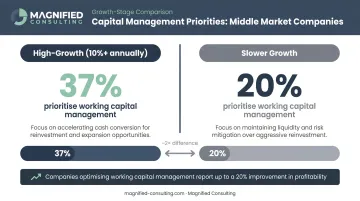
Growth consumes cash. NCMM research found that middle market companies growing revenue 10% or more annually were nearly twice as likely to rank working capital management as their top priority — 37% vs. 20% for slower-growing peers.
A scalability consultant helps owners make smarter capital allocation decisions:
- Where to invest for growth versus where to cut unnecessary costs
- How to structure the business financially to improve profitability
- Cash flow stability during high-growth phases when costs can outpace receivables
- Financial strategy aligned with longer-term goals: exits, ownership transitions, and estate planning
Magnified Consulting's clients have seen a 20% increase in profitability and improved cash flow within the first six months of implementing financial strategies — outcomes driven by deliberate capital alignment, not revenue growth alone.
Building Leadership Capacity and Organizational Structure
Scaling requires the owner to shift from day-to-day operator to strategic leader. That transition rarely happens on its own; it requires deliberate organizational design.
A consultant helps build:
- Clear role definitions with accountability at every level
- A management layer capable of running operations without constant owner input
- Decision-making frameworks that distribute authority appropriately
For privately owned businesses, this is the most transformational shift — and the one most directly tied to long-term value. A business that can operate independently of its owner is worth significantly more, both as a going concern and as an acquisition target.
Common Scalability Challenges for Privately Owned Businesses
Most privately owned businesses encounter three core barriers as they scale:
Quality consistency — maintaining service or product standards as volume increases. Process standardization and quality control frameworks remove the dependency on the owner's personal oversight, so standards hold even when the owner steps back.
Cash flow during growth — costs frequently outpace receivables during high-growth phases. Proactive working capital management and financial modeling help smooth these cycles before they create a crisis.
Team capability gaps — the people and culture that worked at $8M may not be equipped for $25M. Identifying those gaps early — then building the training, hiring, and org structure to address them — prevents a talent ceiling from becoming a growth ceiling.
The founder bottleneck deserves specific attention. When every major decision runs through one person, growth stalls at whatever capacity that person has. An outside consultant brings the structural clarity that's hard to develop when you're running the day-to-day — and can redesign decision flows so the business moves without the owner in every loop.
Industry-specific challenges compound these pressures:
- Construction firms face workforce constraints and cash flow timing issues tied to project billing cycles. The AGC's 2025 Workforce Survey found 88% of construction firms with direct craft labor had difficulty filling positions — a direct ceiling on project capacity.
- Manufacturers deal with capital equipment timing, supply chain discipline, and production capacity planning.
- Professional services firms struggle to systematize expertise that lives inside individual practitioners rather than documented processes.
A consultant with direct industry experience closes the gap between general strategy and what actually works in your specific business model — whether that's construction billing cycles, manufacturing throughput, or billable-hour utilization in professional services.
Signs Your Business Is Ready for Scalability Consulting
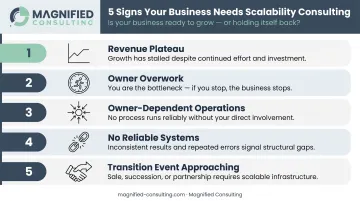
Five concrete signals that it's time to bring in expert help:
- Revenue has plateaued despite strong market demand and a capable team
- The owner is working more hours but not increasing personal earnings — effort is no longer the lever
- The business cannot run for a week without the owner's direct involvement
- No reliable systems exist for hiring, onboarding, or project execution
- A transition event is on the horizon — a potential sale, ownership succession, or equity event
Businesses that build scalable infrastructure before a crisis hits create more enterprise value over time and are better positioned for profitable exits or transitions. Building owner-independent operations is, in practice, a valuation strategy — one that pays off whether you're planning to sell, bring on a partner, or hand the business to the next generation.
Privately owned and family-run businesses across Charlotte, Columbia, South Carolina, Myrtle Beach, Savannah, and Charleston SC face the kind of competitive pressure where structured growth support has a direct, measurable impact.
Magnified Consulting works specifically with businesses generating $10M or more in revenue across Manufacturing, Construction, Retail, Professional Services, Technology, Transportation, and Home Services Businesses — providing industry-specific strategy alongside the long-term mentorship that keeps results in place well after the initial engagement ends.
Frequently Asked Questions
What is the average fee for a business consultant?
Consulting fees vary based on scope, duration, the consultant's depth of experience, and their implementation role. Typical models include hourly rates, project-based pricing, and ongoing retainers. A well-matched consultant generates concrete returns in profitability, efficiency, and cash flow that clearly justify the investment.
What are the 5 C's of consulting?
The five-phase consulting framework includes Clarify, Create, Change, Confirm, and Continue. Each phase moves the engagement forward — from initial diagnosis and strategy development through implementation, outcome validation, and ongoing support.
What does a business scalability consultant actually do?
A scalability consultant diagnoses operational and financial bottlenecks, designs a customized growth roadmap, implements systems that reduce owner dependency, and provides ongoing mentorship so the business can grow sustainably. The goal is to build infrastructure that performs without requiring the owner's constant involvement.
How long does it take to see results from scalability consulting?
Operational improvements often surface within the first six months. Deeper organizational and financial transformations typically take 12 to 18 months to fully take hold.
What industries benefit most from scalability consulting?
Manufacturing, construction, professional services, retail, technology, and transportation all have particularly complex scaling needs. Privately owned and family-run businesses in these sectors — especially those crossing the $10M revenue threshold — stand to gain the most from structured, expert-led growth strategies.
When is the right time to hire a business growth consultant?
The best time is before a growth crisis. If revenue is plateauing, the owner is stretched beyond capacity, quality is slipping under increased demand, or the business is approaching a sale or leadership transition, structured outside guidance and scalable systems should be your next move.