
The default answer for many privately owned B2B companies is cost-plus: add up the costs, apply a margin, call it a price. It's familiar, defensible internally, and easy to explain to the sales team. It's also one of the least profitable ways to price a differentiated product or service.
Pricing is the single highest-leverage variable in a business's P&L. A small improvement in realized price produces a disproportionate gain in operating profit — far greater than the same percentage improvement in volume or cost reduction. Yet most privately owned B2B businesses treat pricing as a back-office calculation rather than a strategic decision.
This guide covers the three core B2B pricing strategies, the structural mistakes that quietly erode margins, and what effective pricing strategy consulting actually looks like in practice.
Key Takeaways
- A 1% improvement in price yields an 8.7% increase in operating profit for the average B2B company — more than any other business lever
- Cost-based, market-based, and value-based pricing each suit different situations; high-performing B2B companies use all three
- The most damaging pricing mistakes are structural habits — inconsistent discounting, fear-based underpricing, one-size-fits-all rates — not isolated bad decisions
- Effective pricing consulting produces a framework the business can use and adjust over time, not a one-time report
Why B2B Pricing Strategy Matters More Than Most Business Owners Realize
The Numbers Most Owners Don't Know
B2B pricing research puts it plainly: for the average B2B company, a 1% price increase translates into an 8.7% increase in operating profits, assuming no volume loss. Systematic pricing programs typically deliver a 2 to 7 percentage-point return-on-sales uplift.
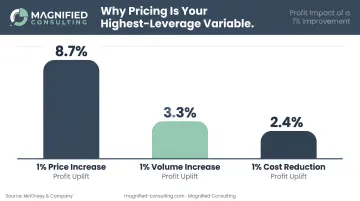
Compare that to the effort required to cut costs by 1% or grow volume by 1%. Pricing wins by a wide margin.
Yet a 2018 HBR survey of 1,700 companies found that only 15% of B2B firms use value-based pricing. The rest rely primarily on cost-based or competition-based approaches — familiar methods, but rarely optimal ones.
Why Cost-Plus Creates a Profitability Ceiling
Cost-plus pricing isn't wrong. It protects margins and gives the sales team a number they can justify. The problem is what it ignores: the value the customer receives, the alternatives they're evaluating, and what they'd actually be willing to pay.
Consider a contractor who prices every job at cost plus 20%. They'll earn the same margin on a routine residential project and a specialized, time-critical industrial repair — even though the customer's willingness to pay differs sharply between the two. The routine job is priced fine. The specialized job is almost certainly underpriced.
That gap between what you charge and what customers would pay is profit left on the table with every invoice.
The Compounding Cost of No Pricing Strategy
When pricing isn't deliberate, problems compound quietly:
- Inconsistent discounting — Sales teams negotiate deals individually, gradually eroding list prices until the discount becomes the real price
- Commoditization by default — When you compete on price instead of value, customers start treating your offering as a commodity — even if it isn't
- Margin compression over time — Each year of undisciplined pricing makes the next year harder to recover from
None of these show up as a single bad quarter. They show up as a business that works harder every year for thinner returns.
The Three Core B2B Pricing Strategies (and When to Use Each)
There is no universally correct B2B pricing strategy. The right approach depends on your competitive position, cost structure, customer segments, and what you're trying to achieve. Most high-performing B2B companies blend all three approaches described below.
Cost-Based Pricing
Calculate the total cost to deliver a product or service, then add a target margin. Simple, defensible, and easy for the sales team to apply without much training.
Its limitation: it prices based on your internal economics, not on what the customer values or what the market will bear. A specialty fabricator who prices complex custom work the same way they price commodity runs is almost certainly leaving margin behind on the high-value jobs.
Market-Based Pricing
Set prices relative to competitors. This works well in genuinely commoditized markets where products are interchangeable and customers actively compare quotes.
The hidden problem: competitive benchmarking usually captures list prices, not net prices. Price waterfall analysis shows that revenue leakage from invoice to actual pocket price can reach 17.7% in commodity chemicals and 28.9% in lighting products after discounts, rebates, freight, and other adjustments. If you're benchmarking against competitors' published rates, you may be benchmarking against a fiction.
Value-Based Pricing
Price based on the measurable economic value your product or service delivers to the customer. This is the most profitable approach for differentiated offerings. It captures what cost-plus leaves behind and grounds the conversation in outcomes rather than rates.
A practical example: A professional services firm that demonstrably reduces a client's operational costs by 20% has real, quantifiable value to price against. If that efficiency gain saves the client $500,000 per year, pricing the engagement at a premium is rational and defensible — as long as you can show the math.
Value-based pricing requires knowing your customer segments well, understanding what specific outcomes they care about, and being able to quantify the alternatives they're weighing.
Choosing the Right Blend
A sound B2B pricing strategy uses all three:
| Pricing Type | Role in the Strategy |
|---|---|
| Cost-based | Floor — protects margins on every deal |
| Market-based | Reference — keeps prices competitive in the market |
| Value-based | Ceiling — captures full worth of differentiated work |
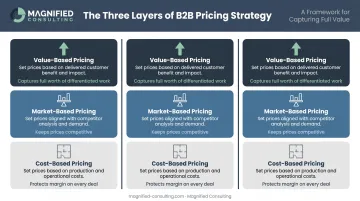
A manufacturing company, for example, might use cost-plus for standard product runs, market-based pricing for catalog items, and value-based pricing for custom engineering work where lead time or expertise sets them apart. The same company, three different approaches — each applied where it fits best.
The Most Common Pricing Mistakes B2B Businesses Make
The most damaging pricing mistakes aren't dramatic missteps. They're structural habits that erode margin slowly enough that no single quarter looks catastrophic. Read through these as a diagnostic — most business owners will recognize at least one.
Treating Discounting as a Sales Tool
Discounting to close a deal feels harmless in the moment. The problem is what happens over time: discounts become the default, list prices become negotiating theater, and customers learn to wait for the discount before committing.
Industry research shows that in most B2B industries, discounts represent the company's largest marketing investment, often amounting to 30% or more of list-price sales. A Professional Pricing Society case study of a manufacturer found cumulative discounts of 27.4% from list price against a 17.9% policy expectation — a 9.5 percentage-point leakage gap that was largely invisible until analyzed.
Without discount governance, the sales team negotiates margin away one deal at a time, and the pattern only becomes visible in aggregate.
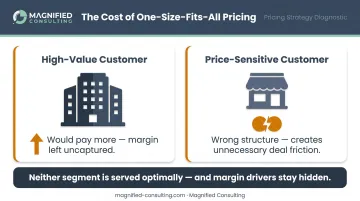
Pricing All Customers the Same
Not all customers derive equal value from what you sell. A construction supplier serving a small local contractor and a large regional general contractor has very different pricing leverage in each relationship — different volumes, different urgency, different alternatives, different switching costs.
Uniform pricing consistently underperforms across both ends of your customer base:
- Leaves money on the table with high-value customers who would pay more
- Creates friction with price-sensitive customers who need a different structure
- Obscures which segments are actually driving margin
Segmenting pricing by customer type, volume tier, or use case is one of the highest-ROI changes a B2B business can make.
Underpricing Out of Anxiety
In professional services, construction, and consulting, pricing too low doesn't just hurt margins — it actively undermines perceived quality. When services are hard to evaluate before purchase, buyers use price as a proxy for capability. A firm that prices well below its competitors signals lower confidence in its own outcomes.
This is fear-based underpricing: setting prices low out of anxiety about losing the deal rather than out of strategic logic. The customers it attracts tend to be the most price-sensitive, the most demanding, and the least profitable.
Separating Pricing from Business Strategy
Those customer-facing problems often trace back to an internal one: pricing that isn't owned strategically. When pricing decisions live in finance or sales rather than being treated as a cross-functional priority, they pull in different directions. Sales wants lower prices to win volume. Finance wants higher margins. Marketing wants competitive positioning.
Without alignment, every deal becomes a negotiation between internal stakeholders before it ever reaches the customer.
This cross-functional misalignment is one of the most common and costly pricing failures in privately owned B2B businesses. The fix isn't a new pricing model — it's treating pricing as a strategic decision with the same rigor applied to hiring, capital allocation, or market expansion.
What Effective Pricing Strategy Consulting Actually Delivers
An Outside View Without Internal Assumptions
The core value of an experienced pricing consultant is perspective that isn't anchored to how things have always been done internally. Most pricing problems persist not because owners can't see them — but because the people closest to the business have normalized them.
An effective consultant brings a structured process to identify three things:
- Where pricing is working
- Where it's leaking margin
- Where it's leaving value uncaptured
This is different from a general business audit. The focus is specifically on the relationship between price, value, and business outcomes.
What a Real Engagement Looks Like
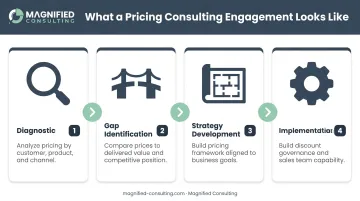
A well-structured pricing engagement typically moves through these phases:
- Diagnostic: Analyze current pricing by customer, product line, and channel. Map the gap between list prices and what customers actually pay after discounts and adjustments
- Gap identification — Compare prices to delivered value and competitive position. Where is the business undercharging? Where is it giving margin away unnecessarily?
- Strategy development: Build a pricing framework aligned with the business's specific goals, whether that's protecting margins, winning new segments, or moving upmarket
- Implementation — Help the sales team understand and apply the new approach. Build discount governance. Establish the internal disciplines needed to hold the strategy
The deliverable is a framework the business can use and adjust — not a recommendation that sits in a drawer.
That's the approach we take at Magnified Consulting with privately owned and family-run businesses generating $10M+ in revenue. Our engagements are built around lasting capability — not one-time deliverables — with ongoing mentorship that continues after the initial work is done. Our partners bring decades of hands-on experience across manufacturing, professional services, construction, and related industries, so the pricing challenges we address reflect how these businesses actually operate.
Why Implementation Is the Hard Part
A pricing strategy that lives in a document but never changes how deals are quoted is a failed engagement. The organizational barriers — sales teams resistant to holding price, finance and sales teams misaligned, managers without visibility into discount patterns — are where most pricing strategies stall.
Effective consulting addresses those barriers directly: building sales confidence around price justification, establishing governance around discounts, and measuring outcomes over time.
How to Find the Right Pricing Strategy Approach for Your Business
Start With an Honest Audit
Before evaluating any consulting engagement, a B2B business owner should answer a few diagnostic questions:
- What method is actually driving prices today — cost-plus, gut feel, or something more deliberate?
- Where is discounting happening, and does anyone have visibility into the cumulative pattern?
- Are prices consistent across similar customers, or does every deal become its own negotiation?
- When did the business last formally review whether its pricing still reflects the value it delivers?
If the honest answer to most of these is "we don't really know," that's the finding. The business doesn't have a pricing strategy. It has pricing habits.
Questions to Ask When Evaluating a Pricing Consultant
Not all consulting engagements produce lasting results. These questions separate firms that deliver real change from those that deliver a polished presentation:
- Do they understand your specific industry, or are they applying a generic framework?
- Will they stay engaged through implementation, or hand off a document and leave?
- Can they point to measurable outcomes — margin improvement, deal size growth, discount reduction — not just deliverables?
- Do they work with businesses at your revenue level and stage?
A firm that checks those boxes is worth a closer look. Magnified Consulting works specifically with privately owned and family-run B2B businesses generating $10M+ in revenue, serving clients across Charlotte, Columbia, South Carolina, Myrtle Beach, Savannah, and the broader Southeast. Their work spans cost structure analysis, market positioning, and strategic planning — with a track record that includes advising on $300 million in capital purchasing decisions and involvement in over $1.5 Billion in mergers and acquisitions.
Frequently Asked Questions
What is B2B pricing strategy consulting?
B2B pricing strategy consulting is a structured engagement where an external expert analyzes your current pricing, identifies gaps between price and value delivered, and builds a strategy to improve profitability. This includes how prices are set, how they vary by customer or product line, and how they tie to broader business goals.
What is the difference between cost-based and value-based pricing for B2B businesses?
Cost-based pricing sets prices by adding a margin to internal costs; value-based pricing sets prices based on the economic outcomes the customer receives. Value-based pricing captures more margin on differentiated products and services, while cost-based pricing is simpler but routinely leaves money on the table.
How do I know if my B2B business needs a pricing strategy consultant?
Common warning signs: inconsistent discounting across the sales team, prices that haven't been formally reviewed in years, difficulty winning deals without competing on price, or a persistent sense that the business is undercharging for high-value work. Any of these suggests pricing isn't functioning as a strategic tool.
How long does it take to see results from a new B2B pricing strategy?
Quick wins — reducing unnecessary discounting, adjusting prices for specific segments — can show results within weeks or months. Broader strategic shifts take longer to work through the customer base.
What's the difference between B2B and B2C pricing strategies?
B2B pricing typically involves negotiated contracts, longer sales cycles, volume-based structures, and multi-stakeholder buying decisions. That complexity means strategy must account for relationship dynamics, contract terms, and how value differs across customer types. B2C pricing is generally more standardized and transaction-oriented.
How do pricing strategy consultants measure success?
Key metrics include gross margin improvement, reduction in average discount depth, deal size growth in high-value segments, and overall profitability gains. A well-structured engagement will define these targets upfront so progress is trackable from the start.