Introduction
You can build a straight wall, manage a crew through a tight deadline, and deliver quality work that keeps clients calling back. But somewhere between $1M and $5M in revenue, the business stops growing — not because the work dried up, but because the same instincts that built it are now holding it back.
Most construction owners are running estimating, sales, project management, and accounts receivable simultaneously. Being busy isn't the problem. Without the right financial visibility and operational structure, more revenue just means more complexity with the same thin margins.
According to SCORE's 2024 small business research, only 50.6% of small businesses survive five years. Construction companies that do survive often find themselves stuck — generating solid revenue but struggling to convert it into real profitability or personal wealth.
That gap between revenue and real profit is exactly where contractor consulting creates traction — from financial structure and estimating accuracy to operational systems that scale without adding chaos.
Key Takeaways
- Revenue ceilings break when operational and financial inefficiencies are tackled together, not in isolation
- Winning higher-margin work matters more than winning more work
- Documented systems, real job costing, and cash-aware scaling separate growing firms from stalled ones
- Sustainable results come from a tailored consulting relationship, not a generic playbook
Why Construction Businesses Hit a Growth Ceiling
The Pattern Is Predictable
A contractor builds a strong reputation through quality work and referrals. Revenue grows to $1M, then $3M, then maybe $5M. Then it flatlines — not from lack of skill, but because the strategies that created early growth won't carry a business to the next level.
At this stage, the owner is typically the business. They're estimating every job, closing every deal, managing every project, and reviewing every invoice. That model works at $500K. At $5M, it's a ceiling.
The Core Culprits Behind Stalled Growth
- Owner dependency — every decision runs through one person, creating a bottleneck on every front
- Reactive pricing — bids are built on gut feel and what the market seems to bear, not true cost data
- No job costing — revenue looks healthy on the surface while individual projects quietly destroy margin
- No formal systems — processes live in the owner's head, making delegation nearly impossible
- Invisible financials — revenue is tracked, but true project profitability isn't
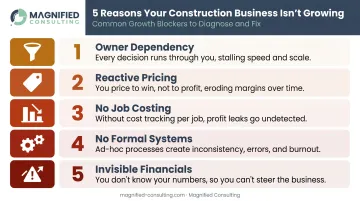
The result: the owner works harder, takes on more projects, and watches margin erode while the business stays stuck.
Working In vs. Working On the Business
Breaking through the ceiling requires stepping back from day-to-day execution to assess the business as a whole — its pricing model, its organizational structure, its financial health. Most owners struggle to see these patterns clearly from inside their own operation. A consultant who has guided other construction businesses through the same inflection points can identify what's broken, prioritize what to fix first, and build the structure to support the next level of growth.
Key Growth Areas Every Contractor Must Address
Winning the Right Work
Not all revenue is created equal. A $3M year with 18% gross margins beats a $5M year at 8% — and leaves more cash in the business. The starting point is pulling your last 12 months of project data and identifying which jobs were actually profitable, not just which ones felt successful.
From that review, define your ideal project profile: project type, typical size range, client profile, geographic scope, and decision-maker. Then commit to pursuing more of those and walking away from the ones that look good on a proposal but drain your team.
FMI's project selection research is clear on this point: the most discerning contractors when it comes to project selectivity are consistently the most profitable — and a single bad project can wipe out an entire year's results.
Building a real sales pipeline means:
- Moving beyond "people who might call" to a structured follow-up cadence
- Setting a target bid volume based on your desired revenue (work backwards from profit goal to required win rate to bid count)
- Tracking bid-to-win rates by project type so you know where your time is best spent
- Qualifying leads against your ideal project profile before investing estimating hours
Protecting and Improving Margins
Margin doesn't disappear all at once. It leaks slowly — through labor overruns that go unnoticed, scope creep that never gets priced, and estimates that don't reflect actual field conditions.
FMI's 2023 Labor Productivity Study found that 60% of construction respondents waste more than 11% of field labor costs due to poor productivity. Equally striking: a 6% improvement in labor productivity can produce a 50% average increase in profitability for contractors.
That ratio makes more sense when you see the baseline — FMI reports the average operating margin for self-performing contractors sits at roughly 4%. There isn't much room for error.
The three biggest margin killers to address:
- Inaccurate estimating — bids built without reviewing actual historical costs on similar projects
- Undocumented change orders — scope changes absorbed informally, with no pricing or written approval
- Untracked labor overruns — comparing estimated vs. actual hours only after project closeout, when it's too late to course-correct
Real-time job costing addresses all three. Comparing estimated costs against actuals mid-project lets you catch overruns while there's still time to act. A disciplined change order process — documented in writing, priced, and client-approved before work begins — turns scope creep from a margin drain into additional revenue.
HKA's 2025 construction claims analysis identifies "change in scope" as one of the leading causes of construction disputes — a significant risk exposure that a disciplined change order process eliminates before it becomes a legal problem.
Building Operational Systems That Scale
A business that runs on the owner's memory has a hard ceiling on growth. Without documented systems, delegation stalls and quality depends entirely on who's in the room.
Documenting key processes allows you to delegate, maintain quality without being present, and scale beyond your personal capacity. Start with the highest-frequency, highest-stakes workflows:
- Estimating and bid review
- Project kickoff and handoff
- Client communication protocols
- Change order documentation
- Punch list and closeout procedures
On the technology side, Dodge Construction Network's 2025 research found that 77% of optimized project management software adopters experienced increased profit margins and productivity gains. The word "optimized" matters here — the benefit comes from mature, committed adoption, not from buying a platform and underusing it.
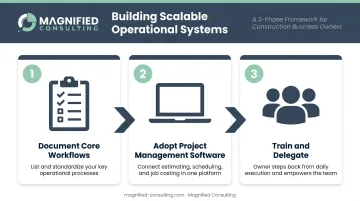
Construction management software that connects estimating, scheduling, job costing, and client communication in one place reduces errors and gives leadership real data to act on. The platform is just the tool — the discipline behind it is what moves the numbers.
How Expert Contractor Consulting Accelerates Growth
What a Contractor Business Consultant Actually Does
A contractor business consultant doesn't show up with a generic playbook. They assess your full operation — financials, sales pipeline, project profitability, team structure, and operational workflows — then identify the highest-leverage gaps between where you are and where you could be. The output isn't a thick report that sits on a shelf. It's a prioritized action plan tailored to your specific business at its specific stage of growth.
The value of an outside perspective is hard to overstate. A consultant working across dozens of construction businesses spots patterns the owner can no longer see — because those patterns became invisible through familiarity. Profit leaks get normalized. Pricing assumptions go untested. Organizational structures that worked at $2M end up strangling growth at $8M.
What to Expect From a Quality Engagement
Results tend to follow a predictable timeline:
- 60–90 days: Early wins appear — margin leaks identified, key processes improved, change order workflows tightened
- 6–12 months: More substantial gains take hold, including improved profitability, reduced operational costs, and a scalable team structure
Magnified Consulting works with privately owned and family-run construction businesses generating $10M or more in revenue, serving clients across Charlotte, Columbia, South Carolina, and the broader Southeast. Their team brings real-world transaction and capital experience, including involvement in over $1.5 Billion in M&A transactions and advisory on $300 million in capital purchasing decisions.
That background directly applies to the high-stakes decisions construction owners face: equipment acquisitions, geographic expansion, ownership transitions, and long-term value building.
What separates a one-time engagement from an ongoing advisory relationship is accountability. Strategy without implementation support stalls. The most impactful consulting relationships include regular check-ins tied to measurable milestones, guidance through day-to-day decisions, and support through major transitions, not a single deliverable and a handshake.
Building Financial Strength and Sustainable Profitability
Know Your Numbers Cold
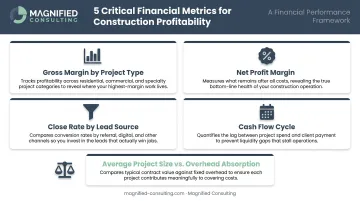
Revenue is the most visible number in most construction businesses — and often the least useful one. The metrics that actually tell you whether you're building a profitable company are:
- Gross margin by project type — which work generates the best return on effort
- Net profit margin — what's left after all costs, overhead, and owner compensation
- Close rate by lead source — where your best opportunities actually come from
- Cash flow cycle — how long between spending and collecting on a typical project
- Average project size vs. overhead absorption — whether your project mix supports your cost structure
CFMA's 2024 benchmarker data shows that best-in-class construction companies achieved a 21.8% gross profit margin — a useful benchmark for knowing where you stand against high performers in the industry.
Once you know where your margins actually come from, capital decisions get easier to evaluate — and easier to defend.
Capital Strategy as a Growth Lever
Poorly timed capital decisions are one of the fastest ways to drain a growing construction business. Equipment purchases, fleet expansions, and technology investments can all make strategic sense — but only when the timing aligns with cash flow and the investment is tied to a clear revenue or efficiency return.
CFMA notes that as construction companies grow, multiple active contracts can require significant upfront funding before billing and collections catch up. That working capital pressure can make a profitable business feel cash-strapped. Working with an advisor who has navigated these trade-offs — Magnified Consulting's partners have advised on over $300 million in large capital purchasing decisions — means those calls are grounded in real financial modeling, not instinct alone.
That capital discipline connects directly to the other challenge most construction owners feel every year: inconsistent cash flow.
Cash Flow and Long-Term Value
The feast-or-famine cycle is structural in construction. Project-based billing creates long gaps between spending and collecting, and most contractors don't have a financial buffer built before they need it.
Practical steps to stabilize cash flow:
- Negotiate more favorable payment schedules upfront (milestone-based billing vs. end-of-project)
- Build a line of credit before you need it — not during a cash crunch
- Review supplier payment terms regularly, especially with volume purchasing leverage
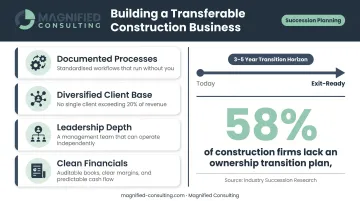
For family-owned construction businesses, the business is often the owner's largest personal asset. FMI's 2024 ownership transfer study found that 58% of construction respondents lack an ownership transition plan, and nearly half of owners planning to exit within 3–5 years have no formal plan in place. Documented processes, a diversified client base, leadership depth, and clean financials don't just support growth — they're what a buyer or successor actually pays for. Building those systems now protects the asset you've spent years creating.
Creating a Growth Plan That Actually Sticks
Start With Real Data
Before any strategy, pull 12 months of actual business data:
- Total revenue and gross margin by project type
- Close rate and average job size
- Top lead sources by volume and quality
- Key overhead costs as a percentage of revenue
- Cash flow timing on representative projects
Identify the two or three areas with the largest gap between current performance and realistic potential. That gap — not a generic list of best practices — is where your growth plan should start.
The Quarterly Review Rhythm
For each initiative, build in three disciplines:
- Set specific, measurable targets before the quarter begins
- Block time monthly to assess progress against those targets
- Share the scorecard with key team members so growth becomes a shared objective, not something the owner carries alone
The goal isn't to work through a checklist. It's to build a business that grows profitably, runs without being dependent on any single person, and builds lasting personal wealth — not just annual revenue that's exhausting to produce.
Magnified Consulting works directly with construction businesses to build and execute this kind of plan — drawing on experience that spans $1.5 Billion in M&A transactions and hands-on advisory work with contractors generating $10M+ in revenue. That outside perspective accelerates the process and keeps the plan grounded in what actually moves the numbers.
Frequently Asked Questions
What does a business growth consultant do?
A business growth consultant assesses your operations, financials, and strategy to identify gaps and high-impact opportunities, then builds a customized plan to improve profitability and drive sustainable growth. Unlike a generalist advisor, a good consultant connects their recommendations directly to measurable financial outcomes.
What are the 4 business growth strategies?
The four core growth strategies are market penetration, market development, service development, and diversification. A consultant helps you identify which combination fits your business stage, market position, and available resources.
How does consulting help with owner dependency in a construction business?
When the owner is involved in every major decision, growth stalls. A consultant helps you build the systems, processes, and team structure needed to delegate effectively — so the business can scale without everything running through you.
How do I know if my construction business needs a consultant?
Common signals: revenue has plateaued despite being consistently busy, margins are thin or inconsistent across projects, the owner is still involved in every major decision, or the business lacks the systems needed to grow without adding chaos. Any one of these is a strong indicator that outside perspective will create value.
How long does it take to see results from contractor consulting?
Early wins — margin leaks identified, key processes tightened, change order discipline improved — often appear within 60–90 days. Larger shifts in net profitability and team structure typically develop over 6–12 months of consistent implementation.
What should I look for when hiring a construction business consultant?
Prioritize real-world business experience over academic frameworks, a discovery-first process before any solutions are prescribed, and a commitment to staying engaged through implementation. A consultant who disappears after delivering a report won't move your business forward.