Against this backdrop, hospitality consulting has moved from a luxury to a necessity. Not the vague, strategy-deck variety — the kind that produces measurable outcomes: leaner cost structures, stronger margins, and businesses built to last through market cycles.
This article breaks down what hospitality consulting actually delivers, where its impact is most visible, and why privately-owned and family-run operations stand to gain the most from the right advisory partnership.
Key Takeaways
- Hospitality businesses face structurally thin margins — operational discipline separates profitable operators from struggling ones
- Consultants spot cost inefficiencies that internal teams, buried in daily operations, routinely miss
- Revenue optimization depends on pricing discipline, sales mix management, and protecting margins
- Strategic readiness directly shapes the financial outcome of any future business transition
- Long-term mentorship compounds results — one-time diagnostics rarely do
What Is Hospitality Consulting?
Hospitality consulting is specialized advisory support that helps hotels, restaurants, bars, resorts, and similar operators improve financial performance, operational efficiency, and long-term strategic direction.
It applies at every stage of business growth, covering a wide range of operator types and challenges:
- Early-stage operators building unit economics and cost structures
- Established single-location businesses improving margins and staffing efficiency
- Multi-location groups preparing for expansion or franchising
- Ownership groups planning a sale, transition, or exit
The consultant's role is to bring outside perspective and industry expertise directly into the operator's decision-making process — converting observations into actions that improve profitability, reduce inefficiency, and position the business for growth, exit, or expansion.
Key Advantages of Hiring a Hospitality Consultant
The advantages below are grounded in operational and financial impact — the kind that shows up in cost structures, profit margins, and business value. They're most visible when consulting is applied consistently, with outcomes reviewed against clear benchmarks and insights acted upon.
Operational Efficiency & Cost Reduction
Operational inefficiency in hospitality rarely announces itself. It accumulates quietly — in redundant labor schedules, inconsistent service execution, unclear accountability across departments, and vendor contracts that haven't been renegotiated in years. By the time owners notice the margin compression, it's usually been building for a long time.
A consultant creates value here through an objective operational audit: assessing staffing models, supply chain practices, workflow design, and day-to-day execution to identify where waste is hiding — then redesigning processes to eliminate it without degrading the guest experience.
Why this matters more than most operators realize:
Internal teams are too embedded in daily operations to see these patterns clearly. An outside consultant brings the distance needed to spot the blind spots — and to quantify what they're actually costing the business.
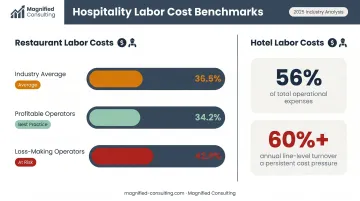
The data makes the stakes clear. Full-service restaurant labor costs averaged 36.5% of sales in 2024 — but profitable operators averaged 34.2%, while loss-making operators averaged 42.9%. That gap reflects scheduling discipline, role-level accountability, and consistent SOPs that high-performing operators build deliberately.
In hotels, labor accounts for 56% of total operational expenses — making it the single largest cost lever available.
Staff turnover compounds the problem. Cornell research found lodging line-level employee turnover averaged over 60% annually — with replacement costs highest for independent properties, high-occupancy operations, and complex roles. Consulting that addresses retention, onboarding structure, and process documentation pays returns far beyond a single hiring cycle.
KPIs most affected:
- Labor cost as a percentage of revenue
- Prime cost (food/beverage + labor)
- Staff turnover rate
- Food and beverage cost ratios
- Table/room turnover efficiency
When it matters most: This advantage is highest-impact for hospitality businesses experiencing declining margins despite stable or growing revenue — a reliable signal that operational inefficiency, not demand, is the actual problem.
Revenue Optimization & Profitability Growth
Revenue optimization in hospitality is frequently misunderstood. It's not about running promotions or chasing covers. It's about building a disciplined approach to pricing, capacity utilization, sales mix, and revenue stream diversification — one that protects margin at every decision point.
A consultant creates this advantage by analyzing where the business is leaving money on the table: underpriced offerings, underperforming dayparts, menu items that generate traffic but not profit, or distribution channels that dilute rather than build revenue quality.
Where the real margin opportunity lives:
Many hospitality owners focus heavily on top-line revenue without fully understanding which products, services, or time periods actually drive bottom-line margin. A consultant reframes every revenue decision around profitability, not just volume.
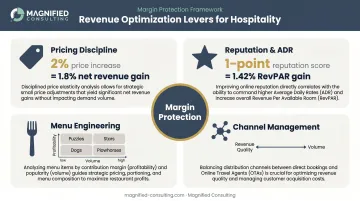
The evidence supports this approach. A 2020 restaurant pricing study found that a 2% increase in average entrée price produced a 1.8% increase in annual net revenue — approximately $28,800 per outlet studied. That's disciplined pricing applied systematically, not a dramatic change in value proposition.
For hotels, Cornell-linked research found that a 1-point improvement in online reputation score was associated with ADR gains of 0.89%, occupancy improvements of 0.54%, and RevPAR gains of 1.42% — reinforcing that pricing power is connected to service quality, not just rate strategy.
Menu engineering applies the same logic to restaurant operators: categorizing items by profitability and sales volume, then adjusting menu design, positioning, and pricing to shift the mix toward higher-margin outcomes.
KPIs most affected:
- Gross profit margin
- RevPAR (hotels)
- Average check/spend per cover (restaurants)
- Food and beverage contribution margins
- Overall EBITDA
When it matters most: This is especially relevant for businesses whose revenue has plateaued or whose profits are not growing proportionally with sales volume — typically a pricing or cost-structure issue that a structured analysis can quickly diagnose.
Strategic Planning & Business Transition Readiness
This advantage addresses the long game. A hospitality business that performs well today but has no formal strategic structure is vulnerable — to market shifts, ownership changes, and transition events that arrive faster than expected.
Restaurant M&A volume increased 42.9% year over year in early 2026, according to Capstone Partners. European hotel transaction volume reached EUR 22.6 billion in 2025 — the highest level since 2019. Transactions are happening at scale. The question is whether individual operators are positioned to participate on favorable terms or to be reactive when the moment arrives.
The value gap most independently-owned operators don't see:
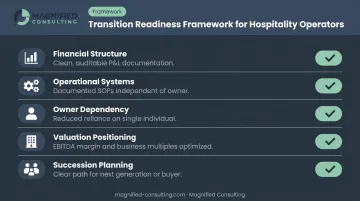
Family-run and independently-owned hospitality businesses often carry significant hidden value that isn't being captured or communicated. Operational systems that exist only in the owner's head, inconsistent financial documentation, and high owner dependency all suppress valuation — even when the underlying business is strong.
Consultants with M&A experience, like the partners at Magnified Consulting who have been involved in over $1.5 Billion in mergers and acquisitions, can identify and build that value systematically. The work involves aligning financial structure, documenting operational systems, reducing owner dependency, and positioning the business so that its value is legible to potential buyers, investors, or successors.
For family-owned hospitality businesses specifically, transition readiness intersects with succession planning. Whether the goal is passing the business to the next generation, bringing in a partner, or preparing for a clean exit, the quality of strategic preparation directly determines the financial outcome.
KPIs most affected:
- Business valuation multiples
- EBITDA margin
- Owner-dependency risk score
- Documented operational systems
- Cash flow predictability
When it matters most: This advantage is critical for business owners approaching any transition milestone — selling, expanding, transferring to family members, or planning retirement. The earlier the preparation begins, the more value can be built deliberately rather than discovered reactively.
What Happens When Hospitality Consulting Is Overlooked
Hospitality businesses that operate without structured advisory support don't always fail immediately. They often plateau, absorb costs they can't diagnose, and find themselves unable to grow or exit on their own terms. These aren't random outcomes — they follow predictable patterns.
The most common patterns:
- Rising operational costs compress margins year over year, but root causes — scheduling inefficiency, food cost drift, vendor pricing — go unaddressed without an objective outside assessment
- Problems get addressed after they become crises, not before; the business is permanently in firefighting mode rather than operating from data
- Guest experience varies by shift, manager, or season when there are no formalized SOPs or accountability structures, quietly eroding reputation
- Operations built around the owner's daily presence can't delegate, can't open additional locations, and can't run without them
- Owners who exit without strategic preparation routinely leave significant money on the table — the business sells for what it appears to be worth, not what it could be positioned to command
Research by Parsa et al. on independent restaurant failure found 26.16% first-year failure rates and 61.4% three-year ownership turnover among independent operators. That data is older, but the underlying dynamic — independent operators carrying compounding risk without structured management support — holds up against current margin data from the NRA and CBRE.
How to Get the Most Value from a Hospitality Consultant
Consulting delivers the strongest results when it's treated as an ongoing structured partnership. The impact compounds when insights are acted upon consistently and performance is reviewed regularly against clear benchmarks.
The conditions under which consulting works best:
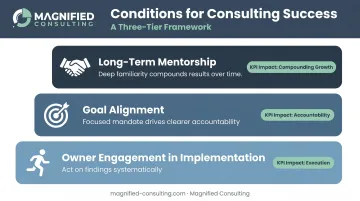
- Owner engagement in implementation — receiving a report and filing it produces nothing; acting on the findings systematically is what drives results
- Alignment to specific goals — engagements focused on cost reduction, revenue growth, or transition planning outperform vague "improvement" mandates because accountability is clearer
- Long-term mentorship over transactional advice — the most impactful consulting relationships develop deep familiarity with the business over time, enabling better decisions at every stage
Selecting the right consulting partner hinges on this distinction. Magnified Consulting structures its engagements around ongoing mentorship and strategies tailored to each business — not a report handed off after an initial assessment. The relationship evolves with the business, providing guidance through both routine operational decisions and high-stakes moments like capital allocation and ownership transitions.
Before entering a consulting engagement, define:
- The specific problem to be solved
- The timeframe within which results are expected
- The metrics by which success will be measured
Clear answers to these questions hold both parties accountable — and give the engagement a defined target to measure against from day one.
Conclusion
Hospitality consulting shows up where it counts: labor cost percentages, profit margins, pricing discipline, and the valuation multiple a business commands at transition. Operational efficiency, revenue optimization, and strategic readiness build on each other — and the longer consulting is applied consistently, the stronger those returns become.
The businesses that benefit most aren't necessarily struggling. Many of the highest-value engagements happen with operators who recognize that their margins could be stronger, their systems could be more scalable, and their transition readiness could be far better than it currently is.
For privately owned and family-run hospitality businesses in particular, working with an experienced consulting partner like Magnified Consulting delivers a concrete edge. With a proven M&A track record, tailored strategies, and a genuine commitment to long-term mentorship, Magnified Consulting helps operators move beyond surviving market pressure — and start building lasting, sellable value.
Frequently Asked Questions
What does a hospitality profitability consultant do?
A hospitality profitability consultant analyzes financial performance, operational workflows, and revenue structures to identify inefficiencies and build strategies that improve margins and reduce costs. The work typically spans labor analysis, pricing optimization, and operational redesign — all tied to measurable bottom-line outcomes.
How much do hospitality consultants charge?
Fees vary based on scope, engagement length, and the consultant's experience — ranging from project-based arrangements to ongoing advisory partnerships. Evaluate the cost against concrete returns — cost savings, margin improvement, and revenue growth — rather than as a fixed overhead line item.
Is hospitality consulting only for struggling businesses?
No. Consulting is equally valuable for high-performing businesses that want to scale, prepare for a transition, or build more disciplined financial and operational systems. Many operators engage consultants proactively to stay ahead of inefficiencies rather than waiting for a crisis to force the conversation.
How long does a hospitality consulting engagement typically last?
Engagements range from short diagnostic projects to multi-year advisory partnerships, depending on the business's goals. Longer-term relationships tend to deliver stronger outcomes — the consultant builds deep familiarity with the business and can guide decisions across multiple planning cycles.
What should I look for when choosing a hospitality consultant?
Prioritize real-world industry experience, a track record of measurable results, a tailored approach (not templated), and a commitment to long-term mentorship rather than short-term fixes. A consultant who asks about your personal goals — not just your operational metrics — is the stronger partner.
How can a hospitality consultant help a family-owned or privately-run business specifically?
Family-owned businesses benefit most from consultants who understand privately-held dynamics — succession planning, equity building, and transition readiness — alongside operational improvement. Business decisions in a family context require both strategic expertise and an unbiased outside perspective.