Introduction
Many business owners hit a frustrating ceiling: revenue keeps climbing, but profits stay flat or shrink. The cause is rarely weak sales. It's margin erosion hiding in plain sight — underpriced services, bloated vendor contracts, slow-paying customers, and cost structures that have outgrown the controls meant to manage them.
This is where profit improvement consulting differs from general business coaching. Rather than broad strategic advice, it zeros in on the specific financial levers suppressing your bottom line: pricing gaps, cost inefficiencies, cash flow bottlenecks, and revenue mix problems.
The Federal Reserve's 2025 Small Business Credit Survey found that 75% of employer firms cited rising costs as a financial challenge, while 51% struggled with uneven cash flows — making targeted profit improvement more urgent than ever.
This article covers five concrete wins that profit improvement consulting delivers for privately-owned businesses, and what to look for when choosing a consultant who can deliver measurable results.
Key Takeaways
- Profit improvement consulting targets revenue leaks, pricing gaps, and cost drivers — not broad strategy frameworks
- A structured profit audit is often the fastest first step to finding where money is silently disappearing
- Pricing optimization tends to deliver the fastest margin gains of any single consulting focus area
- Operational cost reduction and cash flow improvement compound each other to free capital for growth
- The right consultant delivers measurable results within months and stays engaged through implementation, not just the planning phase
What Is Profit Improvement Consulting (and Why Small Businesses Need It)
Profit improvement consulting is a specialized discipline focused on diagnosing and correcting the specific factors suppressing net profit — not strategy in the abstract, but the concrete numbers on your P&L.
Revenue minus Costs equals Profit. A profit improvement consultant works both sides simultaneously, finding ways to grow revenue and reduce costs so the gains compound rather than cancel each other out.
Why $10M+ Businesses Are Particularly Vulnerable
Businesses past $10M in revenue face a specific risk: they've outgrown the informal financial controls that worked at $2M, but haven't yet built the infrastructure larger enterprises rely on, including dedicated CFO functions, systematic cost tracking, and pricing governance.
The result is margin erosion that's invisible without a structured review. A 2024 Intuit QuickBooks survey of businesses with 10–99 employees found:
- 25 hours per week spent on manual data entry and reconciliation
- $3,000 per month overspent on software subscriptions used rarely or never
- 95% of surveyed firms reported challenges with their current digital solutions
These are growth problems, not startup problems. Each one is exactly the kind of drag that a structured profit improvement review is built to catch and correct.
5 Quick Wins: How Profit Improvement Consulting Boosts Your Bottom Line
Win 1: A Profit Audit That Reveals What's Draining Your Margins
Before any recommendations are made, a profit improvement consultant conducts a comprehensive review of the business's financials — P&L statements, cost structures, pricing, and revenue composition — to identify precisely where profit is being lost.
The output isn't a general assessment. It's a ranked list of margin-draining issues specific to that business: underperforming product lines, customers who cost more to serve than they generate, uncollected receivables, or service offerings priced below their actual delivery cost.
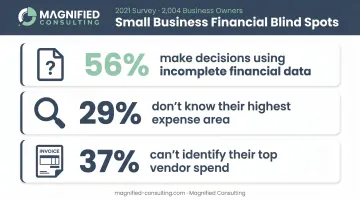
Why this matters: A 2021 survey of 2,004 small business owners found that:
- 56% make monthly business decisions using incomplete financial information
- 29% don't know their highest-expense business area
- 37% can't identify the vendor they spent the most with in the previous three months
For many owners, the audit alone changes the conversation. Harvard Business School research found that structured cost analysis — typically completed within one to two months — regularly shows that a meaningful share of customers are unprofitable to serve.
B2B research confirmed the same pattern: a firm's two largest customers by revenue were actually unprofitable, while accounts ranked 10 through 20 delivered the highest margins.
Knowing which activities generate real profit — and which only appear to — lets an owner reallocate focus without adding a single new customer.
At Magnified Consulting, the financial review process covers cash flow, cost structures, profitability drivers, and revenue stream composition, using data-driven analysis to surface what's costing a business money before prescribing any changes.
Win 2: Pricing Strategy Optimization for Immediate Margin Gains
Underpricing is one of the most common — and most correctable — profit problems in privately-owned businesses. That audit finding from Win 1 frequently points here first: prices set by gut feel or competitor benchmarks, without accounting for true cost-to-serve or actual market positioning.
A profit improvement consultant evaluates current pricing against three variables: actual cost structure, customer value perception, and competitive market position. They then model the specific profit impact of price adjustments before recommending any changes.
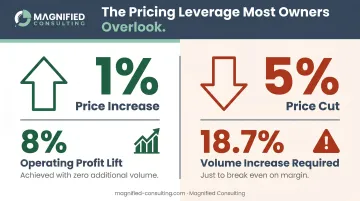
The math works against you. Foundational pricing analysis found that a 1% average price increase — with volumes held stable — can lift operating profit by 8%. Conversely, a 5% price cut requires an 18.7% volume increase just to maintain the same profit level. Most owners drastically underestimate how much pricing leverage they're leaving on the table.
The execution gap is also real. The Simon-Kucher 2025 Global Pricing Study, which surveyed 2,200+ business leaders across 28 countries, found that companies typically realize less than half of intended price increases — meaning even businesses that know they need to raise prices frequently fail to capture the full benefit.
Pricing optimization is the fastest-acting of the five wins because it requires:
- No new hiring
- No capital investment
- No operational overhaul
Just a recalibrated pricing model and the discipline to implement it. For service businesses with labor-intensive delivery models, even modest pricing corrections on select offerings can produce outsized bottom-line improvement.
Win 3: Operational Cost Reduction Without Cutting What Matters
Cost reduction, done correctly, isn't about slashing headcount or degrading service quality. It's about eliminating the spend that isn't generating value — and there's more of it than most owners realize.
Common targets that surface during a cost-structure review:
- Redundant vendor contracts — paying multiple suppliers for overlapping services
- Unused software subscriptions — a 2022 Intuit QuickBooks survey found small businesses average over $3,000/month in unused software spend
- Manual processes consuming billable labor — 25 hours per week of staff time on data entry and reconciliation is profit burning quietly in the background
- Supply chain inefficiencies — procurement patterns that inflate cost of goods without improving output
A consultant maps the business's cost structure against its actual operational workflows, identifying where renegotiation, consolidation, or automation can produce savings that fall directly to the bottom line — without compromising the capabilities the business depends on.
Magnified Consulting's work with privately-owned businesses — across retail, construction, and professional services — covers workflow analysis, operational assessments, and cost management reviews that weigh expense reduction against actual performance impact.
One retail client saw double-digit revenue growth within 18 months after restructuring workflows to eliminate redundant activities — a direct result of redirecting labor toward higher-value work.
The key distinction: a skilled consultant identifies which costs are genuinely wasteful and which are quietly holding operations together. Removing the wrong line items creates new problems faster than they save money.
Win 4: Cash Flow Improvement for Immediate Financial Relief
Profitability and cash flow are related, but they're not the same thing. A business can show a profit on paper while its owner is actively stressed about making payroll — because cash is tied up in unpaid invoices, excess inventory, or poorly structured payment terms.
The receivables problem is widespread. The 2025 QuickBooks Late Payments Report surveyed 2,487 US small businesses and found:
- 56% were owed money from unpaid invoices, averaging $17,500 per business
- 47% had invoices more than 30 days overdue
- 50% of businesses with high volumes of overdue invoices reported cash flow problems as a direct result
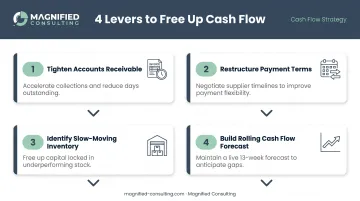
A profit improvement consultant addresses cash flow through specific, actionable levers:
- Tighten accounts receivable — shorten collection cycles, enforce payment terms, add friction to slow-paying accounts
- Restructure payment terms — accelerate customer collections while extending vendor payment windows where possible
- Identify slow-moving inventory — liquidate stock that's consuming working capital without generating returns
- **Build a rolling cash flow forecast** — so the owner can see bottlenecks 60–90 days out, not the week they hit
When cash is more available, the business can capture early-payment vendor discounts, reduce reliance on expensive credit lines, and act on growth opportunities that liquidity constraints previously put out of reach.
Win 5: A Targeted Revenue Growth Strategy That Compounds Over Time
The first four wins protect and recover existing profit. Win 5 is about deliberately growing it — through focus, not undirected expansion.
A profit improvement consultant analyzes the business's existing customer base to identify which accounts are most valuable: highest revenue, highest margin, and lowest cost to serve. Then they build a strategy to systematically acquire more customers that fit that profile.
The finding from Win 1 applies directly here: the customers generating the most revenue aren't always the most profitable. Businesses that redirect their sales and marketing energy toward their actual highest-margin segments — rather than just their largest accounts — typically see faster growth with less cost.
The retention math is compelling. HBR's analysis of customer retention research found that increasing customer retention by just 5% increases profits by 25% to 95%, because retained customers cost less to serve, buy more over time, and generate referrals.
Practical levers in a revenue growth strategy:
- Referral systems built around existing high-value customers
- Sales process refinement to close more of the right accounts, not just more accounts
- Market positioning adjustments to attract better-fit customers organically
With a leaner cost structure, optimized pricing, and healthier cash flow already in place from the earlier wins, each new dollar of revenue contributes more to the bottom line. New revenue no longer gets absorbed by the same inefficiencies — it actually sticks.
What to Look for in a Profit Improvement Consultant
Not every business consultant is focused on profit improvement. The discipline requires a specific combination of financial acumen, real-world operating experience, and the ability to translate analysis into implementation.
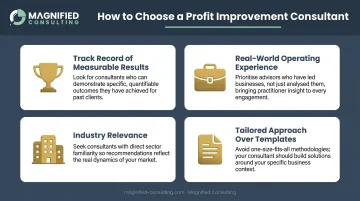
What to prioritize when evaluating consultants:
- Track record of measurable financial results — not just strategic plans delivered, but documented profit improvement achieved for comparable businesses
- Real-world operating experience — consultants who have operated businesses, not just advised them, recognize profit problems that pure analysts miss
- Industry relevance — a consultant who understands your cost structure, margin dynamics, and competitive environment will identify issues that a generalist won't
- Tailored approach over templated frameworks — a good consultant spends time understanding your specific business model before making any recommendations
The distinction between tailored and cookie-cutter consulting matters more than most owners realize. Generic frameworks can identify obvious problems, but the profit leaks specific to a $15M construction company look nothing like those in a professional services firm at the same revenue level.
That same principle applies to the engagement itself. Long-term mentorship matters as much as the initial analysis. Businesses that capture the most value from these engagements work with consultants who stay involved — guiding implementation, adjusting strategies as conditions shift, and holding the owner accountable to the plan.
Magnified Consulting is built around this approach. Their partner-led model keeps consultants actively involved well past any single project, supporting clients through both routine operational decisions and major strategic moves. They work with privately-owned and family-run businesses across the Southeast, including Charlotte, Columbia, South Carolina, Myrtle Beach, and Savannah.
How Much Does Consulting Cost for a Small Business?
Consulting fees vary based on engagement structure and the consultant's experience level. The three most common models are:
| Model | Structure | Best For |
|---|---|---|
| Hourly | Billed per hour of work | Defined, limited-scope questions |
| Monthly Retainer | Fixed fee for ongoing advisory access | Long-term mentorship relationships |
| Project-Based | Fixed fee for a defined engagement scope | Profit audits, operational overhauls |
According to Consulting Success's 2023 pricing study, approximately 30% of consultants use project-based pricing, and 51% of those using value-based fee structures achieved project values of $10,000 or more — compared to 39% of hourly-billed consultants. Higher-value engagements are almost always scoped as projects or retainers, not hourly work.
Evaluating ROI: Focus on expected financial impact relative to cost, not the fee in isolation. A well-scoped engagement should have a clear payback period. If a consultant identifies $150,000 in annual profit improvement and charges $20,000 for the engagement, the return is straightforward.
Before signing, ask prospective consultants to articulate the expected financial impact and set measurable KPIs. Any consultant unwilling to commit to measurable outcomes is worth scrutinizing.
Frequently Asked Questions
How much does consulting cost for a small business?
Costs vary by engagement type — hourly, retainer, or project-based — and the consultant's experience level. Rather than treating it as an overhead expense, evaluate the fee against expected profit improvement. Most structured engagements pay for themselves within the first few months.
What are the 4 ways to increase profit?
The four fundamental profit levers are: increasing revenue, raising prices, reducing costs, and improving your revenue mix by shifting focus toward higher-margin offerings. A profit improvement consultant typically works across all four simultaneously to create compounding gains rather than isolated, one-off fixes.
How quickly can profit improvement consulting show results?
Pricing adjustments and quick cost cuts can show measurable impact within 30–60 days. Structural improvements to operations and cash flow typically manifest within six months. This makes profit improvement consulting a faster-ROI investment than most owners expect going in.
Is profit improvement consulting only for struggling businesses?
Many high-ROI engagements happen with businesses that are performing well but haven't reached their margin ceiling. A profitable business operating below its potential often has more upside to capture — and the financial health to reinvest gains immediately.
What's the difference between profit improvement consulting and general business consulting?
General business consulting covers strategy, marketing, HR, and operations broadly. Profit improvement consulting focuses specifically on the financial levers — pricing, cost structure, cash flow, and revenue mix — that directly determine net profit. The scope is narrower, and the results show up directly on your bottom line.