

The gap between those two skill sets is where most independent dojos get stuck. The U.S. martial arts studio industry encompasses over 76,000 businesses and $21.2 billion in annual revenue, yet many independent schools plateau not because of poor instruction, but because of avoidable business gaps that compound quietly over time.
A business growth consultant bridges that gap — bringing financial strategy, operational discipline, and proven frameworks from outside the martial arts world to help school owners build businesses that are as strong as their curriculum.
Key Takeaways
- A business growth consultant bridges the gap between great instruction and sustainable profitability
- Core growth areas include student acquisition, retention, financial management, operations, and staff development
- Retention has a greater financial impact on profitability than new enrollments alone
- The right consultant brings real-world results, a tailored strategy, and long-term support — not generic advice
- Schools with the most room to improve in pricing, retention, or operations see the fastest gains
Why Martial Arts School Owners Struggle to Grow
Most school owners opened their dojo out of genuine passion for martial arts — not business strategy. That's not a flaw; it's just a different starting point. The problem is that passion alone doesn't pay the rent.
This creates a predictable gap in several critical business areas:
- Setting membership rates based on gut feel rather than margin analysis
- No forecasting, no cash buffer, no visibility into seasonal revenue gaps
- No formal system to track or recover churning students
- Relying entirely on word-of-mouth with no repeatable enrollment process
- Running everything through the owner, which makes scaling impossible
Industry benchmark commentary from MAIA and Zen Planner confirms that small martial arts schools consistently underprice their memberships — one of the most direct, correctable causes of stalled revenue growth.
These problems don't stay isolated. Underpriced memberships compress margins, which cuts into the budget for marketing. With less marketing spend, enrollment slows — and a slower enrollment pace piles more pressure back onto the owner. The cycle is self-reinforcing and hard to break from inside it.
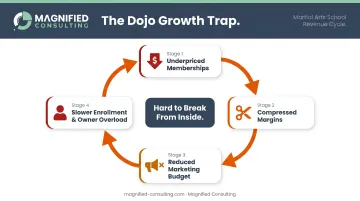
Many owners try to break it with management software or martial arts-specific coaching programs. Those tools help with day-to-day operations, but they don't address the underlying financial and strategic gaps — pricing structure, margin targets, growth planning — that determine whether a school actually builds sustainable revenue over time.
What a Business Growth Consultant Does for Your Martial Arts School
Strategic Planning and Financial Assessment
A business growth consultant starts by looking at what the numbers actually say. That means a thorough assessment of current revenue, cost structure, pricing architecture, and market position — before any recommendations are made.
From that baseline, the consultant builds a growth roadmap tied to the owner's specific goals — crossing a revenue threshold, cutting back operational hours, or laying groundwork for a second location. The plan should fit the person, not just the business.
Magnified Consulting's partners bring this exact approach to privately owned businesses across the Southeast — applying frameworks drawn from manufacturing, retail, and professional services to identify the financial levers that most service-based business owners have never formally analyzed.
Operational Audit and Efficiency
Beyond strategy, consultants identify the inefficiencies that erode margins without obvious warning:
- Class scheduling that doesn't optimize instructor hours or floor capacity
- Staffing ratios that cost more than they produce
- Billing gaps — missed autopay enrollments, inconsistent rate structures
- Overhead spending that grew without a corresponding revenue increase
Fixing these isn't glamorous work, but it directly improves profitability without requiring a single new student. Magnified Consulting has helped clients reduce operational costs by 30% through this kind of structured process review — savings that go straight to the bottom line.
Financial Advisory and Pricing
Most martial arts school owners have never applied a true financial lens to their own business. A consultant brings that perspective: examining the full revenue mix, identifying underpriced offerings, and building cash flow discipline that keeps the school stable through seasonal enrollment dips.
Unlike bookkeeping or accounting, this is advisory work centered on decisions. Key areas typically include:
- Pricing adjustments and how to model their revenue impact
- Payment plan structures that reduce churn and increase collections
- Identifying revenue streams the school has the capacity to offer but hasn't priced or promoted
Long-Term Mentorship vs. One-Time Projects
One consulting project can spark change. Sustaining it requires ongoing involvement — a consultant who remains in the picture as the owner navigates growth transitions, staffing decisions, and eventually exit planning.
Magnified Consulting's model reflects this directly: their relationship with clients doesn't end after the first deliverable. Ongoing mentorship means owners have a strategic sounding board for major decisions — whether that's hiring a second instructor, raising rates, or evaluating a second location — rather than making those calls alone.
The Key Growth Areas a Consultant Will Target
A good consultant doesn't try to fix everything at once. The first step is identifying the two or three highest-leverage areas to address — the ones with the fastest path to measurable improvement. Here's what those typically look like for martial arts schools.
Student Acquisition and Marketing Strategy
Most independent schools rely on word-of-mouth as their primary, and sometimes only, acquisition channel. Word-of-mouth works, but it's not scalable and it's not consistent.
A consultant helps build a repeatable acquisition system that may include:
- Local SEO to capture families actively searching for classes nearby
- Referral programs with structured incentives for current students
- Community partnerships with schools, youth organizations, and employers
- Paid digital campaigns targeted to the school's specific demographic: families, adult beginners, or competitive athletes
Done right, this creates enrollment that flows in steadily — not just when the owner happens to mention the school to someone they know.
Student Retention and Lifetime Value
Retention is the most underappreciated lever in martial arts school economics. Acquiring a new student costs time and money. Keeping a current student costs almost nothing by comparison — and each additional month they stay directly increases their lifetime value to the school.
Research on fitness club members shows dropout rates of 40% to 65% within the first six months of enrollment — a figure that likely mirrors the early attrition many martial arts schools experience. The first 90 days are the highest-risk window.
Consultants build systematic retention strategies that address this window directly:
- Structured onboarding programs that give new students clear early wins
- Belt progression milestones that keep students engaged and forward-focused
- Community events that build social connection to the school
- Proactive communication touchpoints: check-ins, attendance alerts, progress recognition

Research on customer retention found that a 5% improvement in retention can increase profits by up to 95%. At the school level, even modest retention gains translate into meaningfully higher recurring revenue without adding a single new enrollment.
Financial Performance and Pricing
The pricing problem in independent martial arts schools is common. Memberships are often set by what nearby schools charge — not by what the business actually needs to be profitable.
A consultant audits the full revenue picture, including:
- Membership tiers and whether they reflect the school's actual value
- Autopay adoption rates and billing consistency
- Non-tuition revenue: merchandise, belt testing fees, specialty workshops, seminars, online content
- Seasonal revenue patterns and how to smooth them
Most schools find they're leaving money on the table not by undercharging on tuition, but by underdeveloping these secondary revenue streams.
Operational Efficiency and Staff Development
An owner who teaches every class, handles every inquiry, and manages every administrative task has built a job, not a business. Consultants help owners break that pattern by:
- Documenting processes so they can be delegated reliably
- Building staff roles with clear responsibilities and accountability
- Creating systems that run consistently whether the owner is present or not
This operational foundation is non-negotiable for any school considering expansion. You cannot open a second location if the first one falls apart when you're not there.
How to Choose the Right Business Consultant for Your Martial Arts School
Not every business consultant delivers results. Many arrive with a generic framework built for a different industry, a different market, and a different owner — and expect it to fit your martial arts school.
When evaluating consultants, focus on these four criteria:
- Verified track record: Look for demonstrated results with privately owned businesses — not theoretical frameworks. Magnified Consulting's partners have been involved in over $1.5 Billion in mergers and acquisitions and advised on $300 million in capital purchasing decisions, financial depth that translates directly into pricing, cash flow, and expansion guidance.
- A tailored process: A consultant who shows up with a ready-made playbook hasn't done the work to understand your school, your community, or your goals. The right consultant asks first — about your revenue, retention, staff, and what you want the business to look like in three years.
- Ongoing accountability: A 30-page strategy document has limited value without support to implement it. Prioritize consultants who offer ongoing mentorship, regular check-ins, and genuine accountability over time rather than one-time deliverables.
- Return on investment: Management and business strategy consulting typically runs $100–$149 per hour, with project engagements often falling below $10,000 depending on scope.
The better question isn't what consulting costs — it's what it costs to keep running the business without it. If a consultant helps a school improve margins or reduce operational costs by even a modest amount, the engagement typically pays for itself within the first year.
What Kind of Results Can You Expect?
Results depend on where the school starts, how thoroughly recommendations are implemented, and the scope of the engagement. Schools with significant room to improve in pricing, retention, or operations tend to see the fastest early gains.
Specific improvements consultants target in the first six months include:
- 20% profitability increase — Magnified Consulting clients have reported improved cash flow within the first six months of implementation, with some engagements reaching profit increases of 40%
- 25–30% operational cost reduction — streamlining processes and staffing consistently yields measurable efficiency gains
- Stronger revenue mix — introducing non-tuition revenue streams, improving autopay adoption, and adjusting pricing tiers

The numbers tell part of the story. What owners consistently mention — and what's harder to put in a spreadsheet — is that they finally have time to teach again. When the business runs on documented systems rather than constant owner intervention, the day-to-day stops consuming everything.
Most martial arts school owners didn't open their doors to manage invoices and chase down lapsed members. A structured consulting engagement is designed to hand those operational burdens back to the business — so the owner can focus on what they're actually good at.
Frequently Asked Questions
How much does a martial arts school owner make?
Owner income varies widely based on enrollment size, pricing, rent, and staffing structure. A solo operator may earn instructor-level income, while a well-run multi-staff school with strong retention and diversified revenue can generate significantly more. Improving pricing, retention, and operations are the primary levers that move an owner toward the higher end of that range.
How much should I pay for a business consultant?
Strategy and growth consulting typically runs $100–$149 per hour, with project engagements often under $10,000 and ongoing retainers priced by scope and meeting frequency. ROI is the better measure: if a consultant helps increase monthly recurring revenue or reduce operational costs, the engagement typically pays for itself within the first year.
How to grow a martial arts school?
The four primary levers are student acquisition, retention, pricing optimization, and operational efficiency. These interact — better retention improves cash flow, which funds better marketing, which drives acquisition. A consultant identifies which lever to pull first based on the school's specific situation.
When is the right time to hire a business consultant for a martial arts school?
Key indicators include stalled enrollment, declining profitability, operational overwhelm, or plans to open a second location. The best time to engage is before a crisis, not after — when there's still enough runway to implement changes thoughtfully rather than reactively.
Can a business consultant help a martial arts school owner plan for expansion or exit?
Yes. Consultants help owners evaluate expansion readiness, structure multi-location growth, and prepare the business for a future sale or leadership transition. Starting this work early — well before a sale is imminent — gives financial and operational improvements time to increase the business's value.