
That gap is expensive. According to a 2022 CNBC report citing M&T Bank survey data, 98% of small business owners did not know the value of their companies. A more recent RBC Wealth Management study found that **41% of business-owner clients had never completed any type of valuation analysis** — yet nearly 30% of those same owners had plans to sell or transition.
Business valuation is routinely treated as a transaction formality — something you do when a deal is already on the table. That framing misses most of its value. For privately owned and family-run businesses, a professional valuation is one of the most actionable strategic management tools available, long before any deal materializes.
This article covers the concrete strategic advantages valuation delivers, what happens when owners skip it, and how to put it to work as an ongoing practice.
Key Takeaways
- 98% of small business owners don't know their company's value — a gap that surfaces at the worst possible moments.
- Valuation identifies specific value drivers, so capital goes where it builds enterprise value, not just revenue.
- Owners with a current, professional valuation enter negotiations with defensible data, not gut estimates.
- A valuation functions as a structured risk audit — surfacing customer concentration and key-person dependency before a buyer does.
- Recurring valuations build compounding advantages with each business cycle, making them a practice, not a one-time event.
What Is Business Valuation?
Business valuation is the formal process of determining a company's economic worth. A credentialed professional examines assets, liabilities, revenue, cash flow, future earning potential, market position, and risk factors — then applies one or more established methodologies to arrive at a defensible number.
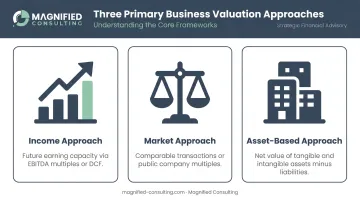
The three primary approaches, as defined by American Society of Appraisers standards, are:
- Income approach — values the business based on future earning capacity, typically through EBITDA multiples or discounted cash flow analysis
- Market approach — values the business by reference to comparable transactions or public company multiples
- Asset-based approach — values the business based on the net value of its tangible and intangible assets and liabilities
Valuations apply across a wide range of situations:
- M&A transactions and exit planning
- Succession planning and buy-sell agreements
- Securing financing or attracting investors
- Tax, estate, and litigation support
Magnified Consulting approaches valuations through two primary frameworks. Fair Market Value (FMV) reflects what a willing buyer and seller would agree upon in an open market. Strategic Value (SV) accounts for the synergies and competitive advantages specific to a particular acquirer.
Regardless of which framework applies, the number itself matters less than what it reveals. A professional valuation shows which levers are driving value up, which factors are holding it back, and how wide the gap is between where the business stands today and where it needs to be.
Key Advantages of Business Valuation for Strategic Decision-Making
The three advantages below are grounded in operational and strategic impact. Each connects directly to outcomes business owners track: growth, profitability, risk, and negotiating power.
Advantage 1: Clarity on What Actually Drives Business Value
One of the most underused benefits of a professional valuation is the identification of specific value drivers — the factors that move a business's worth up or down in the eyes of buyers, lenders, and investors.
According to M&A Source, the most consequential strategic value drivers for privately held businesses include:
- Customer diversity — high concentration in one or two clients suppresses value
- Management depth — key-person dependency is a consistent discount factor
- Contractually recurring revenue — predictable revenue commands premium multiples
- Proprietary products or technology — creates barriers competitors can't easily replicate
- Systems and process documentation — demonstrates operational scalability
The valuation process creates this clarity through a structured, outside-in examination of every dimension of the business. Internal teams often overlook these issues — not because they're careless, but because proximity makes it hard to see what an outside evaluator spots immediately.
Without knowing what drives value, owners frequently invest time and capital in the wrong areas. A business can grow revenue by 20% while unknowingly compressing margins, deepening customer concentration, or increasing owner dependency.
Each of those factors reduces what a buyer would actually pay. A valuation corrects that misdirection before the damage compounds.
KPIs most impacted: EBITDA margin, revenue concentration by customer, recurring vs. one-time revenue ratio, customer retention rate, owner dependency ratio
When this matters most: Annual strategic planning, before committing to major capital expenditures, when evaluating a key executive hire, or when setting 3-to-5-year growth targets
Advantage 2: A Stronger, Defensible Position in M&A, Financing, and Ownership Transitions
In any transaction — whether buying, selling, raising capital, or restructuring ownership — the party with objective, professionally validated data holds the stronger position. A formal valuation replaces gut estimates and wishful pricing with a methodology-backed baseline that holds up to scrutiny.
Here's what that looks like in practice:
- Seller negotiations: Establishes a defensible floor, reducing the likelihood of accepting below-market terms
- Acquisitions: Quantifies synergies and risks, preventing overpayment for targets that look attractive on the surface
- Financing: Satisfies lender requirements for SBA loans and credit facilities, which increasingly require valuation support for change-of-ownership transactions
- Buy-sell agreements: Keeps partner agreements aligned to current market reality, not numbers set five years ago
The data on unprepared sellers is sobering. BVR's DealStats Value Index reported a 13.4% median discount between asking price and final sale price in H1 2024 — with a median ask of $329,000 closing at $284,750. That's a $44,000 gap on a sub-$500,000 transaction. At higher deal sizes, the dollar impact compounds significantly.
That gap is avoidable. Magnified Consulting's partners have been involved in over $1.5 Billion in mergers and acquisitions across the Carolinas and Southeast. The owners who enter transactions with current, credible valuations achieve better outcomes — whether buying, selling, or restructuring. Those who rely on informal estimates tend to face prolonged negotiations or concede terms they didn't have to.
KPIs most impacted: Deal multiple achieved, time-on-market before sale, financing terms secured, buy-sell agreement accuracy, cost of capital
When this matters most: When planning a sale or acquisition within 3–5 years, when a partner buyout is needed, when seeking growth capital, or when updating shareholder agreements
Advantage 3: Proactive Identification of Risk Before It Becomes a Crisis
A professional business valuation functions as a structured risk audit. Independent evaluators apply market benchmarks to stress-test every component of the business — uncovering vulnerabilities that internal teams often miss because operational proximity narrows the view.
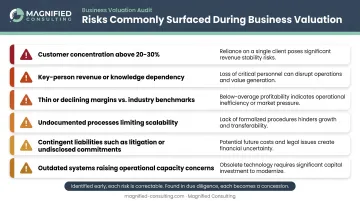
Common risks that surface during valuation include:
- Customer concentration above 20–30% in a single account
- Revenue or institutional knowledge tied to one key person (including the owner)
- Thin or declining margins relative to industry benchmarks
- Undocumented processes that create scalability risk
- Contingent liabilities — pending litigation, environmental obligations, undisclosed commitments
- Outdated systems that raise questions about future operational capacity
These risks share a common trait: they're far cheaper to fix before a transaction than during one. Finding a customer concentration problem during a valuation — when there's time to address it — is a completely different situation from a buyer's due diligence team flagging the same issue mid-sale. In the latter case, the seller is forced into reactive, often costly concessions.
Grant Thornton's M&A dispute survey, covering more than 1,300 deals by 189 US-based M&A professionals, found that approximately **half of surveyed deals resulted in some form of accounting dispute** — most often triggered by issues that were present before the transaction but not surfaced proactively.
When leaders have a clear risk map of their business, they can prioritize operational fixes, succession plans, and protection strategies before those gaps cost real money.
KPIs most impacted: Customer concentration percentage, key-person revenue dependency, debt coverage ratios, operational redundancy, management bench strength
When this matters most: Before any major transaction, during annual strategic reviews, after a period of rapid growth, and when succession planning begins
What Happens When Business Valuation Is Ignored
Without a current, professional valuation, privately owned businesses routinely make high-stakes decisions — acquisitions, capital investments, succession plans — based on assumptions that have never been tested against market reality.
The cost of that gap compounds quietly. An owner who plans to sell at a target multiple they've never validated may spend years building toward a number that doesn't exist. Gallup's 2025 employer-business survey found that 74% of employer-business owners have long-term plans to sell or transfer ownership, with 22% planning to do so within five years.
Many of those owners are working toward financial goals built on gut-feel estimates rather than validated data.
The most common consequences of skipping valuation:
- Negotiating without leverage — buyers and lenders have their own valuation professionals; owners without one are at an information disadvantage
- Buy-sell agreements that no longer reflect current value — creating shareholder disputes when a partner exits or dies
- Misallocated capital — investing in the wrong parts of the business because value drivers were never clearly identified
- Inability to secure favorable financing terms — lenders increasingly require valuation support
- Short-timer syndrome — a disengaged owner allows business performance to erode while mentally preparing for a transition that hasn't been properly prepared
Each of these consequences becomes harder to address with time. A business that hasn't been valued in five years may have quietly accumulated customer concentration, leadership dependency, and margin drift — problems that are expensive to reverse quickly when a transaction or crisis forces the issue.
Only 20% to 30% of businesses that go to market actually sell, according to the Exit Planning Institute. Owners who assume a future sale will be straightforward — without ever testing that assumption against current market conditions — are taking a significant risk with their most valuable asset.
How to Get the Most Value from Business Valuation
A business valuation delivers its greatest strategic return when treated as a recurring management practice, not a one-time pre-sale exercise. Owners who commission valuations annually or biennially build a longitudinal view of value trends, track the impact of strategic decisions over time, and stay ready for opportunities or transitions that arise unexpectedly.
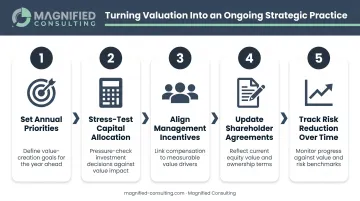
Acting on valuation insights looks like this in practice:
- Set annual operational priorities based on value driver analysis — not just revenue targets
- Stress-test capital allocation decisions against their projected impact on enterprise value before committing
- Align management incentives to value-building metrics, not just top-line performance
- Update shareholder and buy-sell agreements to reflect current market realities on a regular schedule
- Track risk reduction over time — document improvements in customer concentration, management depth, and recurring revenue year over year
What makes valuation insights actionable is working with an advisor who understands your industry, your growth stage, and what buyers in your specific market actually pay for. That context is what turns a financial snapshot into concrete next steps.
Magnified Consulting's partners have advised on over $1.5 Billion in M&A transactions across the Carolinas and Southeast. For privately owned and family-run businesses in this region, that experience means valuation findings connect directly to performance improvements and decisions owners can act on — whether that's a capital move, a leadership transition, or a targeted push to close a value gap before going to market.
Conclusion
For privately owned and family-run businesses, business valuation is not a transaction formality. It's one of the most practical strategic management tools available — and its advantages compound over time.
Owners who understand their value drivers make better capital decisions. A current, professional valuation also changes the dynamic in any transaction — buyers, lenders, and partners negotiate differently when you can substantiate your number. Perhaps most importantly, recurring valuation turns risk into a manageable variable rather than a surprise that surfaces at the worst possible moment.
The businesses best positioned for growth, transition, and long-term value creation are those that treat valuation as an ongoing discipline. That starts with a professional baseline and deepens as valuation becomes part of how the business plans, not just how it exits. For privately owned businesses across the Carolinas and Southeast, Magnified Consulting's advisory work is built around exactly this approach — helping owners build and protect value at every stage, not just at the finish line.
Frequently Asked Questions
How much is a business worth with $500,000 in sales?
Revenue alone cannot determine business value. A business with $500,000 in sales could be worth anywhere from less than one times revenue to several multiples of EBITDA, depending on profitability, cash flow, industry benchmarks, and risk factors. A professional valuation applies the right methodology for your specific situation.
How do you value a business services company?
Business services companies are typically valued using income-based approaches — most commonly a multiple of EBITDA or seller's discretionary earnings — adjusted for factors like client concentration, contract duration, revenue recurrence, and key-person dependency. Market comparables from similar transactions also inform the final value, especially for companies in the $2M–$50M revenue range.
How much should I pay for a business valuation?
Professional valuation costs vary based on business complexity, purpose, and the credentials of the appraiser. RBC Wealth Management estimates that a formal valuation to support strategic planning or a future sale typically runs $30,000 to $50,000.
How often should a business owner get a valuation?
At minimum, every two to three years — and annually when actively planning for a sale, transition, or major capital event. Regular valuations allow owners to track value trends over time and course-correct before gaps become too costly to close quickly.
What are the most common business valuation methods?
The three primary approaches are the income approach (based on future earning capacity, typically EBITDA multiples or discounted cash flow), the market approach (based on comparable transactions or public company multiples), and the asset-based approach (based on the net value of assets and liabilities). Professional valuators often combine methods depending on the business type, purpose, and available data.
Can a business valuation help with succession planning?
Valuation is foundational to succession planning. A current valuation supports:
- Setting a fair baseline for ownership transfers
- Structuring buy-sell agreements
- Planning tax-efficient estate and gifting strategies
It also gives owners the lead time to build value before transitioning to family members, management, or outside buyers.