The gap is measurable. The Financial Services Skills Commission (FSSC) reported in 2024 that 78% of UK financial services CEOs reported internal skills shortages, with roughly 160,000 workers — 16% of the sector — needing upskilling. More telling: the technical skills gap held steady at around 20%, while the behavioral skills gap (coaching, empathy, adaptive judgment) widened from 10% to over 25%.
That widening gap is the real leadership crisis.
This article offers a practical framework for financial firms — especially privately owned and family-run practices — looking to identify, develop, and retain next-generation leaders before the pressure becomes urgent.
Key Takeaways
- Next-gen financial leaders need both technical grounding and human-centered capabilities — not just expertise in numbers
- High performance in a technical role does not predict leadership effectiveness; firms need structured, skills-based identification processes
- Effective development combines structured learning, cross-functional exposure, coaching, and mentorship — no single training event is enough
- Internal development should anchor any leadership pipeline; external hiring should fill specific, defined gaps
- Succession planning is a business strategy, not an HR exercise — and for privately owned firms, timing matters enormously
The Evolving Leadership Challenge in Financial Services
From Complicated to Complex
Not every leadership challenge has a right answer. Complicated problems — tax calculations, regulatory filings, portfolio rebalancing — do. Complex ones don't. They involve ambiguity, competing priorities, and outcomes that shift as you act on them.
Financial leadership has always required the former. It increasingly demands the latter.
Ronald Heifetz and Donald Laurie introduced a useful frame in their foundational Harvard Business Review work on adaptive leadership: the "dance floor to balcony" distinction. Leaders on the dance floor are executing — managing transactions, handling client calls, running compliance reviews. Leaders on the balcony are observing the whole landscape — noticing patterns, anticipating shifts, redesigning how the firm operates.
Most financial professionals are trained for the dance floor. Next-generation leadership demands fluency on both levels — often at the same time.
The Dual Demand Problem
Financial firms face a genuine tension. They still need the precision, rigor, and regulatory discipline that has always defined the sector. A firm that tolerates sloppy compliance to chase innovation has a real problem. But a firm that only rewards analytical precision — and never develops coaching, creativity, or stakeholder communication — will struggle to retain talent and adapt to disruption.
This dual demand makes leadership development uniquely hard in finance. The same behaviors that make someone exceptional in a technical role can become liabilities at the leadership level: perfectionism becomes micromanagement, caution becomes risk-aversion, analytical depth becomes poor communication to non-financial stakeholders.
That internal tension doesn't exist in isolation. A set of external forces is making it harder to ignore — and faster to act on.
The External Pressures Accelerating This
Several forces are compressing the timeline:
- AI and automation: Industry research estimated that 73% of US bank employee time has high potential to be affected by generative AI — split between 39% automation and 34% augmentation (AI-assisted work)
- Advisor demographics: Cerulli reported that 109,093 financial advisors plan to retire over the next decade, representing 37.5% of advisor headcount and 41.5% of industry assets
- ESG accountability: Green financial services vacancies rose from 0.26% of job postings in 2019 to 2.2% in 2023
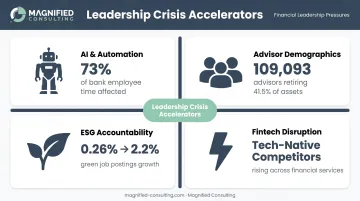
Together, these pressures raise a practical question: what does it actually take to build the next generation of financial leaders before the gap becomes a crisis?
Key Leadership Capabilities Financial Firms Must Develop
Adaptive and Strategic Thinking
Traditional financial management rewards precision within defined parameters. Strategic leadership requires something different.
Next-gen leaders must recognize patterns before they're obvious, anticipate disruption before it arrives, make sound decisions with incomplete information, and reframe problems when the original assumptions no longer hold.
Next-generation financial leaders need to move from answering "what does the data say?" to asking "what does this mean for where we're headed?"
Emotional Intelligence and Coaching Ability
This is not soft skill territory. It's documented as a hard gap.
The FSSC found that 63% of financial services firms reported increased demand for empathy in 2023, up from 33% the prior year. Demand for coaching skills jumped from 56% to 67% in the same period. Both were flagged as among the largest proficiency gaps in the sector — meaning available skill levels weren't meeting what the role actually required.
NatWest responded by enrolling more than 5,000 leaders in its Thrive development program, focused explicitly on empathy and emotional intelligence. That's not a small discretionary investment — it reflects a recognition that people leadership is now a competitive capability.
Digital Fluency and Data Literacy
Next-gen leaders don't need to be data scientists or AI engineers. They need to be informed, confident decision-makers who can:
- Interpret AI-generated insights without blindly accepting them
- Advocate for digital transformation with boards and clients
- Understand what questions to ask when automation changes a workflow
- Govern AI usage responsibly within their teams
Given that Citi GPS reported 54% of banking jobs have high automation potential, leaders who can't navigate this conversation will find themselves sidelined by it.
Self-Awareness and a Growth Mindset
Leaders who can't name their own blind spots tend to recreate the same problems with different people. Self-awareness — understanding one's leadership shadow, strengths, and where one's defaults become liabilities — is foundational to everything else.
In practice, this means leaders who:
- Seek feedback, even when it's uncomfortable
- Acknowledge mistakes without defensiveness
- Model the learning behavior they want their teams to demonstrate
This builds followership and organizational trust in ways that positional authority alone never does.
Communication and Stakeholder Influence
Financial leaders need to translate complexity into clarity — for boards, clients, regulators, and cross-functional colleagues who don't share their technical fluency.
"Storytelling" has become a core leadership competency in finance. Not spin — the ability to connect data to decisions, and decisions to outcomes, in a way that non-financial audiences can actually act on.
How Financial Firms Identify High-Potential Leaders
Moving Beyond Performance Metrics
The most common mistake in leadership identification is conflating high performance with leadership potential. Someone who consistently exceeds targets, delivers results, and stays technically sharp is a genuine asset. That doesn't make them a natural leader.
Effective identification requires assessing a different set of dimensions:
- How does this person influence others without formal authority?
- Do they develop the people around them, or just outperform them?
- How do they handle ambiguity, conflict, or failure?
- Do they actively want leadership responsibility — or do they want deeper subject matter expertise?
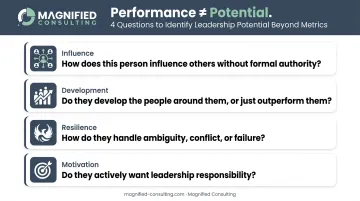
That last point matters more than most firms acknowledge. Not every high performer wants to manage. Forcing someone into leadership who prefers to go deep technically is a losing trade for everyone.
Skills-Based Talent Identification
Firms that identify leaders well use structured, skills-based approaches — mapping employee capabilities against a defined leadership competency framework and assessing observable behaviors, not just output metrics.
The Financial Services Skills Commission's (FSSC) Future Skills Framework offers a practical structure: 13 core technical skills and behaviors with accompanying Skills Gap Analysis tools. The CFA Institute's 2022 Future of Work research similarly identified gaps between supply and demand for leadership-oriented skills — technical, soft, and what it describes as "T-shaped" capability (deep expertise in one area, broad fluency across others).
For privately owned financial firms without a formal talent team, this kind of framework provides the structured lens that informal promotion decisions often lack.
Personalized Development Data
A competency framework sets the standard. Technology makes it actionable. Firms can now collect multi-source data on leadership behaviors — 360-degree feedback, project outcomes, coaching observations — and use it to make development genuinely individualized rather than one-size-fits-all.
One critical consideration: the identification process must be structured to minimize bias. Industry research reported that women held just 18% of global financial services C-suite roles, with women at approximately 6% of CEO roles and 9% of board chair roles in major financial firms. Informal, relationship-driven promotion processes tend to replicate legacy leadership profiles. Structured competency assessment helps prevent that.
Building a Leadership Development Program That Works
Structured Programs and Experiential Learning
The most effective development doesn't happen in a classroom. It happens when someone is asked to solve a real problem outside their comfort zone, with accountability for the outcome.
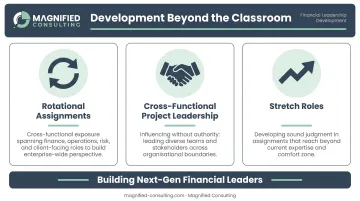
For financial firms, this means:
- Rotational assignments across finance, operations, risk, and client-facing functions
- Cross-functional project leadership that requires influencing without authority
- Stretch roles that demand judgment beyond current expertise
Cross-functional exposure carries particular weight in privately owned and family-run financial businesses, where senior leaders regularly wear multiple hats and must understand the full picture of how the firm operates.
Coaching as a Leadership Development Tool
When senior leaders coach rather than direct, the whole organization learns faster. This distinction matters: coaching as a leadership style builds capacity at every level, not just at the top.
This approach builds organizational capacity in ways that one-time training events don't. It also closes the coaching proficiency gap the FSSC identified — which is significant, given that 67% of financial services firms reported increased need for coaching skills and flagged it as one of the largest documented proficiency gaps in the sector.
Mentorship and External Advisory Partnerships
Long-term mentorship accelerates development in ways that formal programs simply can't replicate. Structured programs build knowledge; mentorship builds judgment.
For privately owned financial firms without a large internal L&D function, external advisory partnerships can fill this gap meaningfully. Magnified Consulting, for example, brings decades of real-world experience advising businesses on growth, capital decisions, M&A transitions, and operational change. Rather than delivering a framework and stepping away, they stay engaged as ongoing partners — providing the accountability and perspective that formal programs rarely sustain.
Building a Learning Culture
No development program survives a culture that punishes mistakes or signals that learning is a distraction from "real work."
Firms that want to develop next-generation leaders must create environments that:
- Reward curiosity and calculated risk-taking
- Normalize learning from failure without blaming individuals
- Give emerging leaders genuine visibility and stretch opportunities
Culture isn't the backdrop for leadership development — it's the precondition for it.
Internal Development vs. External Hiring: Finding the Right Balance
The case for internal development is strong and often underweighted. Research by Matthew Bidwell found that external hires were paid 18–20% more than internal movers into similar roles — and initially performed worse. SHRM data shows employees promoted within three years have a 70% probability of staying through year five, compared to an estimated 38% baseline retention rate.
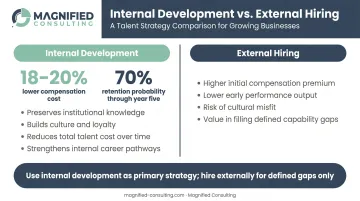
Those numbers make a compelling case for treating internal pipeline development as the primary strategy, not a fallback when external searches stall.
That said, external hiring adds real value in specific circumstances:
- When the firm lacks a capability (AI governance, institutional compliance depth, M&A integration experience)
- When the leadership team needs a perspective shift that internal candidates can't provide
- When a specific senior role requires credibility that only comes from external experience
Those gains come with real risks, though: cultural misfit, disruption to existing talent, and disengagement among high-potential staff who feel overlooked. For most financial firms, the practical answer is a balanced strategy — invest deeply in a defined internal high-potential pipeline, and recruit externally only for specific, identified gaps.
Before launching an external search, audit your internal pipeline. If you've invested in structured development, the stronger candidate is often already in the building.
Making Succession Planning a Strategic Priority
For privately owned and family-run financial firms, succession planning is a core business strategy — one that directly shapes firm value, client relationships, and operational continuity.
The data on how firms actually handle this is sobering. A 2024 DeVoe survey of RIA executives found that **only 42% of firms had written succession plans** — meaning 58% did not. Only about one-third believed the next generation was ready to lead, and 32% had no confidence in that readiness at all.
This is not a minor administrative gap. Cerulli reported that 109,093 advisors plan to retire over the next decade, representing over 41% of total industry assets. The demographic pressure is not theoretical — it is already in motion.
What an Effective Succession Plan Includes
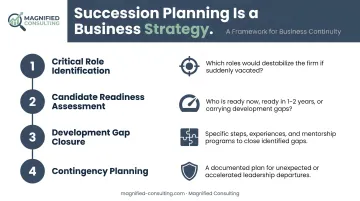
A functional succession plan addresses:
- Critical role identification — Which positions, if vacated unexpectedly, would most destabilize the firm?
- Candidate readiness assessment — Who is genuinely ready now, who could be ready in 1–2 years with development, and where are the gaps?
- Development gap closure — What specific steps, experiences, and mentorship are needed to close those gaps?
- Contingency planning — What happens if a key leader departs unexpectedly before a successor is ready?
The common mistake is waiting until a departure is imminent. By then, there's no time to develop anyone — only time to react.
The Business Value Connection
Closing those development gaps pays off well before a transition occurs. Firms with strong succession pipelines enter M&A discussions from a position of strength. Buyers discount businesses where continuity depends on one or two individuals. A demonstrable leadership bench — with structured development paths and documented succession plans — supports stronger valuations, smoother post-close integration, and continued client confidence through transitions.
This is where succession planning and business value intersect most directly. For privately owned financial firms with growth or exit goals, the leadership pipeline is not a separate conversation from the financial strategy. It is part of it.
Magnified Consulting treats leadership readiness as a prerequisite for deal preparedness. Having been involved in over $1.5 Billion in M&A transactions, the firm has seen directly how a documented succession plan affects buyer confidence — and how the absence of one affects valuation.
Frequently Asked Questions
What leadership skills should be prioritized when developing leaders in financial firms?
Prioritize both technical grounding (regulatory literacy, data interpretation, financial fluency) and human-centered capabilities like emotional intelligence, adaptive thinking, and stakeholder communication. Skills-based competency frameworks, such as the FSSC's Future Skills Framework, provide a structured way to map current capabilities against what leadership roles actually require.
What is the difference between financial leadership and financial management?
Financial management focuses on day-to-day operations: reporting, compliance, short-term planning. Financial leadership is about guiding the organization toward long-term goals, driving strategic decisions, and influencing outcomes across the business, including people, culture, and growth direction.
How do financial firms identify employees with high leadership potential?
Leading firms use skills-based assessments, 360-degree feedback, and defined competency frameworks to evaluate how employees collaborate, communicate, and drive outcomes — not just what they technically deliver. Crucially, firms also assess whether a candidate actually wants leadership responsibility, not just whether they're performing well.
Should financial firms develop leaders from within or hire externally?
Both, but in the right proportion. Internal development should anchor your pipeline: it's cheaper, builds retention, and preserves institutional knowledge. Use external hiring selectively for gaps the internal bench genuinely doesn't cover. Over-relying on outside hires signals to high-potential staff that advancement isn't available.
How does succession planning impact long-term business value?
Firms with strong, documented succession plans experience smoother transitions, greater client confidence, and stronger positioning in M&A or ownership transfer scenarios. Buyers discount businesses with key-person dependency. A visible leadership pipeline is a tangible asset in any valuation or exit conversation.
What role does mentorship play in developing next-generation financial leaders?
Mentorship builds the judgment and perspective that formal training programs can't replicate. For privately owned firms without large internal development infrastructure, long-term advisory partnerships with experienced outside advisors can effectively fill this role, providing real-world accountability alongside strategic guidance.