The problem is that without context, most businesses either underinvest in superficial training that doesn't stick, or overspend on prestigious programs that don't fit their stage or goals. Both mistakes are expensive.
This article breaks down realistic pricing tiers with verified figures, the factors that push costs up or down, what a full investment actually includes beyond the program fee, and how to determine the right budget for your specific situation.
Key Takeaways
- Leadership development costs range from under $500 for self-directed options to $80,000+ per participant for elite executive programs
- Mid-range programs ($1,500–$15,000) often deliver strong ROI for emerging managers and small business owners when paired with reinforcement
- Assessment tools, coaching, and time-away costs can significantly increase the total cost beyond program fees
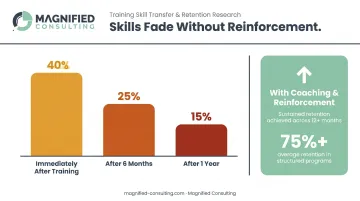
- Research on training transfer shows only 15% of skills learned in training remain after one year without reinforcement, making program design as important as price
- The right budget starts with identifying what leadership gaps are costing the business today
How Much Do Leadership Development Programs Cost?
Leadership development has no fixed price. Costs vary based on program type, delivery format, customization level, and participant seniority. The pricing tiers below reflect verified, publicly available figures — not averages.
Tier 1: Budget Options (Under $500 per participant)
This tier covers self-directed learning. Common options include:
- Books and free online content (LinkedIn Learning, Coursera free tiers)
- Internal lunch-and-learns led by senior staff
- Basic e-learning modules with no live facilitation
- Self-paced assessments and reading programs
Facilitator involvement is minimal and structure is largely absent. This tier works well for introducing leadership concepts broadly or supplementing a more structured program — but it won't build capable leaders on its own.
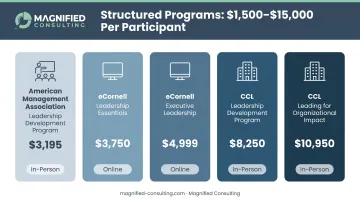
Tier 2: Mid-Range Programs ($1,500–$15,000 per participant)
This is where most structured development happens for emerging and mid-level managers. Verified examples include:
| Provider | Program | Price | Format |
|---|---|---|---|
| American Management Association | Developing Executive Leadership | ~$3,195 (non-member) | 3-day, in-person or live online |
| eCornell | Leadership Essentials Certificate | $3,750 | 4-month online |
| eCornell | Executive Leadership Certificate | $4,999 | 4-month online |
| Center for Creative Leadership | Leadership Development Program | $8,250 (Americas) | 5-day intensive, 5-month journey |
| Center for Creative Leadership | Leading for Organizational Impact | $10,950 (U.S.) | 5-day intensive, 6-month journey |
Note: CCL's Leadership Development Program includes a 360-degree assessment, two self-assessments, and five hours of one-on-one coaching within the program fee — coaching alone at that volume typically runs $1,500–$2,500 separately.
Best for: Emerging managers, high-potential employees, and small business owners who need structured development without enterprise-scale budgets.
For organizations ready to invest in their most senior talent, the next tier offers a different level of depth entirely.
Tier 3: Premium and Enterprise Programs ($15,000–$80,000+ per participant)
At this level, programs bring together elite faculty, immersive residential formats, and senior-level cohorts. Verified pricing:
| Provider | Program | Price | Duration |
|---|---|---|---|
| Harvard Business School | High Potentials Leadership Program | $18,500 | Multi-day, HBS campus |
| Harvard Business School | Program for Leadership Development | $57,000 | Multi-module (includes accommodations) |
| MIT Sloan | Advanced Management Program | $75,000 | 5 weeks, in-person (includes accommodations) |
| Wharton | Advanced Management Program | ~$79,000–$84,000 | 5 weeks or modular |
Best for: Senior executives, C-suite leaders, succession planning for key roles, and organizations investing in long-term leadership bench strength.
Key Factors That Affect the Cost of Leadership Development Programs
Pricing is driven by a combination of program design, delivery, and organizational scope. Understanding these variables helps companies make deliberate choices rather than defaulting to cost alone.
Program Type and Delivery Format
In-person, facilitator-led programs cost more than virtual or self-paced options — venue, travel, and live instruction all add to the base fee. Some providers publish the same price across formats (CCL's LDP is available in-person or live online at the same listed tuition), but this isn't universal. Virtual programs trade some engagement depth for affordability and scheduling flexibility.
Level of Customization
Off-the-shelf programs are less expensive but may not address your company's specific culture, leadership gaps, or industry context. Custom programs built around your organization's goals carry a premium, but they tend to produce stronger application and measurable behavior change.
For privately-owned businesses where culture and relationships are embedded in operations, customization often pays off more than prestige.
Facilitator Expertise
Programs led by credentialed coaches, recognized practitioners, or university faculty command higher fees. The value isn't the credential itself: it's whether the facilitator can connect the content to real business problems participants are facing right now.
A mid-range program with an experienced, adaptive facilitator often outperforms a prestigious one with rigid curriculum delivery.
Group Size and Scope
One-on-one executive coaching costs more per participant than group cohorts. Scaling across a team lowers the per-participant cost, though group formats are less personalized. According to the ICF's 2023 Global Coaching Study, average one-hour coaching fees range from $114 in Latin America to $277 in Western Europe — figures that reflect the regional variability companies should expect when sourcing coaching engagements.
Program Duration and Follow-Through
A half-day workshop costs a fraction of a six-month coaching engagement. But shorter programs without reinforcement rarely produce lasting change. Research shows only 40% of training skills transfer immediately after training, 25% remain after six months, and 15% remain after one year. Programs with built-in coaching, accountability, and application components cost more and generate returns that grow over time.
These factors don't exist in isolation. How they combine — delivery format, customization depth, facilitator quality, and duration — determines both total cost and the actual return your organization sees. The next section breaks down what those costs look like in practice.
Full Cost Breakdown: Beyond the Program Fee
The sticker price of a leadership program is only part of the total investment. Companies that plan only around program fees are often caught off-guard.
What to budget for:
- Program/facilitation fees — The base cost of curriculum and facilitation, paid once or per cohort
- Assessment tools and diagnostics — Common at program start; costs vary by tool:
- CliftonStrengths Top 5: $24.99 per person
- CliftonStrengths 34: $59.99 per person
- Everything DiSC Workplace: $72 per person
- Everything DiSC Management: $108 per person
- CCL Benchmarks for Managers (360°): $320–$380 per person
- Materials, platforms, and licensing — Workbooks, digital learning platforms, and subscription-based tools used across the program duration
- Coaching and reinforcement sessions — Ongoing one-on-one or group coaching to support application between modules; this is often the line item companies cut first and regret most
- Productivity and time cost — Pulling leaders out of operations for training hours carries an opportunity cost, especially for senior leaders whose time directly affects revenue and decision-making
For a 10-person manager cohort, a mid-range program fee of $8,000–$10,000 per participant could easily become a $120,000–$150,000 total investment once assessments, coaching, materials, and time costs are factored in. Knowing the full number upfront is what makes the investment plannable — and defensible to stakeholders.
How to Estimate the Right Budget for Leadership Development
The right budget doesn't start with what competitors spend. It starts with understanding what leadership gaps are costing the business right now.
Step 1: Identify the Specific Problem to Solve
Budget decisions should be anchored to a specific business problem:
- Grooming a succession candidate for ownership transition
- Improving manager performance driving team turnover
- Building accountability in a leadership team that operates reactively
- Developing frontline supervisors who were promoted for technical skill, not leadership ability
Each of these problems has a different investment profile. A succession candidate preparing for an $8M ownership transition justifies a different spend level than a first-time supervisor cohort.
Step 2: Factor in the Cost of Weak Leadership
Gallup research finds that managers account for at least 70% of the variance in employee engagement scores across business units. With only 20% of employees worldwide engaged in 2025, the productivity cost of disengaged teams is measurable at both the macro level ($10 trillion globally, per Gallup's 2026 State of the Global Workplace) and at the organizational level.
SHRM estimates the cost of replacing an employee ranges from 50% to 200% of annual salary, depending on role level. For a $90,000 manager, that's $45,000–$180,000 per departure. That math reframes leadership development: it's as much a cost-avoidance strategy as it is a growth investment.
Step 3: Match Investment to Participant Seniority and Scope
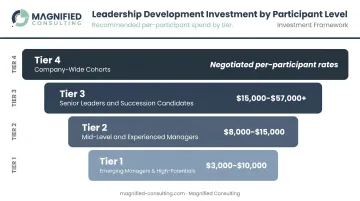
A rough framework for budget calibration:
| Participant Level | Typical Range |
|---|---|
| Emerging managers and high-potentials | $3,000–$10,000 per participant |
| Mid-level and experienced managers | $8,000–$15,000 per participant |
| Senior leaders and succession candidates | $15,000–$57,000+ depending on depth |
| Company-wide cohorts | Negotiate per-participant rates; boutique firms often outperform off-the-shelf programs at scale |
For privately owned and family-run businesses, leadership transitions don't happen in isolation. They intersect with ownership succession, estate planning, and long-term business value — which means the development investment needs to connect directly to business strategy, not sit apart from it. Magnified Consulting works with businesses navigating exactly this overlap, aligning leadership development with succession planning and exit readiness so the two reinforce each other.
What Most Companies Get Wrong About Leadership Development Costs
Most budget mistakes in leadership development aren't about spending too much. They're about spending on the wrong things. Three patterns account for the majority of wasted investment:
Focusing only on the upfront price. A $2,000 workshop with no reinforcement structure delivers less than a $10,000 engagement built around accountability and application. The hidden cost of learning that doesn't stick is rarely visible until a year later, when nothing has changed.
Cost-shopping without evaluating fit. Choosing the cheapest option without assessing facilitator experience, program design, or alignment to business goals leads to wasted spend and leadership teams that feel unchanged. Price and value are different metrics.
Treating development as a one-time event. Companies that see the strongest ROI build it into an ongoing cadence, not a single annual training day. ATD has identified 12 distinct levers of transfer effectiveness — most of which require sustained organizational commitment, not just program attendance. One day of training rarely moves the needle on its own.
Getting the cost equation right starts with understanding what you're actually buying — and what reinforcement you're putting around it.
Frequently Asked Questions
How much do corporate leadership programs cost?
Corporate leadership programs range from under $500 for self-directed options, to $1,500–$15,000 per participant for structured group programs and bootcamps, to $15,000–$80,000+ for senior executive education. Cost depends heavily on program type, delivery format, and the level of customization and coaching included.
Are corporate leadership programs worth the cost?
Well-designed programs aligned to specific business goals typically deliver strong returns — particularly when you factor in the cost of leadership gaps like turnover, team disengagement, and poor operational decisions. Programs that don't fit the business or lack reinforcement rarely pay off, no matter the price.
What is the 70-20-10 rule for leaders?
The 70-20-10 model suggests 70% of leadership development comes from on-the-job experience, 20% from coaching and relationships, and 10% from formal training. Standalone programs have limited impact without experiential reinforcement built in.
What factors affect the cost of leadership development programs?
Primary cost drivers include program type, delivery format (in-person vs. virtual), level of customization, facilitator credentials, group size, and whether ongoing coaching and accountability structures are built into the program.
How can companies measure the ROI of a leadership development program?
Track pre- and post-program metrics: manager performance ratings, employee retention, team productivity, and revenue or efficiency outcomes. Setting measurement benchmarks before the program starts is critical — without a baseline, ROI stays anecdotal.
What is the difference between in-house and external leadership development programs in terms of cost?
In-house programs cost more upfront but scale efficiently; external programs offer ready-built frameworks at a premium. A blended model — external design with internal reinforcement — typically delivers the best balance of cost and lasting impact.