Introduction
Picture this: an inspector arrives at your facility unannounced, or a notice of violation lands in your mailbox on a Tuesday morning. No warning. No heads-up from a regulator. Just a letter outlining violations you may not have known existed.
This happens more often than most small business owners expect. The EPA oversees more than 800,000 regulated facilities through its public ECHO database — and that system logs every inspection, violation, and penalty for anyone to search.
Environmental compliance risk is not a large-corporation problem. Privately owned manufacturers, construction firms, retailers, and transportation companies all carry real exposure. The financial penalties, operational disruptions, and reputational damage from being caught unprepared can follow a business for years.
This article covers what environmental compliance risk actually means, where the most serious violations tend to occur, and how to get ahead of your exposure before a regulator identifies it for you.
Key Takeaways
- Environmental compliance risks span EPA, OSHA, and state regulations covering air quality, hazardous waste, water discharge, and chemical handling
- Non-compliance can trigger fines up to $124,426 per violation per day under certain statutes
- Manufacturing, construction, and transportation carry the highest regulatory exposure
- Unresolved environmental liabilities erode business value and can derail M&A transactions entirely
- Proactive audits, documented policies, and ongoing monitoring are your strongest defense against regulatory action and financial exposure
What Is Environmental Compliance Risk?
Environmental compliance risk is the potential legal, financial, and operational harm a business faces when its operations fail to meet federal, state, or local environmental laws — whether the violations were intentional or not.
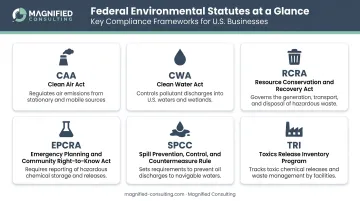
The primary regulatory frameworks business owners need to understand:
| Statute/Program | What It Covers |
|---|---|
| Clean Air Act (CAA) | Air emissions from stationary and mobile sources |
| Clean Water Act (CWA) | Pollutant discharges into U.S. waters |
| RCRA | Hazardous waste from generation through disposal |
| EPCRA | Chemical storage, use, and release reporting |
| SPCC | Oil spill prevention plans for covered facilities |
| TRI | Tracking and reporting of toxic chemical management |
The Notification Gap
Most business owners miss a critical point: regulators do not proactively inform you which rules apply to your operations. As Wisconsin DNR makes clear, facilities must determine which permit applications, reports, and notifications apply to them — and then comply.
The EPA's enforcement and penalty systems are systematic and well-resourced. Its outreach to help businesses understand upcoming requirements is not. Knowing the rules is your responsibility, not theirs.
Compliance obligations attach to what you do, not how large your company is or whether you are publicly traded. The determining factors are:
- Emissions levels and air quality thresholds
- Waste generation volume and hazardous material classification
- Chemical storage quantities and release reporting triggers
- Land disturbance activity and industry classification
Common Environmental Compliance Risks Businesses Face
Hazardous Waste Mismanagement
RCRA gives the EPA cradle-to-grave authority over hazardous waste. Common violations include improper storage, missing or incorrect labels, unlicensed disposal, and incomplete recordkeeping.
Many manufacturers, construction firms, and transportation operators handle regulated materials daily without realizing those materials create generator obligations. Common triggers include:
- Solvents, paints, and industrial cleaning chemicals
- Used oils from vehicle or equipment maintenance
- Batteries (including lead-acid) and electronic waste
Used oil alone carries specific management requirements for vehicle maintenance operations.
Air Emission Violations
Clean Air Act obligations apply to businesses with stationary sources of emissions — equipment, processes, or facilities that release regulated pollutants. Common violations include:
- Failure to obtain required air permits before operating equipment
- Exceeding allowable emission limits
- Missing required monitoring and reporting submissions
Permit requirements vary significantly by state and equipment type, which is why many small businesses discover they needed a permit only after an inspection.
Stormwater and Water Discharge Non-Compliance
NPDES permit coverage is required for stormwater discharges from construction sites disturbing one acre or more — or less than one acre if the site is part of a larger common plan. That threshold catches far more projects than most contractors realize.
Industrial facilities have parallel obligations. Stormwater Pollution Prevention Plans (SWPPPs) must be developed, implemented, and maintained — not just filed once and forgotten.
Chemical Reporting Obligations
EPCRA Tier II reporting applies when a facility stores OSHA SDS hazardous chemicals at 10,000 pounds or more, or extremely hazardous substances at 500 pounds or the threshold planning quantity, whichever is lower.
Everyday materials can push a facility past these thresholds faster than expected:
- Fuels and petroleum products stored on-site
- Lead-acid batteries (sulfuric acid is the trigger chemical)
- Common industrial lubricants and coolants
Missing a filing deadline does not eliminate the obligation — it adds a violation.
Spill Prevention Plan Failures
SPCC regulations apply to non-transportation facilities storing more than 1,320 gallons of oil aboveground or 42,000 gallons underground, with a reasonable potential to discharge to navigable waters. Facilities that commonly hit these thresholds include:
- Fleet maintenance shops with bulk fuel storage
- Agricultural or industrial operations with multiple oil tanks
- Fuel storage facilities serving construction or transportation fleets
The absence of a written, facility-specific plan — not just a spill — constitutes a violation.
The Real Consequences of Non-Compliance
Monetary Penalties
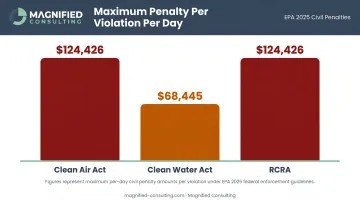
EPA's 2025 civil penalty inflation adjustments set the current per-day maximums at:
- $124,426 per violation per day under the Clean Air Act (42 USC 7413(b))
- $68,445 per violation per day under the Clean Water Act (33 USC 1319(d))
- $124,426 per violation per day under RCRA (42 USC 6928(a)(3))
These are per-day figures. Multi-year enforcement actions can produce penalty totals that dwarf the original violation. EPA recently fined Scranton Manufacturing Company $50,208 for RCRA hazardous waste violations in Iowa — a mid-sized penalty, but one that arrived with compliance deadlines, corrective action requirements, and a public record.
Operational Disruption
Beyond the financial penalties, non-compliance can stop operations entirely. Businesses may be required to halt specific processes — or shut down altogether — until corrections are in place. That means idle workers, missed delivery windows, delayed contracts, and lost revenue, often while bearing the cost of remediation.
Third-Party Lawsuits
Most major federal environmental statutes authorize citizen suits. Under CAA Section 7604, CWA Section 1365, and RCRA Section 6972, any person — including environmental advocacy organizations and neighboring communities — can bring civil action against alleged violators, independent of government enforcement. These groups often operate with experienced legal teams and sufficient funding to litigate aggressively.
Reputational and Relationship Damage
Every EPA inspection, violation, and penalty settlement is logged in ECHO, the publicly searchable Enforcement and Compliance History Online database. Customers, lenders, investors, and potential buyers can search your facility's compliance history with a few clicks.
As ESG scrutiny intensifies among institutional lenders and larger buyers, a visible enforcement history can damage relationships that took years to build.
Business Valuation and M&A Impact
Unresolved environmental liabilities create serious complications in any ownership transition. According to SCS Engineers, environmental liabilities can affect deal valuation directly, leading buyers to negotiate lower prices or demand indemnification provisions.
The ABA's 2025 EHS due diligence guidance confirms that environment, health, and safety issues affect transaction structure and risk allocation in M&A agreements. For family-owned businesses planning a sale or generational transfer, undisclosed compliance exposure can:
- Reduce the final sale price
- Delay or derail closing
- Expose the former owner to post-sale liability
Industries with the Highest Environmental Compliance Exposure
Not every business faces the same level of regulatory complexity. Three sectors consistently carry multiple overlapping obligations:
Manufacturing carries the broadest exposure. A single facility can face simultaneous obligations across five or more federal programs:
- RCRA: Hazardous waste generation and disposal
- Clean Air Act: Emission permits and reporting
- EPCRA: Chemical inventory disclosure
- TRI: Toxic release tracking
- Clean Water Act: Stormwater and discharge permits
EPA maintains dedicated NAICS manufacturing regulatory pages precisely because this regulatory footprint is that extensive.
Construction and home services businesses development face project-by-project variation. Stormwater permit requirements, land disturbance thresholds, and jurisdiction-specific rules shift from one job site to the next. EPA enforcement actions against construction companies in Massachusetts and New Hampshire for stormwater violations resulted in settlements reaching tens of thousands per company — a reminder that project-level compliance gaps carry real financial consequences.
Transportation and logistics businesses often underestimate their exposure. Fleet maintenance operations generate hazardous waste — used oil, solvents, and filters all qualify. Fuel storage above SPCC thresholds triggers spill prevention plan obligations. Hazardous materials handling during transport adds another regulatory layer entirely.
How to Reduce Your Environmental Compliance Risk
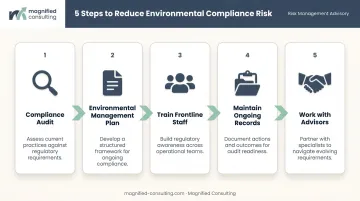
Step 1: Conduct a Compliance Audit
A compliance audit or gap assessment is the essential first step. It reviews current operations against applicable federal, state, and local regulations to identify where the business stands and what requires immediate attention.
EPA has developed audit protocols specifically to assist businesses — and its Audit Policy provides meaningful incentive: businesses with 100 or fewer employees that voluntarily discover, disclose, and correct violations may qualify for full civil penalty waivers. That policy only helps you if you find the problem before an inspector does.
Step 2: Build a Documented Environmental Management Plan
An Environmental Management Plan (EMP) translates compliance obligations into operational procedures. At minimum, it should cover:
- Waste handling and disposal procedures
- Spill response protocols
- Permit tracking and renewal schedules
- Employee roles and responsibilities for compliance tasks
- Inspection and recordkeeping requirements
Documentation matters. A written plan that employees actually follow is also evidence of good-faith compliance if a violation is later discovered.
Step 3: Train Frontline Staff
Most compliance failures happen at the operational level. Frontline workers who handle chemicals, manage waste, or operate permitted equipment need to understand the requirements. Documented training records serve a dual purpose: they reinforce proper practices and demonstrate good faith during regulatory inspections.
Step 4: Maintain Ongoing Records
Regulators want evidence of consistent, documented compliance over time — not a one-time effort. Maintain:
- Inspection logs
- Permit records and renewal documentation
- Training completion records
- Corrective action documentation
Step 5: Work with Advisors Who Understand Operational Risk
Environmental compliance exposure is one piece of a broader operational risk picture. Working with advisors who understand your industry means you can identify regulatory vulnerabilities before they surface during an audit, a business sale, or a financing event.
Magnified Consulting's Risk Management services include regulatory compliance assessment for privately owned businesses in manufacturing, construction, transportation, and related sectors — helping you understand your exposure and act on it before it affects profitability or business value.
Frequently Asked Questions
What are common environmental risks for businesses?
The most frequent categories include:
- Hazardous waste mismanagement
- Air emission permit violations
- Stormwater discharge non-compliance
- EPCRA chemical inventory reporting failures
- Inadequate or missing SPCC plans
Any business handling chemicals, fuel, or regulated waste should assess exposure across all five areas.
What happens if a business is not in environmental compliance?
Consequences can include:
- Fines that accumulate per violation per day
- Mandatory operational shutdowns until corrections are made
- Third-party citizen lawsuits
- Reputational damage visible through EPA's public ECHO database
- Increased scrutiny on future inspections
Which industries face the highest environmental compliance risks?
Manufacturing, construction, transportation, and home services businesses development carry the broadest regulatory exposure due to the nature of their operations — hazardous waste generation, stormwater discharge, fuel storage, and chemical handling all trigger overlapping federal and state requirements.
How does environmental non-compliance affect business value?
Unresolved environmental liabilities can reduce appraised value, prompt buyers to negotiate lower prices or demand indemnification, and expose sellers to post-sale legal liability. In M&A due diligence, buyers can search compliance history, and it directly affects deal structure.
What is the first step to assess my business's environmental compliance?
A compliance audit or gap assessment — reviewing current operations against applicable federal, state, and local regulations — is the essential starting point. It identifies where your business stands, which regulations apply, and what corrective actions to prioritize.
Can small businesses be fined for environmental violations?
Yes — company size provides no protection from EPA enforcement. Fines accumulate per violation per day, and citizen suit provisions allow third parties to sue at any scale. EPA's small business policy offers penalty relief only for violations that are voluntarily discovered, disclosed, and corrected.