Introduction
Picture a manufacturing company in its third decade. Revenue is solid, the brand is respected, and the founding generation built something real. But now, two siblings in leadership haven't had a direct conversation in months. A decision about a major equipment investment has been tabled three times. And nobody has said out loud who runs the company when Dad steps back — though everyone has an opinion.
This isn't a failing business. It's a family business experiencing the specific, layered complexity that no general management consultant is designed to address.
According to the 2025 Family Enterprise USA Annual Survey, family businesses account for 59% of the US private-sector workforce and 54% of US GDP. They're the backbone of the American economy, and they carry a set of challenges that are fundamentally different from those facing publicly traded companies or private equity-backed firms.
This article covers the specific problems a family business consultant is built to solve — from ownership disputes and stalled decisions to succession gaps and governance breakdowns — so you can judge whether outside help is worth pursuing.
Key Takeaways
- A family business consultant works at the intersection of family dynamics, operations, and strategy.
- Common problems they solve include escalating conflict, operational inefficiency, succession uncertainty, and compensation disputes.
- The best time to call one is before problems become entrenched — patterns matter more than single incidents.
- Proactive engagement produces better outcomes than waiting for a crisis to act.
What Does a Family Business Consultant Actually Do?
A family business consultant works on the business as a system — how family relationships, ownership structures, leadership decisions, and financial performance interact with and constrain each other. The role overlaps with general advisory, mediation, and estate planning at times, but the scope is broader than any one of those disciplines.
Their primary function is helping family-owned businesses make better, faster decisions by removing the emotional and structural barriers that prevent progress. They don't manage the business. They build the owner's and family's capacity to manage it better.
How the Work Actually Gets Structured
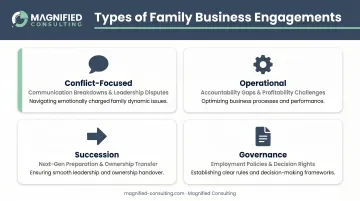
The scope of any engagement varies considerably depending on what the business needs:
- Conflict-focused engagements address communication breakdowns, leadership disputes, and unresolved grievances between family members
- Operational engagements tackle accountability gaps, workflow inefficiencies, and profitability challenges that persist because of family dynamics
- Succession engagements prepare the next generation, structure ownership transfer, and facilitate the outgoing leader's exit
- Governance engagements put formal frameworks in place — employment policies, compensation benchmarks, decision rights, and family councils
At Magnified Consulting, this work is delivered through direct partner involvement, not handed off to junior analysts. Partners Mark Elender, Amanda Gurski, and Brian Elender bring a track record that includes involvement in over $1.5 Billion in mergers and acquisitions and $300 million in capital purchasing decisions. That depth of operational and financial experience is what allows them to address both the business mechanics and the family dynamics of each engagement at the same time.
Problem 1: Family Conflict That Stalls Business Decisions
Why Family Conflict Is Different
Conflict in a family business is rarely just about the business decision at hand. It carries the weight of personal history, identity, and unspoken expectations built over decades. A disagreement about whether to expand into a new market is also a disagreement about whose judgment gets respected. That's why it's more emotionally charged — and harder to resolve — than a typical workplace dispute.
The patterns that signal conflict has become a business problem:
- Important decisions repeatedly deferred or tabled without resolution
- Key family members communicating through intermediaries rather than directly
- Meetings derailed by grievances that predate the company
- Informal alliances forming among family members in leadership
- High-performing non-family employees quietly updating their resumes
What a Consultant Does Differently
A consultant provides a structured, neutral process that separates the emotional dimension from the business decision — helping each party understand what's actually driving the disagreement, not just what it looks like on the surface. Agreements built this way hold over time because they address underlying interests, not just stated positions.
That process also points toward a longer-term fix: governance. Establishing clear rules of engagement, defined decision-making authority, and communication protocols before conflict surfaces prevents the same disputes from cycling back and consuming leadership attention.
The numbers make the case for acting early. A 2023 Campden Wealth report found that nearly half of family businesses had experienced family conflict — yet only 23% relied on external support when disputes arose. A 2025 Family Business Magazine survey found that 75% of family businesses had no formal dispute-resolution process in place. By the time most families seek help, the conflict has already damaged trust and stalled decisions that should have been made months earlier.
Problem 2: Operational Inefficiency and Profitability Gaps
The Family Business Blind Spot
In a non-family business, a persistently underperforming team member gets addressed. An unclear role creates confusion, someone flags it, it gets fixed. In a family business, that same problem can persist for years because the person in the unclear role is the owner's son-in-law, and nobody wants to have that conversation.
This is the operational blind spot that distinguishes family businesses: accountability runs through personal relationships rather than clear structures. Inefficiencies that would surface quickly elsewhere get quietly tolerated — and the margin impact quietly accumulates.
Where a Consultant Adds Value
A family business consultant approaches operational improvement differently from a pure management consultant. Every recommendation has to work within the family context — not just on paper. That means addressing the human dynamics reinforcing the inefficiency, not just redrawing the org chart.
Specific operational areas where outside expertise typically matters most:
- Role clarity — defining accountability across departments when family relationships have blurred reporting lines
- Cost leakage — identifying where margin is eroding through redundant processes or untracked spending
- Cash flow management — improving the visibility and predictability of working capital
- Workflow restructuring — redesigning processes for efficiency rather than organizational comfort
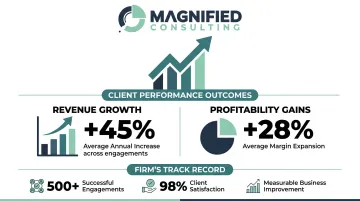
The profitability impact of these improvements tends to be outsized precisely because the problems have been tolerated longer. One Magnified Consulting client — a family-owned retail business — achieved double-digit revenue growth within 18 months through targeted operational work. Across engagements, clients have seen a 20% increase in profitability within the first six months of implementation.
That scale of impact isn't unusual. Nearly half of family businesses in PwC's US family business survey cite supply-chain and operational cost pressures as a top concern — meaning these aren't edge cases. They're the norm for businesses that have prioritized relationships over process for years.
Problem 3: Succession Planning and Leadership Transitions
Why Succession Is the Hardest Problem
Succession isn't just about naming a next leader. It involves at least four separate challenges running simultaneously:
- Aligning expectations across family members with very different assumptions about fairness
- Preparing an incoming leader who may not yet be ready for what the role demands
- Managing the outgoing leader's exit — often more emotionally complex than anyone anticipates
- Keeping the business performing through a period when attention is inevitably divided
The gap between what's planned and what's needed is significant. PwC's US Family Business Survey found that only 34% of US family businesses had a robust, documented, and communicated succession plan in place. Succession affected 44% of US family firms in the past year alone.
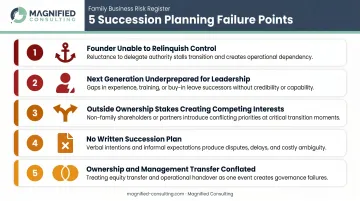
The Most Common Failure Points
- The founder cannot let go, and no formal transition date exists
- The next generation hasn't been adequately prepared for leadership demands
- Family members outside the business hold ownership stakes that create competing interests
- There is no written plan — only assumptions that different people interpret differently
- Ownership transfer and management transition are treated as the same decision, on the same timeline, when they require separate structures
What a Consultant Contributes
A consultant assesses leadership readiness across generations and defines criteria for who leads based on capability rather than birth order. They structure the timeline, clarify role transitions, and facilitate the difficult conversations between outgoing and incoming leaders that rarely happen on their own.
The divide between family members inside the business and those outside it is where succession most often breaks down. Children in the business versus those who aren't. Fairness expectations versus meritocracy. A consultant establishes transparent frameworks that address these dynamics directly — before unspoken assumptions harden into lasting conflict.
That structural rigor is where Magnified Consulting's background becomes relevant. With direct involvement in over $1.5 Billion in M&A transactions, the team understands what business transitions require at a financial and operational level — not just a relational one. Succession is a family conversation, yes. It's also a business transaction, and it needs to be executed accordingly.
Problem 4: Family Employment, Compensation, and Governance Gaps
The Governance Vacuum
Without a formal family employment policy, every decision about who joins the business, what role they take, and what they earn is made informally. Informality breeds resentment — among family members who perceive favoritism, and among non-family employees who see a glass ceiling they can't break through regardless of performance.
PwC research found that only 30% of family businesses have a written family constitution. This governance gap isn't an edge case. It's the default state for most family firms.
What Good Governance Looks Like
A consultant helps put the core components in place:
- Establishes entry requirements, role definitions, and expectations before anyone joins
- Benchmarks compensation to market rate and role — not family status or ownership stake
- Applies performance reviews consistently, regardless of last name
- Defines decision rights so everyone knows who decides what, and when broader family input is required
The Non-Family Employee Dimension
High-performing non-family employees notice when compensation or advancement tracks family relationships rather than contribution — and the best ones leave for companies where it doesn't. A well-structured governance framework sends a clear signal: performance determines advancement, not surname. That distinction shapes recruiting, retention, and culture in ways that extend well beyond the family itself.
How to Know When Your Family Business Needs Outside Help
The clearest signals that it's time to bring in a consultant:
- The same conflict resurfaces repeatedly without resolution, just with different surface-level triggers
- Important business decisions are being delayed because of interpersonal dynamics rather than missing information
- A leadership transition is approaching with no formal plan, only assumptions
- The business has plateaued despite the owner knowing what changes need to happen — the problem isn't insight, it's execution
- Non-family employees are leaving or disengaging without clear cause
Families don't need to be in crisis to benefit. Engaging before problems become entrenched keeps more options on the table — and significantly reduces both the cost and the complexity of the work.
Magnified Consulting works with privately owned and family-run businesses across Charlotte, Columbia, South Carolina, Myrtle Beach, Savannah, and Charleston — primarily businesses generating over $10 million in revenue that are navigating real complexity: ownership transitions, multi-generational structures, operational plateaus, and growth decisions that require more than surface-level advice.
Frequently Asked Questions
What does a family business consultant do?
A family business consultant helps privately-owned and family-run businesses address challenges that sit at the intersection of family relationships, business operations, and ownership structure. Their work spans conflict resolution, governance design, succession planning, and operational performance — often at the same time, because these problems are rarely separate.
How should a family business compensate family members fairly?
Compensate family members based on their role, responsibilities, and market rate for that position — not family status or ownership stake. A written compensation policy, built into a broader family employment framework, prevents resentment and sets consistent standards across the organization.
How can parents reduce succession conflict between children who work in the business and those who don't?
Establish transparent, written criteria for leadership succession early — and keep them separate from ownership distribution. Involving all relevant family members in that process builds aligned expectations, which eliminates the assumptions that most commonly cause conflict when succession decisions are finally made.
When should a family business hire a consultant?
Crisis moments like an approaching ownership transfer or escalating conflict are common triggers, but the ideal time is before problems become entrenched — particularly when the business is growing, a generational transition is on the horizon, or important decisions are consistently being avoided.
How is a family business consultant different from a regular business consultant?
A general business consultant typically focuses on strategy, operations, or finance in isolation. A family business consultant addresses how the family system itself shapes and constrains business decisions, accounting for relationship dynamics, ownership complexity, and generational differences in every recommendation they make.