Introduction
Picture this: a manufacturer in the Carolinas loses a major supply contract during routine vendor qualification — not because of product quality, but because an auditor found incomplete waste disposal records from two years prior. No cleanup. No spill. Just missing paperwork.
That's how fast a waste management gap turns into a business problem.
Most business owners treat waste management as a logistical detail — something handled by a vendor, filed away, and forgotten. The reality is more consequential. Poor waste practices create regulatory exposure, inflate operating costs, and complicate financing.
They can also derail a business sale before a buyer ever makes an offer.
EPA enforcement activity climbed in FY 2024, with 8,533 on-site inspections — up 9.6% from FY 2023 — and $1.72 billion in administrative and civil penalties assessed. The scrutiny is increasing, not leveling off.
That trend has direct consequences for businesses across manufacturing, construction, transportation, and retail. This guide covers the real risks of poor waste practices, the financial and legal consequences across industries, and practical mitigation steps that protect what you've built.
Key Takeaways
- Federal RCRA regulations hold you legally responsible for your waste from generation through final disposal — even after a vendor collects it.
- Civil penalties for hazardous waste violations can reach $93,058 per day per violation.
- Construction, manufacturing, and retail each carry distinct waste risks that require industry-specific attention.
- Documentation gaps — not just violations — are what trigger enforcement actions and kill business deals.
- An annual waste audit is the single highest-return compliance investment most businesses overlook.
Why Waste Management Is a Business Risk, Not Just an Environmental Issue
Most business owners assume that hiring a waste vendor means the problem is handled. It doesn't. Removing waste and managing it are two entirely different things.
What happens after your waste leaves the facility — where it goes, how it's classified, whether it's documented at every handoff — determines your actual legal exposure. Under the federal Resource Conservation and Recovery Act (RCRA), generators bear cradle-to-grave responsibility for how their waste is handled from point of generation through final disposal.
That obligation doesn't transfer when you hire a hauler.
What Cradle-to-Grave Responsibility Actually Means
Under 40 CFR Part 262, your obligations as a generator include:
- Determining whether your waste is hazardous
- Properly labeling, storing, and packaging waste before transport
- Using licensed transporters and permitted disposal facilities
- Maintaining manifests and records proving proper disposition
- Reporting to regulatory agencies when required
Hiring a vendor handles the logistics — the legal accountability stays with you, regardless of who touched the waste last.
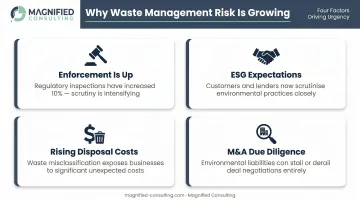
That accountability matters more now than it did five years ago. The compliance environment has tightened, and several forces are pushing it further:
Why the Risk Is Growing
- Enforcement is up — EPA concluded 1,851 civil enforcement cases in FY 2024, with inspections increasing nearly 10% year-over-year.
- ESG expectations — customers, lenders, and private equity buyers are scrutinizing environmental practices as part of business evaluation.
- Disposal costs — landfill tipping fees and hazardous waste treatment costs have risen, making misclassified waste streams more expensive to correct after the fact.
- M&A due diligence — environmental liability reviews are standard in business transactions, and undisclosed waste issues routinely affect deal terms or kill transactions entirely.
For privately owned and family-run businesses, the stakes are especially high — a single enforcement action or deal-killing environmental liability can erase years of built value. That's what makes this a risk management issue, not just an operations one.
The Real Costs of Poor Waste Management
Direct Financial Exposure
The penalty ceiling for RCRA Subtitle C hazardous waste violations is $93,058 per day per violation under current EPA civil monetary penalty tables. Each missed label, improper storage period, or incomplete manifest is a separate potential violation.
Real enforcement cases show the range:
| Company | Sector | Outcome |
|---|---|---|
| Walmart | Retail | $7.6M civil penalty for RCRA and FIFRA violations |
| Stericycle | Hazardous waste services | $9.5M settlement for RCRA violations (2025) |
| Bakelite Chemicals, Conway, NC | Manufacturing | $130,000 penalty for hazardous waste violations (2024) |
| Whole Foods | Retail | Enhanced waste management systems required across all stores |
Indirect Costs That Often Exceed the Fines
These are harder to see until a crisis surfaces them:
- Lost recyclable material revenue from waste streams that weren't captured or properly sorted
- Supply chain friction when customers or large buyers require documented compliance as a contracting condition
- Operational inefficiency from misclassified waste that's disposed of at the wrong cost tier
Criminal and Personal Liability
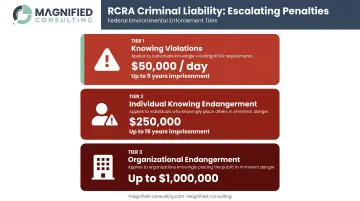
RCRA's criminal provisions carry real personal exposure. Violations involving knowing acts — disposing without a permit, transporting to unpermitted facilities, falsifying records — can result in:
- Up to $50,000 per day and 5 years imprisonment for hazardous waste knowing violations
- Up to $250,000 and 15 years for individuals in cases of knowing endangerment
- Up to $1 million for organizations in the most serious cases
For family-run businesses where owner and business assets aren't cleanly separated, that personal exposure is a real risk, not a theoretical one.
The M&A Risk Owners Frequently Underestimate
Criminal exposure isn't the only threat that surfaces late. Environmental due diligence is standard practice in business acquisitions, and firms like ERM, Antea Group, and Stantec treat environmental liability identification as a standard part of deal-stage review.
Undisclosed waste violations, documentation gaps, or contaminated sites can affect a transaction in multiple ways:
- Deal structure — buyers seek additional protections or restructure terms
- Pricing — discovered liabilities reduce valuation
- Indemnity requirements — sellers bear ongoing cleanup or penalty exposure post-close
- Transaction viability — in serious cases, deals fall apart entirely
Industry-Specific Waste Risks Business Owners Can't Ignore
Construction Industry Risks
Construction and demolition debris is the largest waste stream in the United States. EPA estimates 600 million tons of C&D debris were generated in 2018 — more than twice the volume of all municipal solid waste combined.
That volume comes with serious compliance exposure:
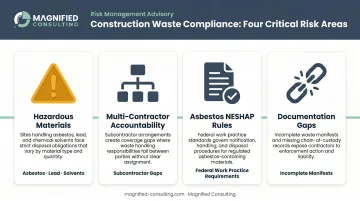
- Hazardous materials — asbestos, lead-based paint, solvents, and chemical residues are common on renovation and demolition sites and subject to specific federal and state handling requirements.
- Multi-contractor complexity — waste responsibility on a job site with multiple subcontractors creates accountability gaps if not explicitly managed.
- Asbestos NESHAP regulations — EPA specifies strict work practice requirements for asbestos during demolition and renovation of qualifying structures.
- Documentation gaps — incomplete waste manifests and disposal records are among the most common violations cited on construction sites.
The compounding risk: improper hazardous material disposal creates both environmental liability and OSHA worker safety exposure simultaneously.
Manufacturing Industry Risks
Manufacturers face a more complex waste profile than most sectors. Industrial by-products, chemical residues, process water, scrap metal, spent solvents, and packaging waste often coexist in a single facility — each with its own disposal requirements.
The most common and costly error is misclassification — treating hazardous waste as general waste. That single decision triggers Subtitle C noncompliance and exposes the business to the full range of RCRA civil penalties.
Large Quantity Generators — facilities producing 1,000 kg or more of hazardous waste per month — must submit biennial reports on the nature, quantities, and disposition of waste generated. Missing or inaccurate filings are an enforcement red flag.
Major customers now require documented waste compliance as a condition of doing business. That makes compliance a supply chain qualification issue, not just a regulatory one.
Retail and Professional Services Risks
Retail businesses face two distinct pressures. First, high-volume packaging waste has drawn increasing legislative attention: 150 EPR (Extended Producer Responsibility) laws have been enacted in 34 states and D.C. across 22 product categories, including packaging. Compliance requirements vary by state and are expanding.
Second, the reputational exposure is more immediate in retail than in most sectors — sustainability shortfalls are visible to customers in ways that manufacturing violations typically aren't.
Professional services firms face a different problem: regulated waste streams that don't look like waste at all. Common blind spots include:
- Electronics — devices containing lead and mercury fall under federal universal waste regulations
- Specialty materials — certain chemicals and consumables trigger handling requirements most offices never anticipate
- Confidential documents — some destruction methods create compliance exposure under data protection and environmental rules
These gaps often go unnoticed until an audit or due diligence review forces them into the open.
Practical Risk Mitigation Strategies for Business Owners
1. Conduct a Formal Waste Audit
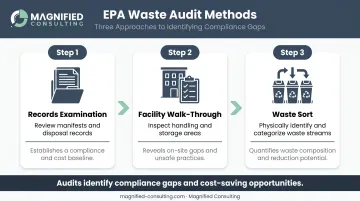
Before you can manage waste risk, you need a clear picture of what your operation actually generates. EPA describes three core audit approaches — records examination, facility walk-throughs, and waste sorts — and together, they identify:
- Every waste stream your operation generates
- Current handling, segregation, and disposal methods
- Documentation gaps or manifest inconsistencies
- Materials that could be recovered or recycled rather than disposed of
Audits frequently uncover cost savings alongside compliance gaps — recyclable materials being landfilled, waste streams misclassified at a higher disposal cost tier, or vendor contracts that don't align with actual waste volumes.
2. Know Your Regulatory Obligations
The federal framework is RCRA, enforced by EPA. State agencies layer additional requirements on top, and those vary meaningfully. Businesses in North Carolina, South Carolina, and Georgia each operate under state-specific hazardous waste rules administered by NC DEQ, SC DHEC, and Georgia EPD respectively.
The most important distinction to get right is hazardous vs. non-hazardous waste. Hazardous waste carries far stricter requirements for storage time, container labeling, transport documentation, and disposal facility selection. Misclassifying waste in either direction creates financial and legal exposure that's difficult to unwind once an audit or enforcement action begins.
Regulatory obligations are not static. Generator thresholds, product-specific EPR laws, and state rules change. Staying current is an active responsibility, not a one-time review.
3. Partner With Licensed, Verified Waste Handlers
Working with a licensed waste management vendor reduces risk, but doesn't transfer it. You remain the responsible generator under RCRA regardless of who handles the waste.
Before engaging or continuing with a vendor, verify:
- EPA and state permits are current (searchable via RCRAInfo and ECHO)
- The vendor provides complete manifests tracing waste to a permitted final destination
- Records are available if you need them for an audit or due diligence request
- The vendor's own compliance history doesn't create exposure by association
4. Build a Documentation and Record-Keeping System
The ability to prove compliance is as important as achieving it. Under 40 CFR 262.40, generators must retain signed manifests, biennial reports, and exception reports for at least three years, with extensions if an enforcement action is pending or EPA requests additional records.
Records to maintain:
- Signed waste manifests for all hazardous waste shipments
- Vendor permits and certifications
- Disposal confirmations from receiving facilities
- Internal inspection and training records
- Any correspondence with regulatory agencies
In enforcement cases, inadequate records are often what convert a minor compliance question into significant penalties — because regulators default to worst-case assumptions when paper trails are missing.
5. Train Staff and Assign Accountability
Most waste compliance failures happen at the operational level: employees who don't know how to segregate waste streams, what to do when a material requires special handling, or who to contact after a spill.
An effective training program covers:
- Waste identification and segregation by stream
- Storage and labeling requirements by material type
- Emergency notification procedures
- Documentation responsibilities at each handling step
Designate a specific person as the internal compliance owner — not a department, a named individual. When no one person owns it, gaps are inevitable.
Building a Waste Management Strategy That Protects Business Value
Businesses that manage waste systematically don't just reduce regulatory risk — they cut disposal costs, improve operational efficiency, and strengthen their position with customers, lenders, and buyers. EPA's WasteWise program documented that participating organizations prevented and diverted over 1.9 million tons of waste and saved nearly $100 million in avoided landfill tipping fees in a single program year. That's cost reduction, not just compliance.
For owners planning a future exit, recapitalization, or ownership transition, clean environmental records carry direct commercial value. Environmental and ESG due diligence is a standard workstream in transactions. Documentation gaps, unresolved violations, or inconsistent vendor records can restructure deal terms or introduce serious friction at the worst possible time.
The practical challenge is that most privately owned businesses don't have internal capacity to evaluate these systems objectively. Outside advisory support fills that gap — not by replacing technical waste specialists, but by assessing where compliance and operational gaps exist. The goal is building documented processes and accountability structures that hold up under audit scrutiny and present the business accurately when it matters most.
That's where Magnified Consulting comes in. Working with privately owned and family-run businesses across manufacturing, construction, and retail — many generating over $10M in revenue — the firm identifies operational risk, builds compliance-ready processes, and prepares businesses for successful transitions. Their Risk Management & Compliance and Operational Efficiency services are built for businesses that need to close compliance gaps before a sale, audit, or regulatory review.
Frequently Asked Questions
What are the biggest risks of poor waste management for businesses?
The primary risk categories are regulatory fines, environmental cleanup liability, reputational damage with customers and partners, and operational inefficiency from mismanaged waste streams. For privately owned businesses, personal liability exposure under RCRA's criminal provisions is an additional risk that owners frequently miss.
What U.S. regulations govern business waste management?
The Resource Conservation and Recovery Act (RCRA), enforced by the EPA, is the primary federal framework. State environmental agencies — including NC DEQ, SC DHEC, and Georgia EPD in the Southeast — add additional requirements. Businesses remain legally responsible for compliance regardless of who handles their waste.
How can improper waste disposal affect my company's valuation or a future business sale?
Environmental due diligence is standard in business acquisitions, and buyers routinely identify undisclosed waste violations, documentation gaps, or historical disposal issues. These findings affect deal structure, purchase price, indemnity requirements, or whether the deal closes at all.
What is the difference between hazardous and non-hazardous waste, and why does it matter?
Hazardous waste is subject to far stricter federal requirements for storage, transport, documentation, and disposal. Misclassifying hazardous waste as general waste is one of the most common RCRA violations — and one of the most expensive to resolve once enforcement begins.
How often should a business conduct a waste audit?
At minimum, annually. Businesses should also conduct audits when operations change, new products or materials are introduced, or regulations in their state are updated. Audits regularly surface cost savings alongside compliance gaps.
How can a business consultant help with waste management risk mitigation?
An experienced business consultant can evaluate operational processes, identify compliance and cost exposure, and implement the documented accountability systems and vendor protocols that reduce risk. For businesses preparing for a sale or audit, that structured preparation directly affects the outcome.