For businesses generating $10M or more in revenue across manufacturing, construction, retail, and professional services, this represents one of the most accessible and underutilized levers for margin improvement. Industry research shows external spend typically accounts for 50%–80% of a company's cost base — making procurement one of the largest controllable cost drivers in the business.
This article evaluates the top consulting firms helping businesses reduce costs and transform procurement — from global leaders built for enterprise-scale change to boutique firms better suited for privately owned businesses that need personalized, hands-on support.
Key Takeaways
- Most companies spend 20%–50% of revenue on procuring goods and services — making it one of the highest-impact areas for cost reduction
- Procurement transformation targets 15%–30% savings over two years, versus 3%–5% through business-as-usual efforts
- Global firms target large enterprises with complex supply chains and technology platforms
- Boutique firms like Magnified Consulting offer senior-led advisory built for privately owned and family-run businesses
- Choose based on business size, industry, and whether you need a one-time engagement or ongoing mentorship
What Is Procurement Transformation and Why Does It Matter?
Procurement transformation is the process of redesigning how a business sources goods and services, manages vendors, and governs spend.
The goal is to move from reactive, ad hoc purchasing — placing orders when stock runs low, accepting whatever price a supplier quotes — to a strategic function with measurable outcomes tied to business performance.
For privately owned businesses, this shift often happens later than it should. Growth gets prioritized. Purchasing processes that worked at $3M in revenue stay in place at $15M. Vendor relationships become entrenched without anyone asking whether better terms or alternative suppliers exist.
The financial exposure is real. Industry data shows most companies spend 20%–50% of revenue procuring goods and services. In construction specifically, procurement accounts for 40%–70% of total company spending — one of the highest concentrations across any sector.
Common triggers that push businesses to seek procurement consulting include:
- Rising input costs without corresponding revenue growth
- Supplier performance issues or supply disruptions
- Rapid business growth that outpaces purchasing infrastructure
- Upcoming capital purchases requiring strategic advisory
- Preparation for a business transition, merger, or acquisition
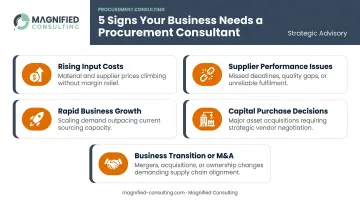
Any of these triggers signals that purchasing has outgrown its current structure. For businesses in manufacturing, construction, or transportation — where materials, equipment, and vendor relationships directly compress margins — the cost of delayed action compounds quickly. Procurement isn't a back-office function. It's where profitability is won or lost.
Top Consulting Firms for Procurement Transformation & Cost Reduction
The firms below were evaluated on depth of procurement expertise, ability to deliver measurable cost savings, client fit (enterprise vs. privately owned), and engagement approach. One important note: the right firm is the one whose model fits your business size, industry, and goals — not necessarily the most recognized name.
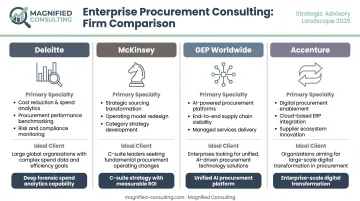
GEP Worldwide
GEP is a specialist procurement and supply chain consultancy that combines strategy consulting, technology, and managed services. Its AI-powered platform, GEP SMART, provides real-time spend visibility, automated analytics, and category management capabilities — making it a strong choice for organizations that want integrated consulting and technology in one package.
GEP was named a Leader in the 2025 Gartner Magic Quadrant for Source-to-Pay Suites, and holds the highest possible scores across 11 criteria in the Forrester Wave for Supplier Value Management Platforms.
| Attribute | Details |
|---|---|
| Specialty Focus | AI-powered procurement, spend analytics, category management, strategic sourcing |
| Ideal Client Profile | Procurement-heavy enterprises seeking integrated consulting and technology platforms |
| Key Differentiator | Proprietary GEP SMART platform combining AI analytics with managed procurement services |
Magnified Consulting
Magnified Consulting is a boutique business consulting firm based in Charleston, SC & Florence, SC, specializing in helping privately owned and family-run businesses across the Southeast achieve measurable cost reductions and operational improvements. Their focus is squarely on businesses generating $10M or more in revenue across manufacturing, construction, retail, transportation, and professional services.
Unlike the global firms above, Magnified Consulting's Partners have collectively advised on $300 million in large capital purchasing decisions — with a client-facing model built around hands-on, senior-led engagement rather than junior staffing. Their track record includes reducing production times by 30% for manufacturing clients, boosting operational efficiency by 30% for a logistics firm, and delivering a 40% profit increase within six months across multiple client engagements.
Partners remain actively involved well beyond the initial engagement, providing ongoing mentorship that enterprise-focused firms rarely extend to smaller accounts. That continuity — senior advisors who know your business — is the model's core advantage.
| Attribute | Details |
|---|---|
| Specialty Focus | Capital purchasing strategy, cost reduction, procurement efficiency, operational performance improvement |
| Ideal Client Profile | Privately owned and family-run businesses generating $10M+ in revenue across the Southeast US |
| Key Differentiator | Personalized, long-term mentorship model with $300M+ in capital purchasing advisory experience; proven track record of significant operational cost reductions |
How to Choose the Right Procurement Consulting Firm
The most common mistake businesses make when selecting a procurement consultant is choosing based on brand name rather than fit. A global firm's procurement practice is built for enterprise scale — their methodologies, staffing models, and minimum engagement sizes reflect that. A privately owned business at $15M in revenue will rarely get senior partner attention from a large enterprise-focused engagement.
The five factors that actually matter:
- Industry track record — Has the firm delivered quantifiable results for businesses in your sector, not just adjacent industries?
- Engagement model — Does the scope end at implementation, or does the firm stay involved as your operations evolve?
- Team accessibility — Will senior Partners lead your engagement day-to-day, or will junior analysts handle most of the work?
- Customization depth — Does the firm tailor strategy to your specific situation, or apply a standardized methodology regardless of context?
- Total cost relative to projected savings — A $500K consulting engagement may generate returns at enterprise scale but be disproportionate for a $12M business
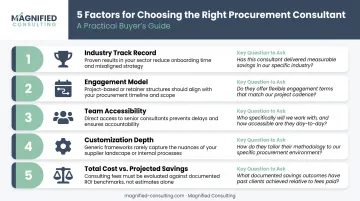
For privately owned businesses, factors 2, 3, and 4 tend to be the most decisive. The ability to access senior-level guidance throughout an engagement — not just during kickoff — and have strategy adapted to your actual operations rather than a generic framework is where boutique firms consistently outperform their larger counterparts.
There's one more factor that often separates good outcomes from wasted spend: post-implementation support. Procurement improvements require ongoing governance to hold. Without it, savings pipelines erode quickly.
Research notes that procurement transformations typically lose about one-third of planned savings in the planning phase and another 20% in execution. Firms that maintain active involvement after launch — through oversight, refinement, and accountability — are the ones that actually protect those gains.
Conclusion
The best procurement consulting firm for your business isn't the one with the largest global footprint or the most recognizable name. It's the one whose expertise, engagement model, and client focus align with where your business actually is — its size, industry, operational maturity, and goals.
For large multinationals with complex supply chains across multiple geographies, enterprise-scale firms offer the technology platforms and industry depth to drive enterprise-wide transformation.
For privately owned or family-run businesses generating $10M+ in revenue, that same model often delivers expensive frameworks with limited senior involvement — and no real continuity once the engagement closes.
Magnified Consulting was built for a different kind of client — one where capital purchasing decisions are high-stakes, vendor relationships are personal, and the right advisory needs to extend well after a project wraps up.
Ready to reduce costs and improve profitability through smarter procurement and capital purchasing decisions? Connect with Magnified Consulting to explore what that looks like for your business.
Frequently Asked Questions
What does a procurement transformation consulting firm actually do?
These firms assess purchasing and sourcing processes, identify cost reduction opportunities, and redesign how a business manages vendor relationships and spend governance. Engagements cover vendor renegotiations, sourcing strategy, contract management, and implementation support — not just high-level recommendations.
How much can a business realistically save through procurement consulting?
Industry benchmarks target 15%–30% savings over two years for enterprise-wide procurement transformations, compared to 3%–5% through business-as-usual efforts. Targeted category initiatives can deliver 10%–20% savings per initiative. Actual results depend on the quality of implementation, ongoing governance, and the complexity of your spend base.
How long does a procurement transformation engagement typically take?
Targeted sourcing projects can deliver results within a few months. Full operating model transformations typically require 12–18 months. Boutique advisory models often extend well beyond initial engagements, providing ongoing oversight to ensure savings are sustained rather than eroded over time.
What is the difference between a large global consulting firm and a boutique procurement consultant?
Large firms bring scale, proprietary technology platforms, and broad industry coverage — well suited to enterprise clients. Boutique consultants offer direct senior-partner involvement, deeper personalization, and ongoing mentorship, making them a stronger fit for privately owned or mid-sized businesses where relationships and continuity matter.
Which industries benefit most from procurement transformation consulting?
Manufacturing, construction, retail, transportation, and professional services all see outsized impact — these are sectors where procurement spend represents a significant percentage of total revenue and where capital purchasing decisions, vendor management, and strategic sourcing directly drive profitability. Construction, for example, sees procurement account for 40%–70% of total company spending.
How do I know if my business needs procurement consulting?
Key signals include rising input costs without corresponding revenue growth, inconsistent vendor pricing, no formal contract management process, and upcoming capital purchases requiring strategic advisory. Any one of these suggests a structured procurement review could uncover significant savings.