
Introduction
Many privately-owned businesses generating $7M–$10M+ have capable leaders, solid products, and a real market opportunity. Yet they consistently miss their growth targets — not because the strategy is wrong, but because leadership, operations, and priorities are pulling in different directions.
Research from the Brightline Initiative and Economist Intelligence Unit found that nearly 90% of senior executives fail to achieve all their strategic goals due to poor implementation. A separate HBR analysis by Mankins and Steele found companies realize only about 60% of their strategy's financial potential because of breakdowns between planning and execution. The strategy exists — execution is where businesses lose ground.
This article covers what strategic alignment consulting is, the warning signs of misalignment, the five pillars of execution, and when to bring in outside expertise.
Key Takeaways
- Misalignment between leadership, departments, and resources — not a bad strategy — is the most common reason privately-owned businesses miss growth targets
- Only 28% of executives and middle managers can name three of their company's top strategic priorities (per Bridges Business Consultancy)
- Strategic alignment consulting closes the gap between what's planned and what actually gets executed
- The five pillars of execution are: clarity of direction, leadership alignment, resource allocation, cross-functional accountability, and adaptability
- Strategic alignment is a direct precondition for maximizing value before a sale, succession, or capital raise
What Is Strategic Alignment Consulting — and Why Private Business Owners Should Care
Strategic alignment consulting ensures a business's vision, leadership decisions, operational structure, and team priorities are all working toward the same goals — not just documented in a strategy deck, but reflected in daily decisions and resource allocation.
Why It's Especially Critical for Private and Family-Run Businesses
Owners of privately held businesses frequently wear multiple hats simultaneously — CEO, CFO, and COO all at once. Without someone holding the organizational view, different parts of the business start moving in separate directions. Sales chases one customer type, operations is built for another, and leadership is describing a third version to partners or investors.
No single person catches it — everyone is focused on their own piece of the business.
Strategic Planning vs. Strategic Alignment
These terms get used interchangeably but describe fundamentally different activities:
| Strategic Planning | Strategic Alignment |
|---|---|
| Defines where the business is going | Ensures everyone is actually moving that direction |
| Sets goals and priorities | Connects goals to budgets, roles, and decisions |
| Happens annually (or less) | Requires ongoing attention and validation |
| Produces a document | Produces consistent execution behavior |
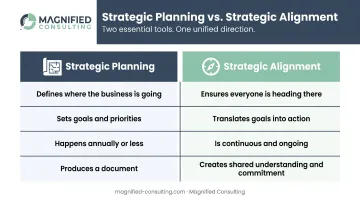
Harvard Business Publishing Corporate Learning notes that 47% of executives wish they had spent more time aligning the top team before launching major strategic initiatives. That gap — between a well-written plan and an organization that actually executes it — is exactly where private business owners lose momentum.
Warning Signs Your Strategy and Operations Are Out of Sync
Most business owners don't recognize misalignment until it's already cost them — in wasted payroll, failed initiatives, or stalled growth. These are the patterns to watch for.
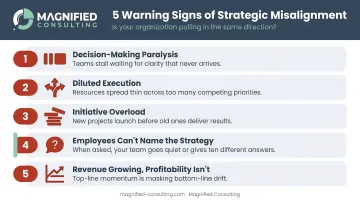
Decision-Making Paralysis
When senior leaders or ownership partners can't agree on priorities, projects stall and teams wait for direction. The cost goes beyond the delayed decision: wasted time, deferred opportunities, and a slow erosion of team confidence in leadership.
Diluted Execution
Different departments operate on their own interpretation of the strategy. Sales is targeting one customer segment, operations is structured for a different one, and leadership is promising something else entirely to capital partners. Each team is working hard — but in different directions.
Initiative Overload
The business has more "strategic" projects underway than it has people or capital to execute. This is one of the most common misalignment patterns for businesses at the $10M+ revenue mark preparing to scale. The result: a portfolio of half-finished initiatives rather than a few well-executed ones — because the business took on more than its team could realistically deliver.
Employees Can't Name the Strategy
MIT Sloan research across 4,012 respondents found that only 28% of executives and middle managers responsible for execution could list three of their company's strategic priorities. A related HBR study found only 55% of middle managers could name even one of the company's top five priorities.
When execution-level leaders can't name the strategy, daily decisions default to habit and department self-interest — not company direction.
Revenue Growing, Profitability Isn't
Growing top-line revenue while margins stay flat or shrink is a telling financial signal. Private middle-market data from Golub Capital's Q1 2026 index showed U.S. middle-market companies posting 1.4% year-over-year revenue growth while earnings were essentially unchanged at -0.1%. This pattern often points to misaligned resource allocation — spending that isn't tied to strategic priorities.
The 5 Pillars of Strategy Execution Every Leader Must Master
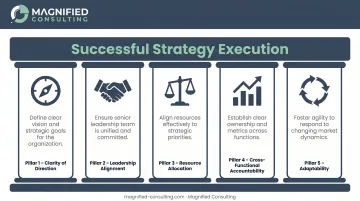
A clear strategy without a structured execution framework predictably fails. Most strategic alignment practitioners converge on five core pillars — and how well a leadership team masters each one determines execution outcomes.
Pillar 1 — Clarity of Direction
Leadership must define a clear, prioritized problem statement and guiding policy. Without it, every department creates its own interpretation, and fractured execution follows.
"Something for everyone" strategic plans are among the most common failure modes for privately-owned businesses. When everything is a priority, nothing is.
Pillar 2 — Leadership Alignment
All senior leaders and key decision-makers must be unified around the same priorities. The DaimlerChrysler merger is a well-documented example: when Daimler's hierarchical engineering culture collided with Chrysler's more flexible entrepreneurial model, strategic disagreements at the top cascaded through the entire organization. Cerberus eventually acquired Chrysler for $7.4 billion — a fraction of the original $36 billion deal value.
Executive misalignment isn't just a large-company problem. It plays out in family businesses and owner-operated firms whenever leadership partners carry different assumptions about direction into the same organization.
Pillar 3 — Resource and Decision-Right Allocation
Strategy must be backed by the right people, budget, and decision authority. HBR found that only 11% of managers believed all strategic priorities had the financial and human resources needed to succeed.
Research on resource allocation found that dynamic reallocators — companies that actively moved resources toward strategic priorities — generated 10% total shareholder returns versus 6% for sluggish reallocators, and could be worth twice as much over a 20-year period.
The practical implication: resources should follow strategic priorities, not be spread evenly across all projects.
Pillar 4 — Cross-Functional Accountability
Each department must have clear KPIs tied to the overall strategy, with regular review cycles built in from the start. Without that accountability structure, a predictable pattern emerges: strong momentum at launch, followed by gradual deprioritization until the initiative is functionally dead — still on the roadmap, but receiving no real attention or resources.
Pillar 5 — Adaptability and Course Correction
Strategy is a living framework, not an annual document. Analysis of high-performing companies found that top performers shift from a "Plan-then-Do" approach to a continuous "Decide-Do/Refine-Do" rhythm — building in regular validation and adjustment rather than treating the annual planning session as a final answer.
For privately-owned and family-run businesses, this matters even more: with fewer organizational layers to absorb strategic drift, course corrections need to happen faster and with greater intentionality.
How Strategic Alignment Consulting Works: A Practical Process
A disciplined strategic alignment engagement follows a structured sequence — diagnosis first, then strategy development, then execution support. Jumping straight to recommendations without diagnosis is a common consulting failure mode.
Diagnosing Misalignment
The engagement typically begins with leadership interviews and a structured assessment to identify where strategic priorities are understood consistently versus where they diverge across the organization.
Common tools at this stage include:
- Structured interviews with owners, senior leaders, and department heads
- Surveys to measure priority recall and strategic awareness at multiple organizational levels
- Performance data review to identify gaps between stated priorities and actual resource allocation
This diagnostic phase regularly surfaces blind spots — areas where leadership assumes alignment exists but operational reality tells a different story. The MIT Sloan study found one large technology firm where 97% of senior leaders said they clearly understood priorities, but only 25% could list three of five official objectives.
Building a Unified Strategic Framework
Once misalignment is diagnosed, the work shifts to building a clear, prioritized strategic framework: a defined problem statement, guiding principles, and a focused set of strategic initiatives tied directly to business goals — not a laundry list of 14 "high-priority" projects.
Magnified Consulting's partners build tailored strategies around each client's specific challenges, ownership structure, and growth objectives. The team's experience spans over $1.5 Billion in M&A transactions and $300 million in capital decisions — which means the frameworks they build reflect how real businesses actually operate under pressure, not how they behave in case studies.
Execution Planning and Accountability
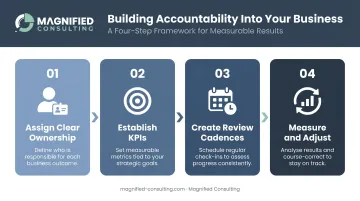
The final phase breaks strategy into actionable priorities:
- Assign clear ownership — each initiative has a named accountable leader
- Establish KPIs — metrics tied directly to strategic goals, not just operational activity
- Create review cadences — regular check-ins that catch drift early, before it compounds
- Measure and adjust — ongoing performance monitoring with a willingness to course correct
Magnified Consulting's model extends beyond the initial engagement. Business owners retain access to ongoing advisory support as conditions shift — whether that means navigating a new capital decision, a leadership change, or an unexpected market disruption. The strategy document is a starting point, not a finish line.
What Strategic Alignment Delivers: Real Business Outcomes
For privately-owned businesses, the value of alignment isn't measured in organizational health scores — it shows up in the financials.
Research found that organizations in the top quartile for health deliver three times the total shareholder returns of unhealthy organizations, regardless of industry. Gallup data shows top-quartile business units achieve 23% higher profitability and 18% higher productivity than bottom-quartile units.
For Magnified Consulting clients specifically, documented outcomes include:
- 40% profit increases within six months of engagement
- 30% improvements in operational efficiency in logistics and production environments
- Doubled revenue within one year for a fast-growing tech company, alongside a 40% reduction in customer churn
- Double-digit revenue growth within 18 months for a family-owned retailer that clarified strategy and streamlined operations
Alignment and Business Value at Exit
For businesses planning a transition — whether scaling, bringing in outside capital, or eventually selling — strategic alignment directly affects valuation readiness. Buyers and investors evaluate whether leadership is unified, whether KPIs are tracked, and whether the business can execute without the owner at the center of every decision.
A disorganized strategy signals execution risk. An aligned organization with clear KPIs and documented results signals something buyers and investors pay a premium for: predictable, owner-independent execution.
When Should a Private Business Owner Bring in a Strategic Alignment Consultant?
The most common triggering scenarios include:
- Growth plateau — revenue is solid but the business has stopped scaling despite continued effort
- Leadership disagreement — ownership partners or senior leaders are frequently in conflict about direction or priorities
- Major transition — preparing for a new market entry, acquisition, succession, or sale
- Failed initiative — a significant project delivered far less than expected despite real investment
Why Misalignment Gets Harder to Fix Over Time
Misalignment compounds over time. The longer an organization operates with fractured priorities, the more entrenched the behavior becomes. HBR research found that 80% of managers said their companies fail to exit declining initiatives quickly enough, and only 9% could consistently rely on colleagues across functions. Siloed cultures become harder and more expensive to realign with each passing year.
That entrenchment is precisely why external consulting expertise is especially valuable for privately owned businesses. Owners are often too close to the business to see misalignment clearly — an objective outside advisor can surface what internal teams won't say directly to leadership.
That's the model Magnified Consulting uses with ownership teams across Charlotte, Columbia, South Carolina, and the broader Carolinas — working alongside leadership to surface the real picture, build alignment, and stay engaged through execution.
Frequently Asked Questions
What are the 5 pillars of strategy execution?
The five pillars are: clarity of direction, leadership alignment, resource and decision-right allocation, cross-functional accountability, and adaptability. When all five are in place, strategy moves from a document into consistent, measurable action.
What are the 4 models according to which a consultancy firm can operate?
The four common consulting operating models are: the expert model (delivering specialized knowledge), the experience model (applying proven industry patterns), the efficiency model (standardizing processes for scalable delivery), and the co-creation model (collaborative problem-solving with the client organization).
What is the difference between strategic planning and strategic alignment?
Strategic planning defines where the business is going and how. Strategic alignment ensures that leadership decisions, departmental priorities, resources, and day-to-day behavior are consistently oriented toward executing that plan — bridging the gap between intent and action.
How do you know if your business has a strategic alignment problem?
Common indicators include:
- Leadership disagreements on priorities
- Employees unable to articulate company goals
- Multiple stalled initiatives competing for the same resources
- Revenue growth that isn't translating into improved profitability
How long does a strategic alignment consulting engagement typically take?
Timelines vary by business size and complexity. A typical engagement starts with a diagnostic phase of 4–8 weeks, moves into strategy development, and then transitions to ongoing execution support. Many client relationships continue well beyond the initial project as major decisions arise.
Can strategic alignment consulting help a business prepare for a sale or succession?
Yes. Buyers and investors directly evaluate whether leadership is unified, whether KPIs are in place, and whether the business can execute without the owner involved in every decision. A well-aligned business reduces perceived risk and supports a stronger exit multiple. Magnified Consulting's partners have been involved in over $1.5 Billion in M&A transactions, bringing direct transactional experience to this exact scenario.