Here's the uncomfortable truth: in most of these situations, the consultant wasn't the primary problem.
Research on client-consulting relationships found that the single strongest predictor of consulting project success was the client's internal readiness — not the consultant's methodology. That means how leadership shows up during an engagement shapes the outcome more than almost anything else.
This article is written for owners and leaders of privately held and family-run businesses — whether you're considering hiring a consultant or trying to understand why a past engagement fell flat. By the end, you'll know exactly which leadership behaviors sabotage consulting ROI, and what to do instead.
Key Takeaways
- Damaging mistakes happen before, during, and after the engagement — not only when choosing the wrong firm
- Blocking consultant access to top leadership and letting middle managers gatekeep are common engagement killers
- Defining measurable success metrics before work begins is non-negotiable
- Treating consulting as a one-time fix leaves significant value on the table
- Great consulting results require active, committed leadership — not passive sign-off
Mistakes Before the Engagement Even Starts (Mistakes #1–3)
Many consulting engagements are set up to fail before the first meeting. The decisions leaders make in the weeks before signing a contract: who to hire, why they're hiring them, and what they expect determine whether the engagement has any real chance of delivering.
Mistake #1: Assuming Your Internal Team Has All the Answers
Long-tenured teams build deep institutional knowledge. They also build blind spots.
The "we've always done it this way" mindset is especially common in family-run businesses, where loyalty to long-standing processes can make outside perspective feel disloyal. But that outside perspective is precisely what those businesses need most.
A 2025 study of family SMEs found that structured management practices had a significant positive effect on business success, while authority requirements rooted in family legacy had a negative effect, with a beta coefficient of -0.471 in the success model.
Put plainly: businesses that protect legacy practices over sound management tend to underperform. An outside consultant doesn't imply your team failed. It means you're serious about growth.
Mistake #2: Hiring Without Vetting Track Record and Industry Fit
Hiring a consultant because they "seem like a good fit" or came in cheapest is a fast path to disappointment. Proper vetting looks like this:
- Look for documented outcomes: revenue growth, cost reduction, operational improvements with numbers attached
- Evaluate how they ask questions: consultants who pitch frameworks before understanding your business are a red flag
That last point matters more than most leaders realize. IMC USA's enforceable code of ethics requires consultants to establish mutual understanding of objectives, scope, work plan, fees, and realistic benefits before work begins. If a consultant skips that step, walk away.
Mistake #3: Entering the Engagement Without Defined Goals or Success Metrics
Hiring a consultant without defining what success looks like in measurable terms means there's no shared standard for evaluating the work. The consultant delivers what they think you need; you evaluate it against criteria you never articulated. Both sides end up frustrated.
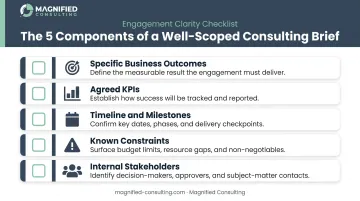
A well-scoped engagement brief includes:
- Specific business outcomes: not "improve performance," but "reduce cost of goods by 15% within 9 months"
- Agreed KPIs that both sides sign off on before work begins
- Timeline and key milestones: when decisions are expected, when deliverables are due
- Known constraints: budget limits, team capacity, systems that can't change
- Internal stakeholders who will be involved and what their roles are
Without this foundation, even a skilled consultant can't deliver consistent results. A clear brief protects both sides and gives the engagement an actual target to hit.
Mistakes That Derail the Engagement Itself (Mistakes #4–7)
Even leaders who hire the right consultant and set clear goals can undermine an engagement through how they manage it day to day. These four mistakes are the most common — and the most avoidable.
Mistake #4: Keeping the Consultant Away from Top Leadership
A consultant working on strategy, growth, or operations needs to understand the vision, decision-making style, and real priorities of the person at the top. Without that direct access, they're working from filtered, secondhand information — and their recommendations will reflect that gap.
"The owner is too busy" is not a valid reason. Transformation research found that transformations are 5.4 times more likely to succeed when senior leaders are actively involved and model the behavioral changes being pursued. If you don't have time to engage meaningfully with the people you hired to help your business, that's a priority problem — not a scheduling problem.
Mistake #5: Letting Middle Managers Override the Consultant
A leader hires an outside expert to solve a problem the internal team couldn't solve — then lets that same internal team filter, second-guess, or block the consultant's recommendations. It's circular, and it's self-defeating.
Internal managers have an appropriate role during a consulting engagement:
- Providing operational context and ground-level insight
- Flagging implementation constraints the consultant should know about
- Supporting execution once decisions are made
What they should not be doing: gatekeeping access to data, overriding deliverables, or running their own parallel process that contradicts the consultant's work. Final decisions belong to the leader, not a layer of defensive middle management.
Mistake #6: Underfunding the Engagement or Nickel-and-Diming
Cutting corners on consulting fees or withholding resources mid-engagement is a false economy. If the scope requires access to financial data, team time, technology, or third-party research — and leadership makes constant cost-driven adjustments that limit that access — the work suffers.
Align budget with scope before signing. Once committed, resource the engagement properly:
- Define resource requirements upfront — data access, staff time, and third-party tools included
- Avoid mid-engagement scope cuts that force the consultant to work around gaps they didn't create
- Treat the fee as an investment, not a line item to minimize once the contract is signed
Mistake #7: Dismissing Recommendations Without Real Consideration
Some leaders hire consultants while having already decided internally that nothing significant will change. They receive the recommendations, shelve the uncomfortable ones, and cherry-pick only the changes that require zero disruption.
This is expensive theater.
The right posture is to genuinely evaluate every recommendation before deciding what to act on — including the ones that challenge existing assumptions. The most valuable insights from a consulting engagement are almost always the ones that are hardest to hear.
Research on transformations found organizations lose an average 42% of expected value during implementation — often because inconvenient recommendations get deprioritized before they're ever tried. If the goal is real change, the uncomfortable recommendations deserve the first honest look, not the last.
Mistakes That Kill Long-Term Results (Mistakes #8–10)
Some of the most damaging mistakes happen after the engagement ends. The consultant has left, the deliverables have been handed over, and the leader assumes the work is done. It rarely is.
Mistake #8: Treating Consulting as a One-Time Transaction
Real business transformation — improving operations, preparing for a transition, scaling revenue sustainably — doesn't happen in a single project sprint. Leaders who get the most from consulting treat it as an ongoing relationship, not a one-time transaction.
That means bringing the consultant back at key decision points, building on prior work rather than starting over, and continuing to engage as new challenges arise.
Magnified Consulting is built around exactly this model. Rather than delivering a report and moving on, their approach centers on ongoing mentorship: "Our relationship with clients doesn't end with a single project. We provide ongoing mentorship, helping you navigate both day-to-day operations and major decisions with confidence."
For privately owned and family-run businesses navigating growth, transitions, or generational change, that continuity is what separates a project that fades from a change that actually holds.
Mistake #9: Failing to Measure Results Against Defined Outcomes
If success metrics weren't defined upfront, or aren't tracked after the engagement ends, there's no way to know whether the investment worked — or what to improve next time.
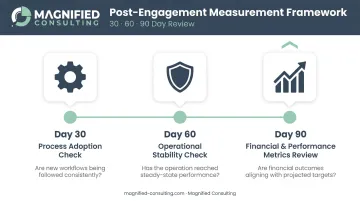
Post-engagement measurement in practice looks like:
- 30-day review — are new processes being followed? Are early indicators moving?
- 60-day review — are the operational changes holding under real conditions?
- 90-day review — are financial and performance metrics trending in the right direction?
Connect the changes to financial outcomes. Document what shifted. Build on that foundation rather than approaching the next challenge from scratch.
Mistake #10: Not Reinforcing Change After the Consultant Leaves
Organizations snap back. It's predictable, it's well-documented, and it happens in businesses of every size. New processes that weren't embedded into day-to-day management routines simply get abandoned when the outside pressure is removed.
Sustaining what an engagement produced is the leader's responsibility. That means:
- Assigning internal ownership of every new process — a specific person accountable for it
- Building accountability mechanisms into regular team rhythms (meetings, reporting, reviews)
- Continuing to communicate the why behind the changes so the team understands the rationale, not just the directive
Industry research notes that fewer than one-third of transformations succeed and sustain results over time. Preventing that reversion requires deliberate reinforcement: assigned ownership, structured accountability, and consistent communication about why the changes were made in the first place.
How to Build a Consulting Relationship That Actually Delivers
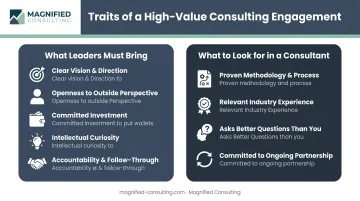
The traits of a high-value consulting engagement aren't complicated. On the leader's side, they look like this:
- Clear, measurable goals defined before work begins
- Genuine executive involvement throughout — not just at sign-off
- Budget aligned with scope, committed to without constant renegotiation
- Openness to uncomfortable recommendations before deciding what to act on
- A long-term mindset that views the consultant as a partner, not a vendor
On the consultant's side, look for:
- Tailored strategies built around your specific business — not generic frameworks repackaged for every client
- A documented track record with businesses of similar size, ownership structure, and complexity
- Questions before proposals — consultants who ask smart, probing questions about your goals before pitching solutions
- Ongoing involvement after delivery — not a hand-off once the report is filed
Magnified Consulting works with privately owned and family-run businesses across Charlotte, Columbia, South Carolina, Myrtle Beach, Savannah, and beyond. With involvement in over $1.5 Billion in mergers and acquisitions and decades of hands-on experience, the team builds every engagement around your specific situation — not a templated framework. If you're looking for that kind of partnership, it's worth starting a conversation.
Frequently Asked Questions
What is a common leadership mistake when working with consultants?
Blocking the consultant from direct access to top leadership and failing to define success metrics before the engagement starts are two of the most frequent and costly errors. Both can be prevented with intentional planning in the weeks before the engagement begins.
How do I know if a business consultant is the right fit for my company?
Vet their track record with businesses of similar size, speak with past clients beyond the provided references, and watch whether they ask clarifying questions before proposing solutions. A consultant who pitches a framework before understanding your business hasn't earned the engagement yet.
What should I define before hiring a business consultant?
Define specific business outcomes, measurable KPIs, timeline, budget, and which internal stakeholders will be involved and in what capacity. This shared standard protects both sides and creates a clear basis for evaluating whether the work succeeded.
How do you measure the success of a consulting engagement?
Success should be measured against the outcome metrics defined before work began — revenue growth, cost reduction, operational efficiency improvements, or whatever specific targets were agreed on. Completing deliverables on time is not the same as achieving results.
Should consulting be a short-term or long-term relationship?
Some engagements are appropriately project-based. But businesses that see the greatest results tend to maintain ongoing consulting relationships — long-term mentorship gives the consultant the context to apply prior work to each new challenge instead of rebuilding from scratch.
How involved should a business owner be during a consulting engagement?
The owner or top leader must be actively involved throughout — not just as a decision-maker at the final presentation. The consultant's ability to deliver relevant, actionable strategy depends directly on access to the person who controls vision, resources, and final decisions.