Introduction
Hiring a business consultant is a significant decision — and the gap between consultants who deliver real change and those who produce polished reports that collect dust often comes down to one thing: leadership.
Many business owners have experienced the frustration of bringing in outside expertise, receiving a comprehensive analysis, then watching the recommendations stall the moment implementation begins. The consultant wraps up the engagement, and without someone to carry the work forward, the strategy quietly dies on the shelf.
Technical expertise can diagnose a problem, but it takes leadership to actually move an organization through change.
This article breaks down the leadership qualities that separate consultants who create lasting results — for privately owned businesses, family-run enterprises, and growing companies alike — from those who simply deliver recommendations and walk away.
Key Takeaways
- Leadership qualities determine whether consulting strategies get implemented or stay on paper
- Emotional intelligence and communication drive adoption — not just the quality of recommendations
- Mentorship-oriented consultants build lasting client capability, not just deliverable counts
- Change management excellence makes projects 7X more likely to meet objectives
- Asking the right questions about a consultant's leadership style reveals whether they'll drive real change — or just produce reports
Why Leadership Qualities Define the Value of a Business Consultant
There's a meaningful difference between a consultant who hands over a strategy deck and one who leads an organization through the hard work of acting on it.
The consulting industry has a well-documented execution problem. Transformation research has found that fewer than one-third of organizational transformations both improve and sustain performance — with 55% of value leakage occurring during implementation, not in strategy design. The implication is direct: the quality of the recommendation matters far less than the quality of leadership applied to making it stick.
For privately owned and family-run businesses, the stakes are even more personal. These engagements don't just involve spreadsheets and process maps. They involve legacy, identity, family dynamics, and deeply embedded operating habits. A consultant without strong leadership qualities will struggle to navigate those dimensions — no matter how technically sound their analysis is.
Those personal stakes are especially pronounced in sectors like Manufacturing, Construction, Professional Services, and Home Services Businesses — industries where decades of owner investment create both deep institutional knowledge and genuine blind spots to outside perspective.
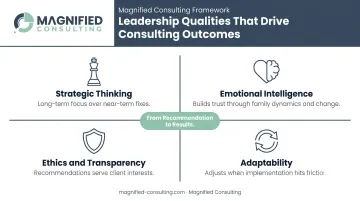
That's where leadership qualities do the real work. Qualities like strategic thinking, emotional intelligence, ethics, and adaptability are what convert a solid recommendation into operating results:
- Strategic thinking keeps the engagement focused on long-term outcomes, not just near-term fixes
- Emotional intelligence builds the trust required to navigate family dynamics and change resistance
- Ethics and transparency ensure recommendations serve the client's interests, not the consultant's
- Adaptability allows the consultant to adjust when real-world implementation hits unexpected friction
Core Leadership Qualities Every Business Consultant Should Have
Strategic Thinking and Problem-Solving
Strategic thinking in consulting means connecting an operational recommendation to its financial consequence, its people impact, and its long-term growth effect. Skilled consultants anticipate what happens downstream when a fix is applied — not just whether the fix works in isolation.
In practice, this looks like diagnosing root causes rather than surface symptoms. A consultant who identifies that a client's cash flow problem stems from poor job costing practices — not just slow collections — has done something qualitatively different from one who recommends better invoicing.
Clear and Adaptive Communication
Effective consultants communicate the same insight differently depending on who's in the room. A business owner needs to understand strategic implications. An operations manager needs clear process guidance. A frontline team needs to know what changes for them on Monday morning.
Active listening comes first. Before any diagnosis, a skilled consultant listens carefully enough to understand not just what a client says, but what they haven't said yet.
Emotional Intelligence
Consultants regularly deliver findings that challenge long-held assumptions — sometimes telling a founder that a process they built is the source of the problem. High emotional intelligence enables consultants to deliver those moments honestly without triggering defensiveness that shuts down the engagement.
Research from HBS Online shows that EQ accounts for nearly 90% of what differentiates high performers from peers with equivalent technical skills. In consulting, empathy and relationship management are practical implementation tools — not soft skills layered on top of the real work.
Decisiveness Under Uncertainty
Consulting engagements rarely come with complete information. Waiting for certainty before making a call is itself a choice — usually the wrong one. Effective consultants make reasoned, defensible judgments based on available evidence and adjust as new information emerges.
The distinction worth drawing is between recklessness and calculated decisiveness. Recklessness creates new problems; calculated decisiveness moves the engagement forward while leaving room to course-correct.
Ethics and Integrity
The judgment calls a consultant makes only carry weight if the client trusts who's making them. Business owners routinely share sensitive financial data, family dynamics, and strategic vulnerabilities — and that requires absolute confidence that the consultant is working in the client's interest, not toward the path of least resistance or a vendor relationship that benefits the consultant.
The IMC USA Enforceable Code of Ethics requires consultants to operate with:
- Integrity in all client dealings
- Competence appropriate to the engagement scope
- Independence from conflicts of interest
- Full disclosure of any relationships that could affect advice
These aren't aspirational standards. They're the baseline for any engagement built on real trust.
Adaptability
No two businesses are the same, even within the same industry. A framework that worked for a $12M logistics firm won't map cleanly onto a $40M family-owned manufacturer with a 30-year leadership team and a pending ownership transition. Generic models miss the constraints that matter most — and those constraints are usually where the real opportunity lives.
Advanced Leadership Qualities That Separate Good Consultants from Great Ones
Mentorship Orientation
The difference between transactional consulting and transformational consulting comes down to what's left behind: a report, or a team that can actually use it.
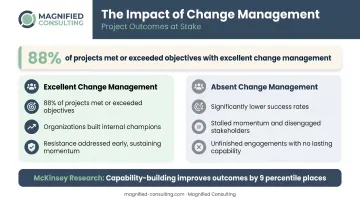
Capability-building research found that transformations with embedded capability building improved outcomes by an average of nine percentile places, while those without it showed no improvement. Organizations that trained at least 30% of employees were 2.4X more likely to succeed.
The best consultants leave clients stronger than they found them — managers who can solve the next problem without calling for outside help. Magnified Consulting's partners build engagements around exactly this principle, extending mentorship well beyond the initial project as the business grows.
Cross-Sector Perspective Paired with Industry Knowledge
Truly impactful consultants bring both relevant sector expertise and the ability to borrow solutions from other industries. Businesses in industries with deeply entrenched operating norms — Manufacturing, Construction, Home Services Businesses, Professional Services — can develop blind spots that only cross-sector experience can surface.
The consultant who has worked across industries can recognize when a solution that's standard in one sector could solve a non-obvious problem in another.
Change Leadership
Recommending change and leading an organization through it are different skills. Change leadership means handling the human side: building internal champions, addressing resistance early, and keeping leadership aligned when momentum stalls.
Prosci's research is clear — 88% of participants with excellent change management met or exceeded their project objectives, compared to dramatically lower rates when change leadership was absent. Consultants who treat change management as someone else's job are leaving the most critical part of the engagement unfinished.
Accountability for Outcomes
Great consultants measure their own performance by what the client achieves — not by what was delivered. That shift — from vendor to partner — is what turns a single engagement into a relationship worth returning to.
Magnified Consulting operationalizes this through continuous performance monitoring, measurable milestones built into every engagement, and a stated philosophy: "We judge our performance by yours." Documented client outcomes include a 40% profit increase within six months and a 30% reduction in production times for manufacturing clients — results that demonstrate what genuine accountability looks like.
How Leadership Qualities Directly Impact Business Outcomes
Leadership qualities aren't abstract virtues — they produce specific, measurable results.
Strategic thinking → Operational savings
Consultants who diagnose root causes rather than symptoms eliminate real waste. When an advisor identifies that a client's production inefficiency stems from scheduling logic rather than labor capacity, the fix is more targeted and far less expensive. This is precisely the kind of diagnostic work that has generated documented operational savings for Magnified Consulting's manufacturing and logistics clients.
Communication and EQ → Successful implementation
Strategies fail most often not because they're wrong, but because they weren't communicated or adopted effectively. A consultant who can translate analysis into language that resonates at every organizational level — and who can handle the emotional friction that comes with change — dramatically increases the probability that a team actually executes the plan.
Mentorship orientation → Long-term profitability
Clients who work with mentorship-driven consultants build compounding value over time. Stronger internal decision-making, improved cash flow management, and higher business valuation are downstream outcomes of the capability-building that good consultants leave behind.
These three qualities matter most during transitions — ownership changes, acquisitions, or scaling decisions. That's when the stakes are highest, the margin for error is smallest, and the difference between a consultant who advises and one who leads becomes clear. Magnified Consulting's partners have guided clients through over $1.5 Billion in M&A activity, which means this isn't a framework — it's how they work.
What to Look for When Evaluating a Business Consultant's Leadership
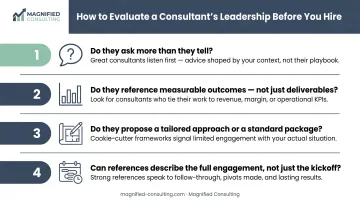
Before hiring any consultant, watch for these signals during initial conversations:
- Do they ask more than they tell? Strong consultants are curious before they're prescriptive. If a consultant arrives with solutions before they understand your business, that's a signal.
- Do they reference measurable outcomes from past engagements? Not deliverables — results. Ask specifically: what did the client achieve, and how was that measured?
- Do they propose a tailored approach or a standard package? A one-size-fits-all proposal signals one-size-fits-all thinking.
- Can their references speak to the full engagement — not just the kickoff? Leadership shows up in implementation, not just discovery. Ask for references who can describe the consultant's presence throughout the process.
Beyond early conversations, vet a consultant's track record not just on the quality of their thinking, but on their willingness to stay involved when the hard work begins. The consultants who show up during the difficult middle of a transition — when resistance is high, momentum is fragile, and decisions are genuinely uncertain — are the ones whose leadership qualities are real.
Magnified Consulting's partners bring decades of hands-on leadership experience, with collective involvement in over $1.5 Billion in M&A activity and $300 million in capital purchasing decisions. That track record was built inside the same high-stakes, complex decisions that privately owned and family-run businesses face at their most critical moments.
Their long-term mentorship model extends well beyond the initial engagement — making them one of the few consulting firms where the relationship deepens as implementation gets harder, not easier.
Frequently Asked Questions
What are the 7 qualities of leadership?
Core leadership qualities typically include integrity, strategic thinking, emotional intelligence, communication, decisiveness, adaptability, and accountability. In a consulting context, these qualities matter most in how they're applied without formal authority — the consultant must earn trust through credibility and results, not through a title or reporting structure.
What makes a good business consultant beyond technical expertise?
Emotional intelligence, a mentorship mindset, and the ability to lead organizations through change separate effective consultants from those who simply deliver analysis. Recommendations only create results when the client actually acts on them — and that requires a consultant who can lead, not just advise.
How do leadership qualities in consulting differ from those in corporate management?
Consulting leaders must earn trust and drive change without positional authority. That makes communication, credibility, and adaptability more critical than in an internal management role, where authority is built into the org chart.
Why is emotional intelligence important in business consulting?
Consultants regularly challenge decisions business owners have defended for years and deliver findings that are genuinely uncomfortable. EQ enables them to do that without losing the client's trust or buy-in along the way.
How can business owners assess a consultant's leadership qualities before hiring?
Watch how the consultant listens in early conversations, whether they customize their approach to your specific business, and whether their references can describe sustained results — not just the quality of their initial recommendations.
What is the difference between a leadership consultant and a business consultant?
A leadership consultant focuses on developing the people within an organization. A business consultant addresses operational, financial, and strategic challenges. The best business consultants, however, bring genuine leadership qualities to every engagement — because without them, even strong strategic advice rarely gets implemented.