Introduction
Most cultural change initiatives don't fail because the strategy is wrong. They fail because the people expected to execute the strategy haven't changed how they think, communicate, or lead.
Consultants can diagnose culture gaps, redesign processes, and build detailed roadmaps. What they can't do through strategy documents alone is change the daily behavior of the leaders who determine whether new culture takes root or fades out. Industry research has found that 70% of transformations fail, and behavioral barriers are consistently among the primary culprits.
This matters most in privately owned and family-run businesses, where leadership behavior and company culture are often the same thing. The owner's habits become the organization's habits. Family dynamics shape professional expectations.
The result is a change initiative that looks right on paper but stalls in practice.
This article makes the case that executive coaching, embedded within a consulting-led engagement, is what converts strategy into lived culture — and walks through the specific mechanisms that make it work.
Key Takeaways
- Cultural change fails when leaders change their policies but not their behavior — coaching addresses the gap.
- The most effective engagements run coaching and strategy work in parallel, not as separate phases.
- For family-run businesses, coaching builds both individual leadership and long-term organizational resilience.
- Behavioral shifts can begin within 60–90 days; full cultural transformation typically takes 12–24 months.
- Coaching ROI is measurable — an ICF/PwC study found the median company return was 7x the initial investment.
Why Cultural Change Initiatives Often Stall
The Problem Is Behavioral, Not Strategic
The strategy is rarely the failure point. Consultants identify culture gaps, design frameworks, and map out implementation phases. What derails change is what happens when the roadmap hits reality.
Gartner reports that only 32% of leaders globally get employees to adopt changes in a healthy way. The gap isn't knowledge — leaders generally understand what the new culture is supposed to look like. The gap is behavior. Leaders continue showing up the same way they always have, and the organization follows their lead, not the roadmap.
Research on transformation failures identifies four behavioral barriers that recur across organizations:
- False consensus — assuming alignment exists when it doesn't
- The curse of knowledge — leaders can't see the organization the way employees do
- Learned helplessness — teams stop trying because past change attempts went nowhere
- The mum effect — bad news stops flowing upward, starving leadership of accurate feedback
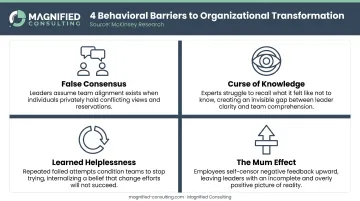
Each of these requires a shift in how individual leaders behave — something no org chart or mission statement can force.
Why Family Businesses Are Especially Vulnerable
In privately owned and family-run businesses, these dynamics are amplified. Three patterns show up repeatedly:
- Entrenched owner-operator habits — behaviors that helped build the business become the de facto norm. Challenging them feels like challenging the founder personally.
- Family dynamics bleeding into professional leadership — decisions about roles and authority get filtered through family relationships rather than capability.
- Middle management mirroring the top — regardless of what the change roadmap says, managers model whoever has the most power, not whoever has the best ideas.
PwC's Global Family Business Survey found that only 65% of family businesses believe they are fully trusted by their employees — a trust deficit that makes any top-down cultural change initiative harder to land.
Resistance to change is rarely about disagreeing with the destination. It stems from the personal discomfort of being asked to lead differently — and that's a challenge no consulting roadmap is designed to solve.
Consulting vs. Coaching: Two Roles, One Mission
These two disciplines are genuinely different, and conflating them creates problems.
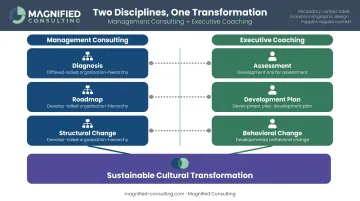
Management consulting operates at the organizational level — diagnosing problems, designing solutions, building roadmaps, and advising on decisions. The deliverable is a plan.
Executive coaching operates at the individual level — helping leaders build self-awareness, change behavioral patterns, and develop the capacity to lead differently. The deliverable is a changed person.
As the International Coaching Federation defines it, coaching is "partnering with clients in a thought-provoking and creative process that inspires them to maximize their personal and professional potential." It is explicitly not consulting, training, or mentoring — it is a structured process of guided self-discovery.
Research published in the Journal of Change Management found that executive coaching during organizational change significantly improved goal attainment, solution-focused thinking, change readiness, leadership self-efficacy, and resilience — precisely the outcomes that make cultural change actually stick.
Why Each Needs the Other
| Without Coaching | Without Consulting |
|---|---|
| Strategy stays on paper | Coaching lacks organizational context |
| Leaders understand what to do but not how to change | Development plans drift from strategic priorities |
| Behavioral change is slow and inconsistent | Structural changes outpace personal readiness |
| Culture shifts are superficial | Personal growth doesn't translate to business outcomes |
The table above reveals a consistent pattern: structural change and personal change have to move together. When Magnified Consulting integrates coaching into a transformation engagement, behavioral development and organizational redesign advance in parallel — which is how cultural change moves from a slide deck into daily practice.
How Executive Coaching Amplifies Consulting-Led Cultural Change
Leadership Modeling Drives Culture Faster Than Policy
Culture flows from the top down. Research on change management identifies role modeling as one of the four primary mechanisms through which employee mindsets and behaviors actually shift. When senior leaders are coached to embody the target culture — in how they communicate, delegate, respond to setbacks, and treat their teams — that behavior becomes the norm far faster than any policy document could achieve.
For owner-operators, this matters most. In privately owned businesses, the founder's behavior is the culture. Coaching that helps an owner consciously shift their leadership style creates ripple effects across the entire organization.
Breaking Communication Silos
WTW research from 2023 found that only 43% of employees say their organization is effective at managing change — and communication failures are a primary driver of that gap.
Executive coaches work with leaders on three communication skills that most frequently break down during cultural transitions:
- Active listening — genuinely receiving and reflecting input from teams, rather than performing engagement
- Message clarity — translating strategic intent into language that connects with frontline employees
- Conflict navigation — addressing friction between old and new cultural norms without avoiding or escalating it
Aligning Leadership Teams Around Shared Values
One underappreciated risk in cultural change is misalignment at the leadership layer itself. Different executives hold different assumptions about what the new culture actually means — and without coaching, those differences surface as passive resistance, inconsistent signals, and confused teams.
When leaders in the same business are coached in parallel, that process creates alignment consulting alone cannot force. Coaches surface conflicting assumptions, help leaders resolve them privately, and prevent those conflicts from undermining the initiative publicly.
Sustaining Change Beyond the Engagement
Industry research reports that only 26% of transformations are successful at both improving performance and sustaining those improvements over time. The pattern is consistent: initiatives gain momentum during active implementation, then regress when external support withdraws.
This is where ongoing mentorship after the consulting roadmap matters most. Magnified Consulting's approach — continuing to work with clients well past the initial engagement — reflects this reality directly. Ongoing coaching ensures new behaviors don't revert when pressure fades and attention moves elsewhere.
Building Emotional Resilience in Change Leaders
Sustaining structural change is only part of the challenge. Cultural transformation is also psychologically taxing, especially for founders who built the original culture themselves. Being asked to lead differently can feel like being told the way you built the business was wrong.
Coaching creates a private space for leaders to process that weight — to work through the discomfort of vulnerability without performing certainty they don't feel. Leaders who do that internal work show up differently: steadier under pressure, more credible when asking their teams to change, and less likely to undermine the initiative during the moments it gets hard.
A Practical Framework: Four Phases of Coaching-Integrated Consulting
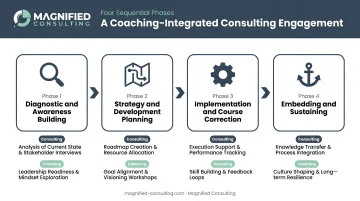
Phase 1 — Diagnostic and Awareness Building
The consulting team conducts a cultural and operational assessment: identifying gaps, inefficiencies, and leadership behaviors that support or undermine the target culture.
At the same time, executive coaching begins with individual leader assessments — often using 360-degree feedback tools — to surface how each leader's behavior is perceived versus intended.
DDI notes that 360 feedback consistently reveals a gap between a leader's intentions and their actual impact. In many cases, leaders discover that behaviors they consider strengths are precisely what their teams experience as obstacles.
Phase 2 — Strategy and Development Planning
The consulting team translates diagnostic findings into a cultural change roadmap. Coaches work one-on-one with key leaders to create personal development plans aligned to that roadmap.
A critical discipline here: limit each leader to one or two high-leverage behavioral changes. Depth matters more than breadth. A leader who genuinely changes how they handle conflict will shift team dynamics more than a leader who partially addresses five different development areas.
Phase 3 — Implementation and Course Correction
Consultants support the rollout of structural changes — processes, communication systems, team structures. Coaches run regular check-ins to review progress, address obstacles, and recalibrate development priorities as implementation surfaces unexpected challenges.
Research on habit formation published in a 2024 systematic meta-analysis confirms that behavioral habits can begin forming within roughly two months — but the timeline varies significantly across individuals. Check-in schedules should be responsive to each leader's pace, not driven by a fixed schedule.
Phase 4 — Embedding and Sustaining
The goal of this phase is for new behaviors to become the default — no longer requiring active external support to maintain.
Practical strategies for embedding include:
- Hold leaders mutually accountable for commitments made during coaching sessions
- Equip middle managers to apply coaching principles with their own direct reports
- Tie progress reviews to operational outcomes — retention rates, decision speed, employee engagement scores
A note on family-run businesses: Engagements in this context require additional attention to succession dynamics, role clarity between family and non-family leaders, and the emotional stakes of changing a business that is also, in many ways, a family legacy. These dimensions don't invalidate the framework — they add necessary layers to it.
The Business Case: Measurable Outcomes for Privately Owned Businesses
Executive coaching in a consulting context is not a soft-skills supplement. It's the mechanism through which efficiency gains and profitability improvements become sustainable rather than temporary.
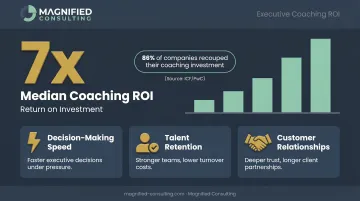
The evidence is direct: an ICF/PwC Global Coaching Client Study found that 86% of companies recouped their coaching investment, with a median ROI of 7x the initial cost. A 2023 meta-analysis further confirmed that executive coaching produces stronger effects on behavioral outcomes than on attitudes or personality — meaning coaching changes what leaders do, not just how they think about doing it.
Culture's Operational Impact
For businesses in manufacturing, construction, and professional services — industries where Magnified Consulting works regularly — team cohesion and execution speed are direct competitive advantages. A healthier culture reduces friction in three measurable areas:
- Decision-making speed — less conflict at the leadership layer means faster decisions reaching the frontline
- Talent retention — employees stay longer in cultures where leadership behavior matches stated values
- Customer relationships — consistent internal culture produces more consistent external service
Long-Term Value for Business Owners
PwC's research found that 73% of family businesses with double-digit growth have a clearly defined set of family values guiding the organization. That pattern holds across privately owned businesses more broadly: culture shapes how decisions get made, how talent is retained, and how consistently the business delivers.
For privately owned businesses considering succession, exit, or expansion, a strong internal leadership culture is a tangible asset. It means the business can operate and grow without depending entirely on the founder's daily involvement, which is precisely what makes it valuable to successors, partners, or acquirers.
Magnified Consulting's tech startup case work offers a concrete example: a three-phase engagement that included a dedicated leadership development plan resulted in doubled revenue within a year and a 40% reduction in customer churn. When leadership behavior changes at the top, the operational results follow — and they tend to hold.
Frequently Asked Questions
What is the 80/20 rule in coaching?
The 80/20 principle in coaching refers to the coach spending roughly 80% of each session listening and asking questions, with only 20% providing input. This ratio ensures the coachee drives their own development — building more durable behavioral change than advice-giving alone ever produces.
What are the 5 C's of coaching?
The 5 C's commonly referenced in coaching frameworks are Clarity, Commitment, Confidence, Competence, and Consistency. In a cultural change context, these describe the internal conditions a leader needs to adopt new behaviors and credibly guide others through change.
What does executive presence look like in a cultural change context?
The Bates ExPI measures executive presence across 15 facets grouped under Character, Substance, and Style. In cultural transformation, how a leader shows up — composure, credibility, communication clarity — signals what the new culture values. That signal reaches the organization more directly than any formal announcement.
How does executive coaching differ from management consulting?
Consulting focuses on organizational-level diagnosis and strategy — identifying what needs to change and designing the how. Coaching focuses on individual leader development — the personal behaviors and mindsets that make change possible. The most effective cultural transformation engagements use both.
How long does cultural change take with executive coaching support?
Meaningful behavioral shifts can begin within 60–90 days of consistent coaching. True cultural transformation — where new behaviors become default norms across the organization — typically requires 12–24 months, particularly in privately owned businesses where culture is closely tied to founder behavior.
How do you measure the success of executive coaching during a consulting engagement?
Common methods include 360-degree feedback re-assessments, employee engagement surveys, operational metrics (retention, decision-making speed, efficiency), and progress against development plan milestones set during the diagnostic phase.