Introduction
AI-driven business strategy is no longer a future consideration — it's a present-day operational reality. The global AI market is projected to grow from $36.67 billion in 2026 to $194.79 billion by 2031, a 39.7% compound annual growth rate. Yet adoption is outpacing governance: many organizations struggle with implementation, with success rates for AI initiatives well below expectations.
For privately owned businesses, growth-focused companies, and established enterprises, that gap between deployment and results is where the wrong consulting partner becomes a costly mistake. Selecting the right firm is a high-stakes decision — one where generic IT vendors and internal teams routinely fall short.
The challenges are structural. AI-driven business strategy requires navigating:
- Technical complexity — selecting the right AI tools, platforms, and integration approaches
- Operational fit — ensuring AI tools actually work within existing workflows and team structures
- Change management — driving adoption and sustaining results after implementation
Specialized consulting firms bring the domain knowledge and implementation experience to address all three — turning AI investments into operational efficiency gains, improved decision-making, and verifiable ROI.
This guide evaluates seven leading AI business strategy consulting firms across specializations to help you make a more informed choice heading into 2026.
TL;DR
- AI business strategy consulting firms cover strategy, implementation, and optimization that internal teams can't easily handle alone
- The strongest firms pair domain knowledge with technical depth and change management experience
- Strategy, process automation, data analytics, and enterprise transformation are distinct practice areas
- Evaluate firms on industry-specific case studies, integration depth, post-deployment support, and verifiable ROI
- The seven firms below were selected for focus, technical depth, client outcomes, and delivery at scale
What Is AI Business Strategy Consulting?
AI business strategy consulting is a specialized advisory and implementation service that connects advanced AI technologies — such as machine learning, NLP, and predictive analytics — with the operational, strategic, and financial needs of businesses.
Unlike general technology consulting, this work requires navigating several overlapping challenges at once:
- Regulatory and data governance requirements
- Existing system integration constraints
- Team adoption and change management
- ROI measurement and performance tracking
The market backdrop makes specialized guidance urgent. With significant investment flowing into AI tools and platforms, the question for most business owners isn't whether to adopt AI — it's how to do it without ending up among the majority of implementations that underdeliver on their initial business case.
AI business strategy consulting firms exist to bridge that gap — bringing both technical depth and strategic fluency to organizations that can't afford to learn those lessons the expensive way.
Top AI Business Strategy Consulting Firms to Work With in 2026
These firms were evaluated on industry experience, technical depth, compliance track record, client outcomes, and ability to serve organizations ranging from established enterprises to growth-focused privately owned businesses.
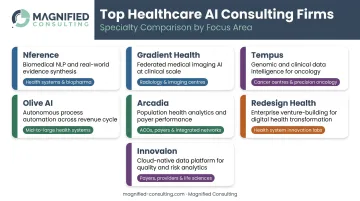
Chartis Group
Chartis is a specialized consulting firm with deep expertise in strategic transformation, digital strategy, and AI deployment across complex organizations. Their dedicated Chartis Centers for AI and Strategic Intelligence and the Chartis Leap AI Studio accelerate AI prototyping, agent development, and structured use-case testing.
The singular focus shows in the results: Chartis was named Overall Best in KLAS for IT Services for the second consecutive year in February 2026, with a 96.5 client satisfaction score from nearly 60 client interviews across more than 1,900 organizations served annually.
Their work with Bronson demonstrates the model: Chartis helped build a repeatable AI use-case intake, prioritization, and governance process — with an early revenue cycle AI initiative producing up to 10x ROI and measurable cash flow acceleration.
| Category | Details |
|---|---|
| Focus Area | Business strategy, AI transformation, revenue cycle, and technology innovation for complex organizations |
| Key Differentiator | Deep domain focus with no cross-industry dilution of expertise |
| Best Suited For | Large enterprises, multi-location organizations, and complex operational environments |
Aidoc
Aidoc is a specialized AI company focused on workflow automation and operational efficiency. Their AI-driven tools are deployed across more than 1,600 organizations worldwide, helping teams prioritize work and improve throughput without disrupting existing processes.

For high-volume operational environments, Aidoc operates less like a consulting firm and more like a productized AI platform, which is the right fit for organizations that need proven, operational tools rather than custom model development.
| Category | Details |
|---|---|
| Focus Area | AI-powered workflow prioritization and decision support for operational teams |
| Key Differentiator | Proven deployment at scale across major organizations with measurable efficiency gains |
| Best Suited For | Organizations with high-volume operations needing intelligent prioritization tools |
Tempus AI
Tempus is a data intelligence company that integrates operational and analytical data to power AI models for strategic decision-making, growth planning, and performance optimization. Their 2024 Nasdaq IPO (ticker: TEM, raising $410.7 million) validated the market's confidence in their platform.
The scale behind it: 5.6 million de-identified records, 1.3 billion pages of operational text, and more than 200 petabytes of cloud data — powering insights that help organizations make faster, better-informed decisions.
| Category | Details |
|---|---|
| Focus Area | Data intelligence, analytical AI, and AI-driven decision support for complex business environments |
| Key Differentiator | One of the largest real-world operational data platforms combined with AI infrastructure |
| Best Suited For | Data-rich businesses, research-intensive organizations, and enterprises seeking analytics-driven growth |
CitiusTech
CitiusTech is a technology consulting and product engineering firm serving mid-to-large organizations. Their focus spans AI applications across data analytics, process automation, and operational improvement — including a 2024 launch of a dedicated Generative AI Quality and Trust solution for designing, integrating, and governing GenAI in enterprise contexts.
Their global delivery model combines strategic consulting with engineering execution, with particular depth in system interoperability. For organizations that need both advisory thinking and hands-on technical build capability, that combination is a genuine differentiator.
| Category | Details |
|---|---|
| Focus Area | AI consulting, data science, and product engineering for complex operational environments |
| Key Differentiator | End-to-end engineering and consulting under one roof with deep interoperability expertise |
| Best Suited For | Mid-to-large enterprises, technology-intensive businesses, and organizations with complex system environments |
LeewayHertz
LeewayHertz is an end-to-end AI development firm offering generative AI tools, system enhancement, workflow automation, and custom AI platform development for businesses across sectors. They hold SOC 2 Type II certification and ISO/IEC 27001:2022 certification (per official site disclosure), with stated compliance alignment to both relevant data and security standards.
Their primary value proposition is ownership: LeewayHertz builds proprietary AI solutions from scratch, which matters for organizations that want to retain control over their AI infrastructure rather than license a vendor platform.
| Category | Details |
|---|---|
| Focus Area | Custom AI platform development, generative AI, process automation, and system integration |
| Key Differentiator | SOC 2 and ISO certified with a strong record in custom AI builds from the ground up |
| Best Suited For | Businesses seeking proprietary AI tools, technology-focused firms, and organizations with custom workflow needs |
Tribe AI
Tribe AI operates a talent-network consulting model, matching organizations with vetted machine learning engineers and data scientists to build custom analytical models, predictive analytics tools, and operational insight platforms. Rather than a fixed delivery team, they assemble specialists tailored to each engagement's specific technical requirements.
The model works best for organizations with a defined AI use case but limited internal data science capacity — growth-stage businesses and innovative operational teams being the clearest examples.
| Category | Details |
|---|---|
| Focus Area | Custom ML model development, predictive analytics, and data-driven decision support |
| Key Differentiator | On-demand access to vetted ML specialists without the overhead of building an internal AI team |
| Best Suited For | Growth-stage businesses, innovative operational teams, and organizations with specific AI use cases |
Cognizant
Cognizant is a global technology and consulting firm with a dedicated AI and business transformation practice covering AI-driven process automation, workflow redesign, and performance optimization. Their practice is oriented toward enterprise-scale transformation — multiple departments, multiple geographies, simultaneously.
Published case study outcomes include an 8x ROI from intelligent automation and a business unit that quadrupled upfront collections within six months after Cognizant consolidated preservice access workflows. Where specialized niche firms go deep in a single domain, Cognizant goes wide. When the transformation agenda spans the entire enterprise rather than a single workflow, that breadth becomes an advantage.
| Category | Details |
|---|---|
| Focus Area | Enterprise AI transformation, intelligent automation, workflow redesign, and data analytics |
| Key Differentiator | Global delivery scale with a proven track record serving multinational enterprises |
| Best Suited For | Large enterprises, multi-location businesses, and organizations undergoing broad digital transformation |
What Services Do AI Business Strategy Consulting Firms Typically Offer?
Leading AI business strategy consulting firms generally cover these service categories:
- AI strategy and readiness assessment — use-case prioritization, ROI modeling, governance design
- Custom AI and ML model development — proprietary model builds tailored to operational or business data
- System and data infrastructure integration — compatibility with existing platforms and workflow tools
- Process and workflow optimization — redesigning operations around AI-generated insights
- NLP for unstructured data — extracting value from documents, communications, and operational records
- Analytics and performance improvement — identifying opportunities to reduce costs and accelerate growth
- Governance and compliance frameworks — ensuring AI deployments meet relevant regulatory and data standards
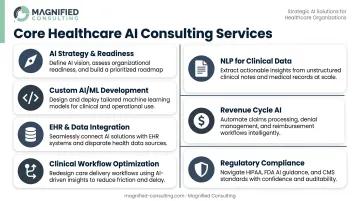
The blend of these services varies significantly by firm. Chartis and Cognizant are strategy-first advisors with enterprise transformation capability. Aidoc and Tempus deliver productized AI within defined domains. CitiusTech and LeewayHertz sit closer to the build-and-deploy end. Tribe AI provides flexible technical execution capacity.
Post-deployment support is where mature engagements pull ahead. AI models drift over time as operational data evolves — a well-documented challenge. Firms that offer structured model monitoring, retraining protocols, and performance dashboards deliver meaningfully better long-term outcomes.
How to Choose the Right AI Business Strategy Consulting Firm
Verify Domain-Specific Experience First
The most common mistake is selecting a firm based on AI credentials without confirming relevant domain depth. General AI firms can lack the operational workflow knowledge, system integration experience, and strategic familiarity that effective implementations demand.
Ask for:
- Case studies from organizations similar in type and size to yours
- Demonstrated experience with your relevant compliance or regulatory requirements
- Named client outcomes — not just logo slides
Confirm Technical Compatibility
Mismatched technical approaches are a leading cause of failed AI projects. The right firm should have direct integration experience with your specific platforms and existing data infrastructure.
Questions to ask:
- Have you integrated AI tools with our existing systems before?
- How do you handle data normalization across disparate source systems?
- What's your approach to maintaining workflow continuity during deployment?
Prioritize Post-Deployment Support
Research consistently shows that model drift — where an initially accurate model degrades over time — often goes unmeasured. An engagement that ends at go-live leaves organizations exposed.
Look for firms that include:
- Ongoing model monitoring with defined accuracy thresholds
- Retraining schedules tied to operational data changes
- Performance dashboards accessible to internal stakeholders
Evaluate the Financial Case Rigorously
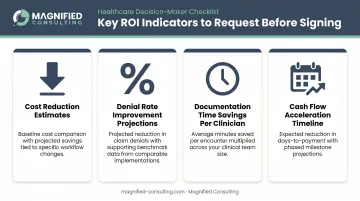
For privately owned businesses, regional enterprises, and growth-focused companies, the ROI case must be clear before committing to a major AI consulting engagement. Insist on firms that can articulate expected returns in measurable terms and provide transparent pricing tied to defined deliverables. Key ROI indicators to request include:
- Cost reduction estimates with a defined baseline
- Efficiency improvement projections
- Time savings per team member or process
- Revenue or cash flow acceleration timelines
Bringing an independent business advisor into the process adds a critical check. A trusted strategic advisor can stress-test the financial assumptions, structure the vendor evaluation, and confirm the commitment fits your organization's broader financial position before the contract is signed.
Conclusion
Selecting an AI business strategy consulting firm is a strategic decision that deserves the same rigor as any major capital commitment. Domain expertise, technical capability, strategic depth, and post-deployment support all matter more than name recognition or broad AI credentials.
For business owners — particularly those running privately owned enterprises, growth-focused companies, or established businesses undergoing transformation — the financial and operational stakes of getting this decision wrong are significant. The technology evaluation and the business case evaluation need to happen in parallel, not sequentially.
Magnified Consulting works with privately owned businesses to build the strategic clarity and financial discipline needed to evaluate and execute decisions of this scale. With a track record that includes advising on over $1.5 Billion in M&A activity and $300 million in large capital purchasing decisions, the firm helps business owners structure complex investment decisions with the confidence to commit at the right time.
Use this guide as a starting framework and request discovery calls with your shortlisted firms. If you need a trusted advisor to evaluate the financial and strategic dimensions of a major AI investment, contact Magnified Consulting to schedule a consultation.
Frequently Asked Questions
What does an AI business strategy consulting firm actually do?
These firms help organizations assess AI readiness, identify high-value use cases, select or build appropriate AI solutions, manage implementation, and maintain governance throughout the process. Most engagements begin with a readiness assessment before any build work starts.
How much does AI business strategy consulting typically cost?
Costs vary based on scope, customization level, and duration. Key drivers include:
- Data infrastructure complexity
- System integration requirements
- Whether the AI constitutes regulated software or involves sensitive data
- Extent of post-deployment monitoring included
Requesting itemized pricing tied to specific deliverables is the best way to compare proposals across firms.
What is the difference between a general AI consulting firm and a specialized one?
Specialized firms bring deep domain knowledge, system integration experience, and familiarity with relevant governance requirements that general firms typically lack. That domain depth reduces implementation risk and accelerates time to measurable value.
How do I know if my organization is ready for AI consulting?
AI readiness depends on data quality, IT infrastructure maturity, stakeholder alignment, and clearly defined use cases. A reputable firm will diagnose gaps in each of these areas before any technical build work begins.
How long does an AI business strategy consulting engagement typically take?
Timelines vary widely. Focused operational pilots can deliver results within six months. Enterprise-wide AI programs with broad system integration, governance requirements, and organizational change management take considerably longer. Data readiness and integration complexity are the primary drivers.
What questions should I ask an AI consulting firm before hiring them?
Before hiring, ask:
- For relevant case studies with named outcomes from similar organizations
- How they approach data governance and system integration
- What their post-deployment monitoring model looks like
- For transparent pricing tied to defined deliverables
Also confirm how they handle model drift and whether ongoing support is included in the engagement scope.